




Why Are European and American Parents Choosing Electronic-Free Wooden Toys?
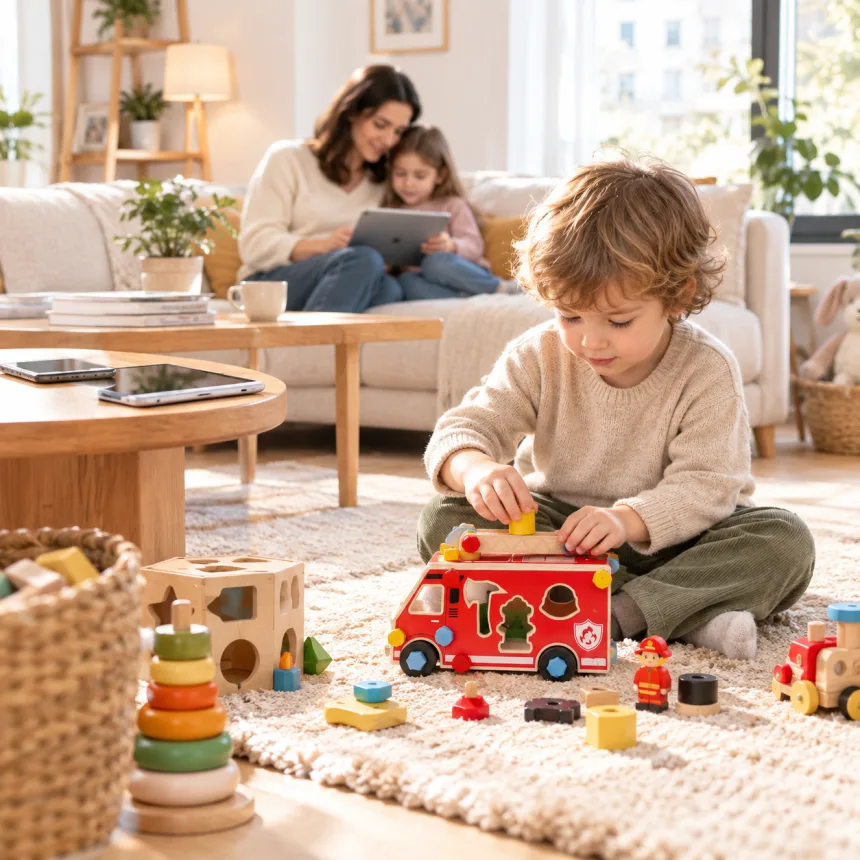
In living rooms from Berlin to Boston, parents are deliberately delaying and limiting their children's exposure to battery-powered, screen-based and sound-emitting toys. This is not nostalgia, and it is not a rejection of technology in general. For brand owners and buyers, the commercially relevant question is what this preference actually requires of a product: what must be removed from a design, what that does to the safety assessment, and how the category should be specified and sourced.
- From Parental Preference to an Assortment Decision
- What the Guidance on Young Children Actually Says
- What "Electronic-Free" Removes From a Design
- Safety Testing Consequences of Removing Electronics
- Age Grading, Play Value and Labelling
- Sourcing: Materials, Finishes and Documentation
- Building an Electronic-Free Range
From Parental Preference to an Assortment Decision
Consumer preference only becomes a business fact when it changes what people buy. In this case it has, and the mechanism is specific enough to plan around: parents are not buying fewer toys, they are buying different toys, and the difference is concentrated in the early age bands where the preference is strongest.
Three features of the demand are worth noting because they affect how a range should be built.
- It is strongest for the youngest age bands. The preference is most pronounced for toddlers and preschoolers, which is exactly where wooden toys are already competitive on safety, durability and price.
- It is expressed as a purchase filter, not a preference ranking. A parent who has decided against battery toys does not buy a quieter battery toy; they exclude the category. That makes it a range-level decision rather than a product-level one.
- It travels with gifting. Grandparents and family friends buying for a child often follow the parents' stated preference, which widens the demand beyond the household and supports higher price points.
For a buyer, the implication is that electronic-free is worth treating as a defined segment with its own specification, rather than as a styling note applied to an existing range.
There is also a structural reason the segment holds up commercially. An electronic-free wooden item has no firmware, no battery regulation to track, and no component obsolescence, so a design that sells can remain in the catalogue for years without a revision. For a buyer managing a range across several seasons, that stability reduces the two costs that quietly erode a toy programme: retooling and re-certification. It is not the reason customers buy these products, but it is a good reason to build the range deliberately.
What the Guidance on Young Children Actually Says
Public-health guidance is frequently overstated in marketing copy, so it is worth being precise about what can be verified.
The World Health Organization published guidelines in 2019 on physical activity, sedentary behaviour and sleep for children under five years of age. On sedentary screen time, the guidance is: for infants under one year, sedentary screen time is not recommended; for one-year-olds, sedentary screen time is not recommended; for two-year-olds, no more than one hour, with less being better; and for children aged three to four years, no more than one hour, with less being better.
Two cautions matter for anyone writing copy or briefing a design team. First, these are public-health guidelines issued by the WHO, not legal limits on toy design, and they address the child's total sedentary screen time rather than toys specifically. Second, they are dated: guidance is reviewed and revised, so anyone citing it in marketing or product documentation should confirm the current version with the issuing body before publication.
The same 2019 guidelines also address the opposite side of the balance, and it is worth stating because it shapes the product brief: they recommend that children under five accumulate at least three hours of physical activity per day, with specific sleep durations by age, and they frame sedentary restraint as limited time rather than zero time. The design takeaway is that these products are not competing with outdoor play or sleep; they are competing with passive screen time, and they are bought to fill indoor hours with something self-directed.
What "Electronic-Free" Removes From a Design
Electronic-free is a design constraint with a clear definition, and it is stricter than many first briefs assume.
| Element | Status in an electronic-free design | Design consequence |
|---|---|---|
| Battery compartments | Excluded | No compartment, no fastener requirement, no battery-access safety assessment |
| Sound modules and speakers | Excluded | Sound must come from the material, if at all |
| Lights and LED elements | Excluded | Visual interest comes from colour, grain and form |
| Screens and displays | Excluded | Feedback must be mechanical or absent |
| Mechanical motion | Permitted | Gears, ramps, marbles and bead runs give cause-and-effect feedback without power |
| Magnetic elements | Permitted with assessment | Secured magnets are assessed under the applicable mechanical and magnetic requirements |
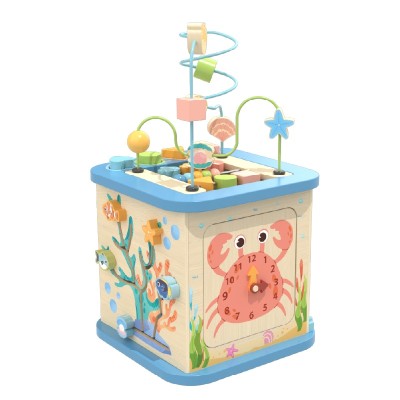
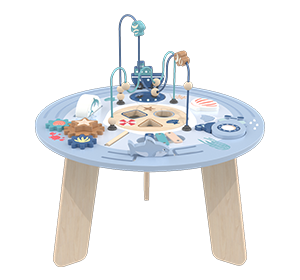
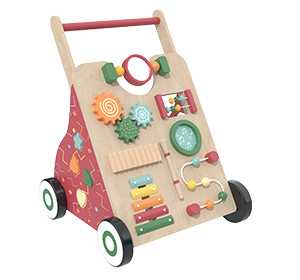
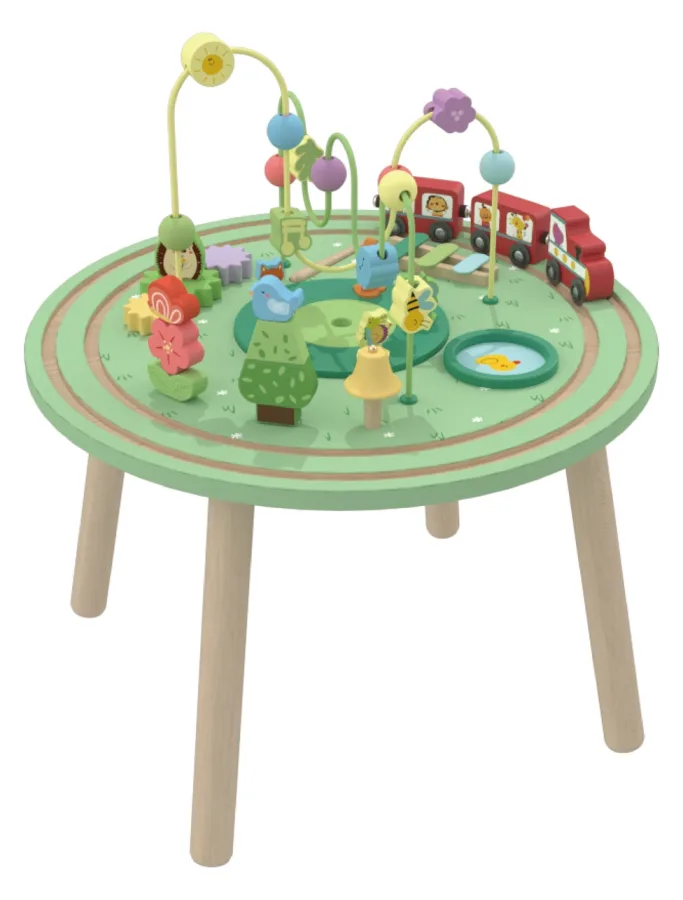
The interesting design consequence is that removing electronics increases the burden on mechanics. A battery toy produces feedback for free: press a button, get a sound. Without power, the feedback has to be built into the object: a marble that runs a track, a bead that follows a wire, a gear that turns when another turns. This is why the strongest electronic-free wooden products are usually mechanism-led rather than figure-led.
It also changes what "open-ended" means in practice. Without a prescribed response, the child supplies the narrative. That is the property parents are buying, and it is worth stating on packaging in plain language rather than in developmental claims.
One more consequence belongs in the brief rather than in the design review: packaging copy. An electronic-free product is often bought precisely because a parent has decided against powered toys, and they look for confirmation on the box. Plain factual statements — no batteries required, no electronic components, no screens — are safe and useful. Broad developmental claims are not, because they carry evidentiary expectations that differ by market. Writing the packaging specification alongside the product specification avoids a situation where the product is right and the copy is not.
Safety Testing Consequences of Removing Electronics
Removing electronics simplifies some parts of the safety assessment and leaves others unchanged. Buyers should not assume that electronic-free means less testing.
What becomes simpler
Battery compartments carry specific requirements: accessibility, fastener security, and protection against access to batteries. Removing the compartment removes that assessment. Electrical and thermal requirements associated with powered toys also fall away, as does any electromagnetic or radio-related assessment for connected features.
What does not change
Mechanical and physical safety is unchanged and remains the core of the assessment: small parts, sharp edges and points, structural integrity, drop and impact behaviour, and, where relevant, tip-over and entrapment. Chemical requirements are unchanged, and for a painted wooden item the coating remains the critical item. Flammability requirements continue to apply where the product includes textile or loose material.
What can become more demanding
Mechanisms are assessed as mechanisms. A marble run has moving parts, potential pinch points and containment requirements; a magnet has to be secured and assessed. In other words, the design burden moves from the electrical system to the mechanical one, and it should be reviewed at the design stage rather than discovered at test.
Age Grading, Play Value and Labelling
Age grading is where an electronic-free range either earns credibility or loses it. It drives which safety requirements apply, it appears on the packaging, and it is the first thing a parent reads.
For the US market, the Consumer Product Safety Commission publishes age determination guidance relating children's ages to toy characteristics and play behaviour, and this is the reference most buyers use to justify a stated age range. It considers physical and cognitive development, the toy's characteristics, and typical play behaviour for the age. Using it produces a defensible age statement; guessing produces one that a retailer's compliance reviewer will challenge.
Age grading also interacts with the small-parts assessment in a way that is easy to get wrong. The small-parts requirement is not a property of the product alone; it is applied in relation to the age group the product is intended for. A component that is acceptable for a three-plus product may not be acceptable for an eighteen-month-plus product, which means changing the age statement after the design is frozen can force a design change. Decide the age band first, then design to it.
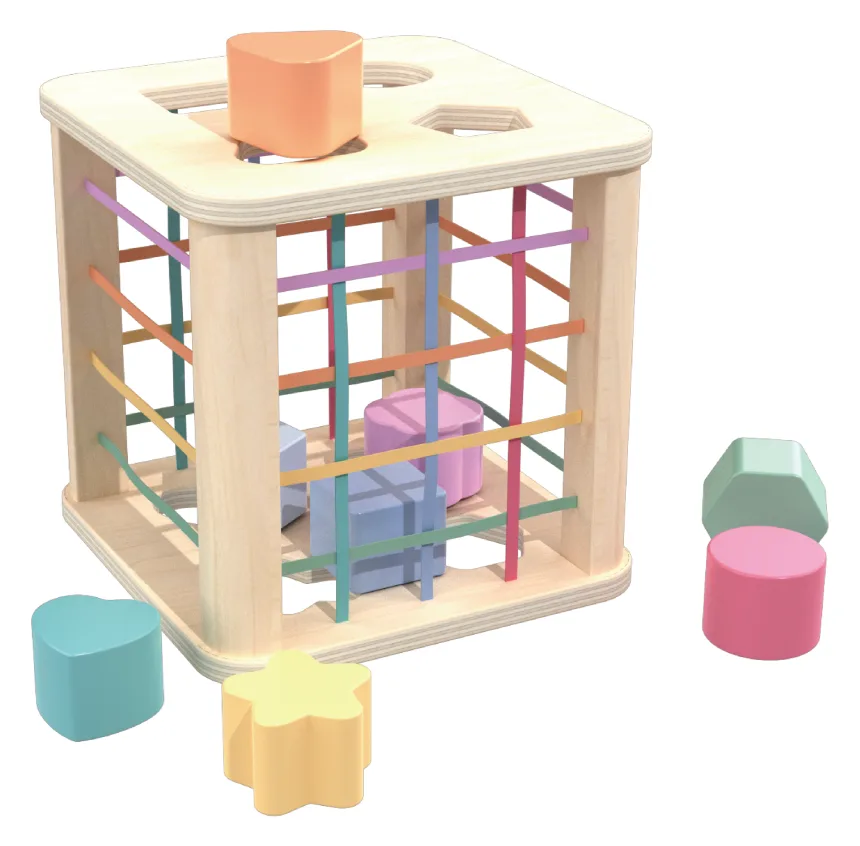
Play value should be stated in plain language. Claims about developmental outcomes are tempting and risky: they are marketing claims with evidentiary expectations attached, and they vary in permissibility by market. Describing what a child does with the product — stacks, sorts, threads, rolls, matches — is factual, verifiable and sufficient.
Finally, consider instructions. An electronic-free product still needs a clear, short instruction sheet where assembly or a specific use is involved, and for the EU market instructions and warnings must appear in the language of the market. This is a printed item with a lead time, so it belongs on the same parallel track as the carton artwork rather than being produced after the goods are packed.
Sourcing: Materials, Finishes and Documentation
An electronic-free range is, in sourcing terms, a conventional wooden toy range with a tighter specification. Three items deserve explicit treatment.
Species and surface
Fine-grained species — beech and birch — are the usual choice for items where edge quality and finish uniformity are visible, which is most of this category. Pine remains viable where cost is the dominant factor and slight grain variation is acceptable. Because these products are handled extensively by young children, sanding quality and edge radiusing are the two process details that most affect perceived quality, and they should be specified rather than left to a general standard of workmanship.
Finish system
Water-based coatings are standard for this category, and the system has to be validated against the chemical requirements of the target market. For the EU, that means EN71-3 under Directive 2009/48/EC; for the US, the CPSIA limits under the ASTM F963 framework. There is no universal validity period for test reports: a report covers a defined product with a specific coating and colour set, and if the product remains unchanged it can generally still be used, while a change of materials, coatings or applicable standard may require further testing. This is why the finish must be locked before the test sample is submitted.
Commercial terms
Our standard minimum is 500 pieces per style for large structural items and all-wood products, and 1,000 pieces per style for small items and designs with a high proportion of plastic components, applied per style rather than per order. Sampling a new custom design takes 15 to 20 working days and mass production runs 30 to 45 days after sample approval, extending to 45 to 60 days during the Q2 to Q3 peak season.
One sourcing detail specific to this segment: because the products are mechanism-led, the components that most often cause a batch problem are the moving ones. Bead wire alignment, gear concentricity and marble-track clearance are dimensional issues that a single approved sample will not reveal. Agreeing an in-process check on those dimensions, and retaining a golden sample for comparison, is what keeps the tenth hundred units matching the first.
Building a screen-free or electronic-free wooden range? Send us your age bands, categories and target markets, and we will tell you which mechanisms and finishes suit the brief.
Discuss Your Range Purchasing GuideBuilding an Electronic-Free Range
Three practical recommendations close the loop between the demand and the buy.
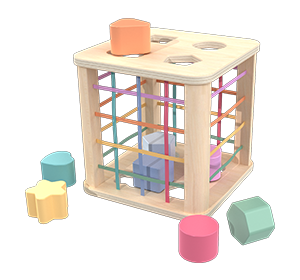
Choose mechanism-led categories first. Marble runs, bead mazes, gear boards, sorting and stacking sets and simple vehicles all deliver feedback without power, and they are the categories where the segment is strongest. Character figures and intricate shapes are better served elsewhere.
Specify the finish and the edge quality, not just the material. Two suppliers quoting "beech" can deliver noticeably different products. Naming the sanding sequence and the edge radius is what makes the quote comparable and the result consistent across batches.
Plan the range around age bands, not around themes. A parent shopping for a one-year-old and a parent shopping for a four-year-old are making different decisions and reading different parts of the packaging. Organising an electronic-free range by age band makes the assortment easier to shop and easier to restock, and it keeps the safety assessment aligned with the stated age for every item in it.
Decide the age statement before the artwork. It appears on the box, it determines the applicable safety requirements, and it is expensive to change once printed. Use the CPSC age determination guidance for the US market and the equivalent expectation in your other markets, and record the rationale.
The commercial terms for custom programmes are set out in the KIDMERRY wooden toy purchasing guide, and our OEM and ODM customisation page explains how a custom range is developed. To discuss specific categories and age bands, contact us with your brief.