
Quality Control First, Safe Play Guaranteed

Quality Control Philosophy
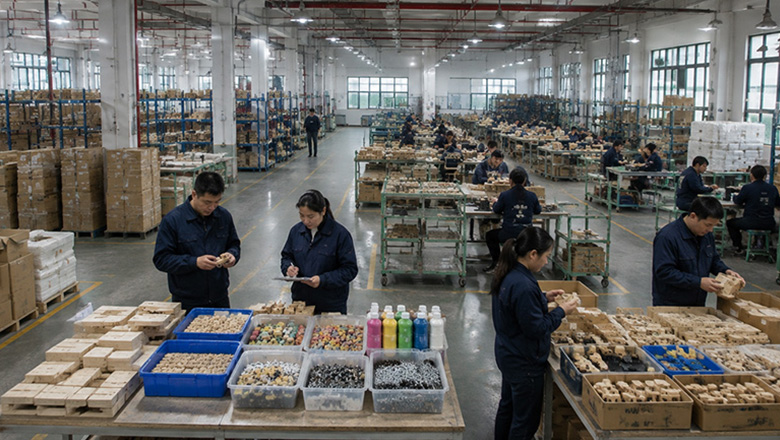
Main Tasks at Different Stages
Pre-Production Assessment and SOP Development Stage for New Products

Process Feasibility Assessment:
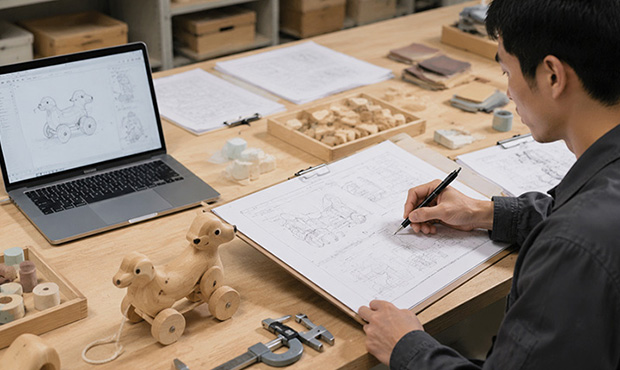
Before new product production, senior engineers, combining product design drawings, the characteristics of wooden toy production, and EN71 safety standards, comprehensively assess the feasibility of the entire process flow, including CNC machining, sanding, painting, and assembly. This proactively mitigates issues such as mass production process defects, dimensional deviations, and paint compatibility.
Standardized SOP Output:
Based on the process assessment results, complete mass production SOP work instructions are developed. These instructions clearly define core control indicators such as standard wood moisture content, CNC cutting parameters, sanding finish, paint film thickness, water-based paint usage specifications, and inspection standards for each process. This provides a unified basis for mass production and QC inspection.
Small-batch Trial Production and Sample Confirmation Phase
Small-batch Trial Production Implementation:
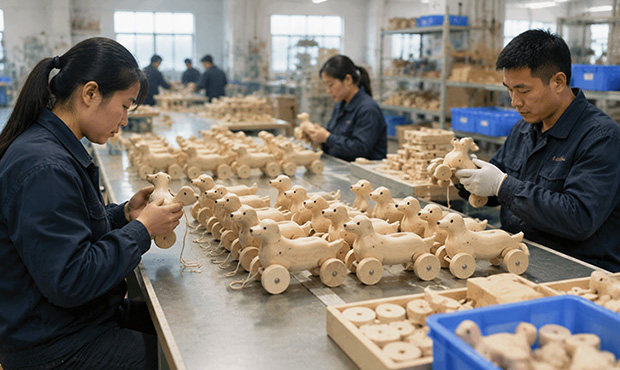
Small-batch trial production is initiated before formal mass production. The entire mass production process is replicated to verify equipment parameters, process connections, and product quality stability. Various quality issues related to dimensions, appearance, structure, and coating are identified during the trial production phase.
Quality Sampling Inspection and Third-Party Inspection:
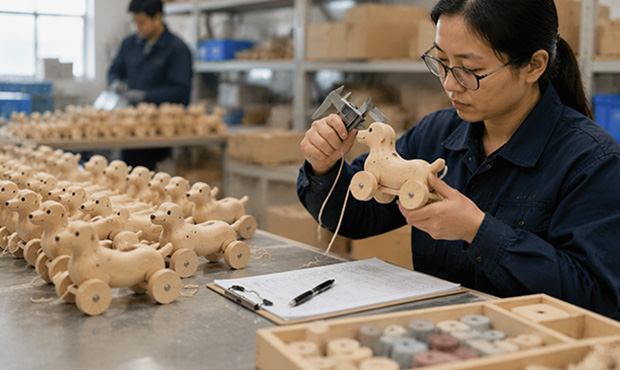
Throughout the trial production process, QC conducts sampling inspections according to the AQL 1.5 industry standard. Simultaneously, on-site sampling inspections and confirmation by a third-party quality inspection agency designated by the customer are supported. Mass production can only commence after the trial product quality meets standards and any issues are rectified.
Small-batch Trial Production and Sample Confirmation Phase
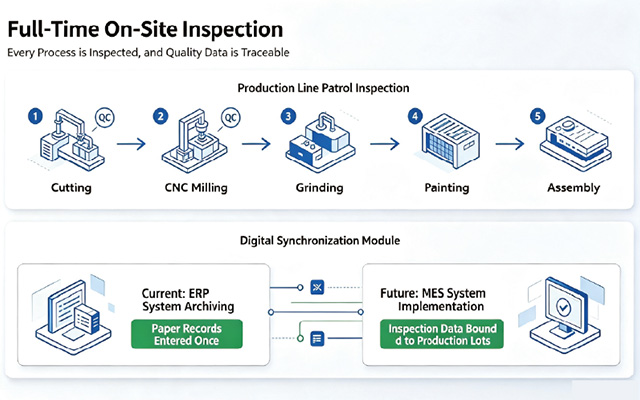
Full-Process On-Line Inspection:
QC personnel will be stationed on-line 24/7 throughout the entire production process, conducting regular spot checks on all processes including material cutting, CNC milling, grinding, painting, and assembly, to monitor the quality of each production stage in real time.
Digital Synchronization:
Currently, paper inspection records from each workshop are uniformly entered into the ERP system for archiving. Once the MES system is fully implemented in Plant 3, inspection data will be linked online to the corresponding production batches, achieving full online traceability of process quality data.
Core Inspection Contents:
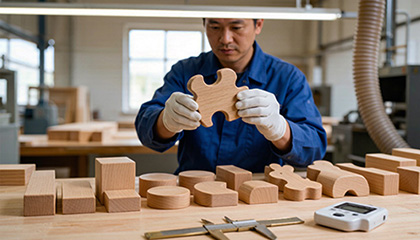
Wood Blank Processing Section:
Accurately verify the dimensions, corner radii, and surface finish of the wood blanks. Dynamically monitor the moisture content of the wood blanks while awaiting spraying to prevent burrs, cracks, material shortages, and dimensional deviations caused by humidity from flowing into the next process.
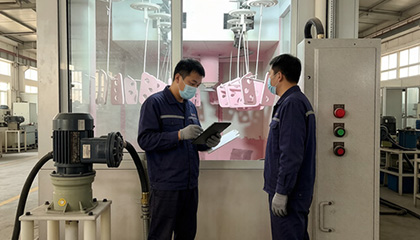
Spraying Section:
Real-time inspection of spray uniformity, rigorously checking for surface defects such as particles, color differences, and runs.

Assembly Section:
Randomly inspect the structural sturdiness and component compatibility of assembled structures, promptly intercepting defective semi-finished products to prevent batch quality declines.
In-Production Finished Product Sampling Inspection Stage
Routine, high-intensity destructive and physical performance sampling inspections are conducted on semi-finished products completed on the production line and the first batch of finished products. Key Industry Standard Tests Implemented:
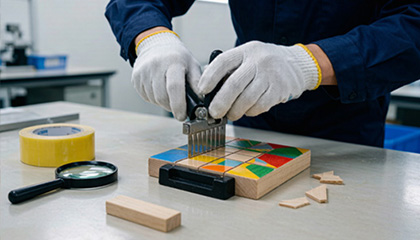
Paint Adhesion Test:
Cross-Cut Test is performed according to customer requirements to ensure that the water-based paint layer does not peel or flake off.
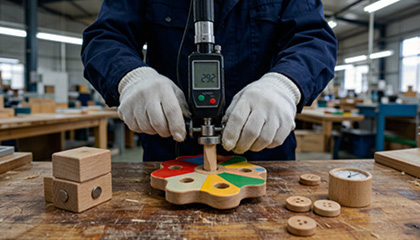
Physical Safety Test:
Small Parts Test and tensile/torsion test are performed to ensure that small parts such as building blocks, magnets, and wooden buttons will not detach under stress, completely eliminating the risk of children swallowing and choking.

Appearance and Function Verification:
The overall appearance and texture, component fit, and product functional integrity are evaluated.
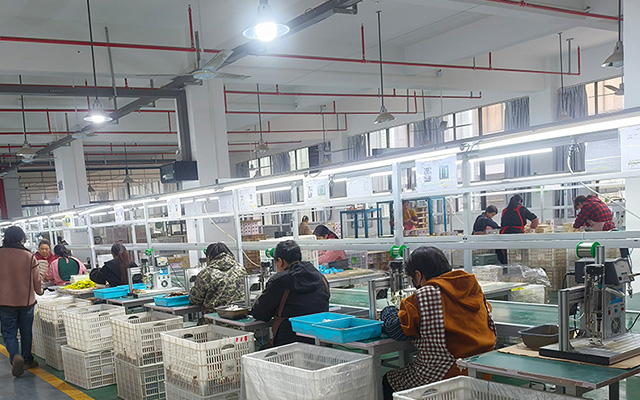
Third-Party Inspection Access:
During mass production, we support on-site inspections by customers and third-party quality inspection agencies (such as SGS, TÜV, Intertek, etc.). On-site inspection points can be set up at key processes such as painting, assembly, and packaging, allowing third-party inspectors to conduct real-time spot checks and verification. We simultaneously provide daily batch quality records and QC inspection reports, supporting on-site verification by customers to ensure full traceability of mass production quality and fully meet the regulations of exporting countries and customer standards.
Finished Goods Warehouse Outbound Sampling Inspection Stage
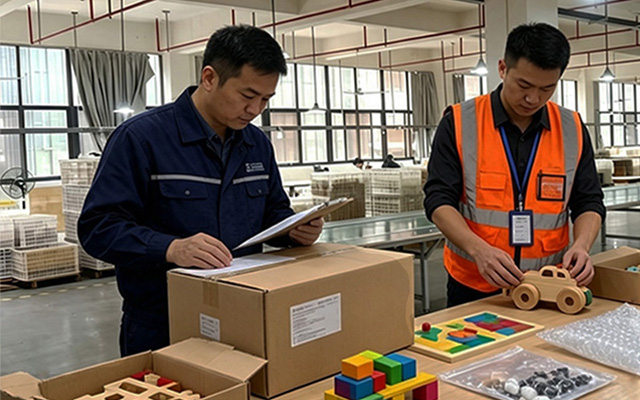
Comprehensive Finished Goods Sampling Inspection:
After products enter the warehouse and are shipped, the finished goods warehouse QC conducts a comprehensive inspection according to AQL sampling standards, verifying product dimensions, appearance, coating, structural function, and ensuring that all finished products meet mass production standards and customer requirements.
Compliance and Packaging Verification:
Simultaneously verify product compliance markings, including CE safety markings, FSC wood certification markings, MADE IN CHINA origin markings, and production batch numbers. Verify that finished products meet moisture-proof and protective packaging standards, achieving product traceability and verifiable compliance. Third-party finished goods warehouse full inspection is supported.
Packaging and Transportation Stage
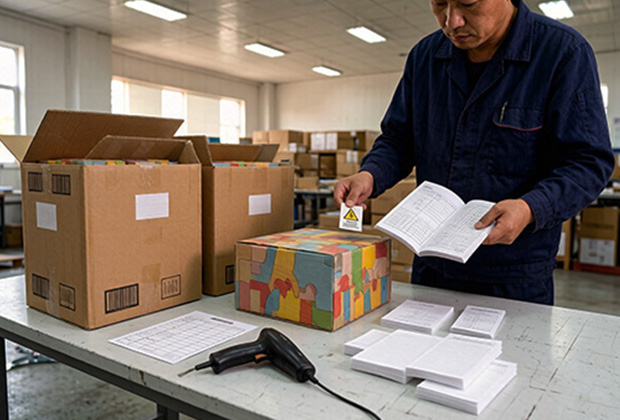
Packaging Inspection:
Ensure each toy is packaged according to customer requirements. Check that the color box, warning labels, barcodes, and instruction manuals are complete and accurate.
Check that the outer box markings and barcodes are accurate, and that the quantity inside the box matches the specifications. Ensure the packaging is neat, the labeling is accurate, and there are no mispackaged or missing items.
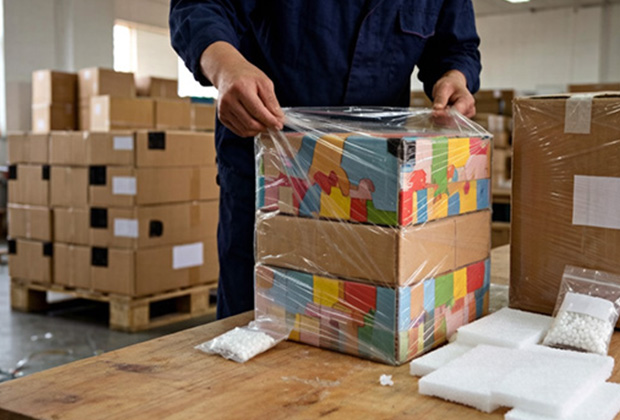
Transportation Safety Inspection:
Considering the characteristics of sea freight and long-distance transportation of wooden toys, implement protective measures such as moisture-proof film, desiccants, and shockproof reinforcement.
Prevent problems such as moisture damage, mold, bumps, and deformation during transportation to ensure the goods are delivered intact.
Delivery and After-Sales Stage
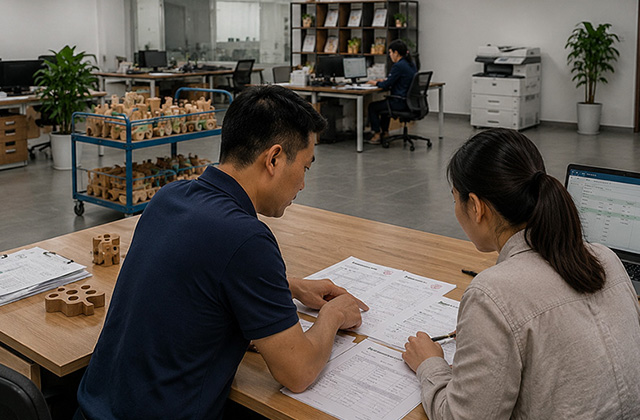
Shipping Handover Inspection:
Ensure the quantity of goods, packing list, and documents (such as bill of lading, certificate of origin, EN71 toy test report, FSC certificate) are complete and accurate.
Customer Feedback Tracking:
Collect customer feedback on the product, especially regarding quality issues. Trace the corresponding process based on the product production batch to pinpoint the root cause, update SOP process standards accordingly, analyze and improve any quality problems that arise, and prevent similar issues from recurring.