






Which Magnet Rules Apply to Your Wooden Maze Board? A Buyer’s EU vs US Guide
A magnetic maze board looks sealed, so it often gets less scrutiny than it deserves. The magnets inside decide which markets the product can legally enter, under two very different legal routes. This guide is for importers, brand owners and product development managers sourcing wooden magnetic maze boards: what each market actually requires, where the EU and US genuinely differ, and what to confirm before approving samples and bulk orders.
The magnets inside a maze board decide market access, and the physics converges even where the paperwork diverges: both the EU and the US judge any magnet that fits the small-parts cylinder against a flux index of 50 kG²mm² or more. What differs is the legal route — EN 71-1:2014+A1:2018 clause 4.23 under CE marking with the manufacturer's EU declaration of conformity, versus ASTM F963-23 with the flux measurement at sections 8.25.1–8.25.3 and a Children's Product Certificate under 16 CFR 1250. Get the magnet specification in writing per product — grade, dimensions, coating and supplier flux data for every magnet in the board and the stylus — and treat any magnet substitution as a redesign: same size, different grade, new flux measurement.
What This Guide Covers
- Why enclosed magnets still need a risk assessment
- EU magnet requirements and the EN 71-1 framework
- US requirements under ASTM F963-23 and CPSIA
- EU vs US: what differs and what does not
- Five design and production risks to watch
- Questions to ask a wooden toy manufacturer
- A compliance process from design to bulk
- Where to start before approving a sample
In the development inquiries we receive, magnet questions rarely arrive alone. One subscription-program buyer asked for EN 71 reports plus magnet pull testing for a range aimed at children under 24 months. Another sent a checklist carried over from a previous supplier, listing EN 71 and ASTM F963 for a single market where only one of the two is relevant. Both were asking the same question: which magnetic maze board safety requirements apply to the same wooden magnetic maze boards, and for which market.
The starting point is to stop treating “the magnets are enclosed” as a risk assessment. It is a design feature, not a conclusion.
Why Magnet Safety Matters in Wooden Maze Board Design
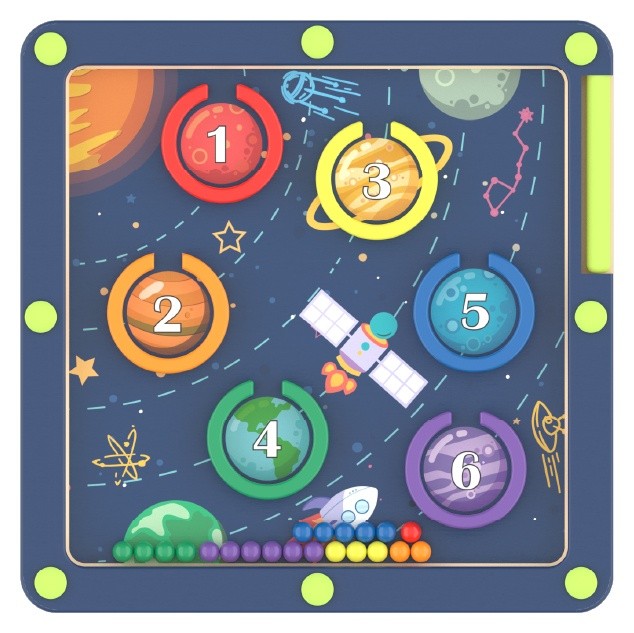
A wooden magnetic maze board is not one product type; the category contains several magnet configurations, assessed differently:
- Magnets inside the board — for example, magnetized targets under the playfield.
- Magnetic beads enclosed inside the board — steel balls moved through a sealed channel beneath a printed panel and cover sheet.
- A magnetic stylus — an external accessory whose tip magnet drags the beads through the maze.
- Loose magnetic pieces supplied with the product — the rarest format, and the least forgiving.
The shared hazard is magnet ingestion: two or more swallowed magnets can attract each other through intestinal tissue. That is why magnetic toy safety standards assess magnets after use and abuse testing, and measure any magnet that fits entirely within the small-parts cylinder (defined in small-parts regulations) by its flux index — a number calculated from a magnet's flux density and pole area — a proxy for how strongly a small magnet can pinch tissue if swallowed.
Wood adds its own failure modes: grain cracks, adhesive creep, cover sheets flexing loose at the frame, a stylus that gets chewed. A sealed magnet stays sealed only if the enclosure survives foreseeable use and foreseeable abuse.
EU Magnet Requirements for Wooden Toys
EU magnetic toy regulations sit inside one legal framework with a defined transition. Directive 2009/48/EC still governs toys placed on the EU market today; Regulation (EU) 2025/2509 repeals and replaces it as of 1 August 2030, with certain framework provisions applying from 1 January 2026. Products placed on the market in conformity with the directive before that date may continue to be sold, and EC type-examination certificates issued under the directive remain valid until 1 February 2031.
The EN 71 magnet requirements live in EN 71-1:2014+A1:2018, the harmonized standard for mechanical and physical properties. Clause 4.23 sets the requirements for magnets and magnetic components; as applied by an EU joint market-surveillance project that tested 145 magnet toys, any magnet that can detach from the toy must either have a flux index below 50 kG²mm² or be too large to fit entirely into the small-parts cylinder. The assessment combines the standard's abuse tests with a tension test for magnets (clause 8.34) and a flux index measurement (clause 8.35).
Chemical requirements reach the magnet assembly too: the board's coating, the adhesive fixing each magnet and any plating on magnetic pieces are evaluated under EN 71-3 for migration of elements, and the harmonized standards list added EN 71-3:2019+A2:2024 as the current version in December 2025.
Conformity is declared by the manufacturer — CE marking plus an EU declaration of conformity, backed by technical documentation kept for ten years. Where harmonized standards are applied in full, the route is internal production control; where they are absent or only partly applied, an EC type-examination by a notified body is required. The declaration of conformity remains the operative document until the digital product passport replaces it from August 2030.
US Magnet Requirements for Wooden Toys
US magnetic toy regulations are anchored in the CPSIA. The CPSC's mandatory toy standard, 16 CFR part 1250, incorporates ASTM F963-23 by reference; it has been the operative edition since 20 April 2024 and remains the cited edition after the December 2025 update of part 1250.
The ASTM F963 magnet requirements treat a magnet as hazardous when it fits entirely within the small-parts cylinder — the geometry defined at 16 CFR 1501.4 — and has a flux index of 50 kG²mm² or more, measured with the flux-index procedures at sections 8.25.1 through 8.25.3 of ASTM F963. That is the formulation CPSC's published magnet guidance uses; the agency also recommends use and abuse assessment of the kind set out at 16 CFR 1500.51–1500.53.
A structural nuance: children's toys subject to 16 CFR part 1250 are exempt from CPSC's separate small high-powered magnet rule, 16 CFR part 1262 — which catches magnet products sold outside the toy standard. Loose magnetic accessories packed alongside a wooden maze board therefore raise a different compliance question than the board itself.
Conformity runs on a different rail. CPSIA requires third-party testing at a CPSC-accepted laboratory, and for imported toys the Children's Product Certificate is issued by the importer of record — the manufacturer supports it with test reports and production records but cannot sign the CPC on the buyer's behalf. The tracking-label obligation likewise sits with the importer of record. CPSIA's lead limits and phthalates provision apply to the board's coatings, inks and adhesives, as they do for any children's product.
EU vs US: What Buyers Need to Check Separately
Compared honestly, the magnet criteria themselves are close: both markets assess magnet accessibility after foreseeable use and abuse, both use the small-parts cylinder, and both apply the 50 kG²mm² flux-index threshold. Treating that convergence as a difference wastes testing budget on duplicates. The real differences sit one level up:
| What to check | EU | US |
|---|---|---|
| Legal instrument | Directive 2009/48/EC now; Regulation (EU) 2025/2509 applies from 1 August 2030 | 16 CFR part 1250 incorporating ASTM F963-23, under CPSIA |
| Magnet criteria source | EN 71-1:2014+A1:2018, clause 4.23 (harmonized standard) | ASTM F963-23 magnet requirements |
| Flux-index test | EN 71-1, clause 8.35 | ASTM F963, sections 8.25.1–8.25.3 |
| Who signs conformity | Manufacturer: CE marking + EU declaration of conformity | Importer of record: Children's Product Certificate |
| Testing route | Internal production control if harmonized standards fully applied; EC type-examination otherwise | Third-party testing at a CPSC-accepted laboratory, mandatory |
| Documentation | Technical documentation kept 10 years; digital product passport from August 2030 | CPC plus tracking label handled by the importer of record |
| Warning system | Article 11 and Annex V warnings, including online display | Small-parts warnings per ASTM F963-23, per the applicable rules |
Swipe sideways to see the full table
The separate 16 CFR 1262 magnet rule and the EU's transition to a digital product passport are genuine regulatory differences. The conformity route is procedural: EU self-assessment under harmonized standards versus mandatory US third-party testing. The signature is documentary: the manufacturer's declaration of conformity versus the importer's CPC. And component changes reopen the assessment in both markets — but only the signing party can declare the product still compliant. For the document set behind those declarations — report numbers, lab accreditation and per-order coverage — our guide to EN 71 compliance documents for wooden toys breaks down what each file actually proves.
Five Magnet Design and Production Risks Buyers Should Watch
Risk 1: one test list for two markets
A buyer inherits a checklist listing EN 71 and ASTM F963 for every product, then ships to a market where only one baseline applies. The unused report adds cost; the item missing from everyone's list stops a shipment.
Risk 2: the enclosure changes during mass production
The board passes its sample report; then the adhesive, cover-sheet thickness or magnet housing changes mid-run. The magnets did not change — the retention did. A sample report says nothing about the product actually shipped.
Risk 3: magnet specification drift
A substitute magnet of the same size but a different grade changes the flux index and the retention force. Any magnet change is a redesign and reopens the flux measurement.

Risk 4: the stylus is treated as an afterthought
In magnetic toy testing the stylus is assessed as part of the product: a redesigned tip joint, a stronger tip magnet or a changed cord all alter the accessibility and retention picture — and the stylus is the component children handle and mouth most.
Risk 5: the age label is treated as a solution
A buyer planning a range for children under 24 months asked whether small-parts risk can be managed by raising the printed age. It cannot: the assessment follows the design and the foreseeable user, not the marketing decision.
What Should Buyers Ask a Wooden Toy Manufacturer?
A wooden magnetic maze board manufacturer should answer the following in writing, per product:
- Magnet specification: grade, dimensions, coating and supplier flux data for every magnet in the board and the stylus.
- Enclosure and retention: adhesive type, mechanical retention, cover-sheet material, and how the assembly survives the abuse tests.
- Change control: which material or component changes trigger reassessment, and who is notified.
- Testing scope: which applicable parts of EN 71 (EU) and which provisions of ASTM F963-23 and CPSIA (US) apply, tested by a third-party laboratory, per product.
- Sample approval: what the golden sample is, whether a sealed retained sample exists, and which market the sample test plan covers.
- Bulk consistency: incoming magnet inspection, retention checks in assembly, and final inspection criteria.
- Market-specific documents: EU declaration of conformity support now and digital product passport readiness for 2030; CPC support data for the US importer; warning artwork checked against destination-market rules.
Ask before the sample: each answer changes what it must prove. The buying-side view is set out in the wooden toy purchasing guide.
From Product Design to Bulk Production: Building a Reliable Compliance Process
The same sequence runs for wholesale programs and single SKUs. At design, magnet selection happens with flux data in hand, and retention is engineered — adhesive choice plus mechanical interlock — not added at assembly.
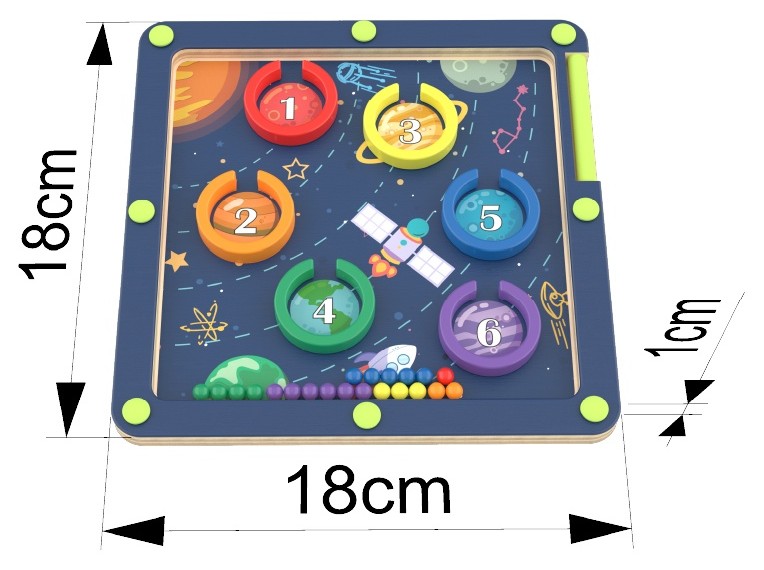
At sampling, the board goes through in-house abuse pre-checks, the golden sample is sealed, and the test plan is written per market. At production, consistency is controlled at three points: magnets inspected on arrival, retention checked on the line, and finished boards inspected against the approved sample, including warning artwork. Timing: sampling runs 7–10 working days for an existing style and 15–20 working days for a design developed from customer drawings; bulk takes 30–45 days after sample approval, or 45–60 in the Q2–Q3 peak season — factory-level planning figures, not industry statistics. A magnetic maze board OEM program that locks the magnet specification, enclosure design and test scope into the first sample avoids every re-test above.
A Pre-Shipment Magnet Checklist for Importers
The risks above converge into one sequence. Before a magnetic maze board ships, every line below should be answered from documents already in hand — anything still open is a question, not an assumption:
- Magnet specification on file — grade, dimensions, coating and supplier flux data for every magnet in the board and the stylus, in writing per product.
- Per-market test scope confirmed — which EN 71 parts apply for the EU, which ASTM F963-23 provisions and CPSIA documents apply for the US; a report for a market you do not ship to adds cost without adding evidence.
- Enclosure specified as built — adhesive type, mechanical retention and cover-sheet material recorded, with any mid-run change treated as a retention change that reopens the assessment.
- No magnet substitution since sampling — a replacement magnet of the same size but a different grade is a redesign that reopens the flux measurement.
- Stylus assessed as a component — a BOM line with its own test scope, not an accessory added after the report was issued.
- Golden sample sealed and bulk re-checked — pull-force and flux-index verification repeated on the first bulk units, with warning artwork checked against destination-market rules.
- Conformity documents routed to the right signer — EU declaration of conformity support from the manufacturer, CPC support data for the US importer of record.
Fix every line at sampling and you pay for testing once; leave one open and it resurfaces as a re-test after production.
Run the checklist twice: once at sample approval, when it sets the specification, and once before shipment, when it confirms that production still matches it. The second pass is where the enclosure risks live — adhesive, cover-sheet thickness and magnet housing are the items that can change mid-run without anyone touching the magnet itself. It is also where the two edge cases get caught early: loose magnetic pieces packed alongside the board, which raise a different compliance question than the board under the toy standard, and age-grade changes, which alter the foreseeable user the assessment follows rather than the printed label alone.
Frequently Asked Questions
Frequently Asked Questions
Are magnetic maze boards suitable for children under 3?
Most magnetic maze boards are designed and labelled for ages 3 and up — at that grade the enclosed magnets are not accessible small parts. An under-3 version changes the assessment: the magnets must remain permanently enclosed even after abuse testing, and the whole configuration is re-evaluated against the lower band.
Which magnet rules apply in the EU versus the US?
In the EU, magnet hazards are assessed under the EN 71-1 mechanical requirements; in the US, ASTM F963-23 sets the magnet and flux-index requirements. The scopes differ, so a board cleared for one market is not automatically cleared for the other — confirm per-market test scope before sampling.
How is magnet retention tested before shipment?
Each magnet is housed in its own cavity and bonded, then verified on the golden sample with a defined pull-force and flux-index check — and re-checked on the first bulk units. Any magnet substitution, even at the same size, is a change that reopens the flux measurement.
Do magnetic pens meet small-parts requirements?
The stylus is sized to pass the small-parts cylinder for the 3+ band, and its cord or tether is specified against the same assessment. Treat the pen as a component line in the BOM with its own test scope — not as an accessory added after the report was issued.
Conclusion
The physics of small magnets is identical in Rotterdam and Los Angeles — the same flux index, the same small-parts cylinder, the same ingestion hazard. What differs is the legal route and the signature: CE marking and the manufacturer's EU declaration of conformity today, a digital product passport from 2030; a CPC signed by the US importer of record on third-party test results. Magnetic maze board safety requirements are a design input, not a post-production checkbox — and buyers who fix the magnet specification, the retention design and the market-specific test scope at sampling pay for testing once.
As a wooden toy OEM/ODM manufacturer in Yunhe, Zhejiang, KIDMERRY develops magnetic maze boards for EU and US programs with third-party testing arranged per product and market. Planning one for next season? Send your target market, age grade and artwork through the contact page and we will reply with the questions above answered in writing.
Check Magnet Rules Before You Sample
About Kidmerry: Yunhe Kidmerry Toys Co., Ltd is a wooden toy manufacturer based in Yunhe, Zhejiang, China. The factory runs in-house CNC machining, finishing and assembly, and holds ISO 9001:2015 certification, with FSC-certified board available on request. Sampling takes 7–10 working days for existing styles and 15–20 working days for custom drawings; bulk production runs 30–45 days after sample approval. Ask Kidmerry for a quotation, a sample set and third-party test reports before your next development cycle.
Request a Quotation