



Should You Buy Wooden Pretend Play Toys from a Supplier or a Factory?
Wooden Pretend Play Toys: Should Your Order Go to a Supplier or a Factory?
Every wooden toy buyer eventually faces the same fork in the road. You have a pretend play line to source — play kitchens, dollhouses, busy boards, role-play sets — and two very different doors to knock on. One door says supplier. The other says factory. Behind each one sit different capabilities, different communication loops and different levels of control over your product.
This guide explains what actually separates a wooden pretend play toy supplier from a wooden toy factory, compares the two routes across the capabilities buyers care about most, and shows you how to verify which one you are really talking to — without treating either route as the enemy of the other. If you already know you need a manufacturing partner rather than a catalogue reseller, the guides on how to choose a wooden toy manufacturer for pretend play products and what makes a reliable wooden toy factory for global buyers take the next steps from there.
A supplier resells or coordinates; a factory makes. A trading supplier offers breadth and low commitment but sits between you and production, while a direct factory controls engineering, tooling, QC and documentation in-house — at the cost of a narrower catalogue and an MOQ per style. The right route depends on how custom your pretend play line is: catalogue replenishment can suit a supplier, and anything OEM or ODM almost always ends up at a factory anyway. Verify which one you are talking to by auditing the building, the machinery and the documents, not the website.
What This Guide Covers
Supplier, Factory or Manufacturing Partner?
The words get used loosely in trade conversations, so it is worth pinning down three roles that often hide behind one business card.
Factory vs. trading supplier
A wooden toy factory owns production. Machines, workers, raw board, machining, finishing, assembly and packing happen under its own roof or under roofs it directly controls. When you ask about tolerances, coatings or the moisture content of a batch, the person answering talks to the workshop the same day. A trading supplier owns no production. Its value is a network: many factories, one contact, one currency, one language bridge. That is a legitimate service — for a buyer who wants breadth without depth, it can be exactly right. The risk is not the model itself but the mismatch: when a quote goes through two or three hands, every technical question takes a round trip, and every round trip is a chance for a requirement to arrive at the workbench diluted.
There is also a third role buyers meet more often than they expect: the manufacturing partner. This is a factory that behaves like a supplier in the pleasant ways — one contact, proactive updates, flexible communication — while keeping the control of a factory: in-house engineering, in-house QC, direct accountability for documents. The best sourcing outcomes for custom pretend play lines come from this hybrid, and it is the model this article keeps returning to.
Where pretend play toys sit in the picture
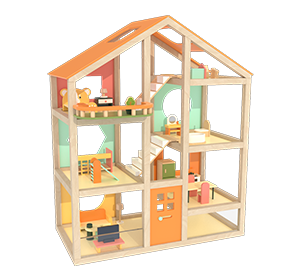
Wooden pretend play products raise the stakes of this choice more than most categories. A play kitchen is not a simple block set: it has hinged doors that must survive thousands of open-close cycles, printed graphics that must survive wiping, accessories that must be counted, and structures tall enough to be tipped by an enthusiastic toddler. A dollhouse has staircase geometry and miniature furniture that multiply the part count. Every one of those details is decided somewhere — in a design file, on a machining path, at a finishing station. The further the company you sign with sits from that somewhere, the more of your product lives in other people's memory.
OEM and ODM wooden toy development
The difference between routes becomes sharpest in customized work. Under OEM and ODM wooden toy development, your brand owns the design and the factory turns it into tooling, samples and a repeatable batch. A trading supplier can forward your artwork; it cannot answer why a tenon cracked in the sample, propose a different joint, or adjust a CNC path — those answers live on the factory floor. If your roadmap includes private-label pretend play products, the factory route is not an ideology, it is where the technical decisions get made. Buyers weighing this step in depth can also compare how play kitchen suppliers differ on MOQ, tooling and freight, since tooling economics are where supplier and factory quotes genuinely diverge.
Capabilities Buyers Should Compare, Side by Side
Routes are abstractions; capabilities are checkable. The table below compares the two sourcing routes across the dimensions that decide whether a pretend play program runs smoothly or stalls — followed by a short note on each row.
| Capability | Direct wooden toy factory | Trading supplier |
|---|---|---|
| Communication loop | One hop to the workshop; technical answers come from people who run the machines | Every technical question is relayed; answers arrive filtered and delayed |
| Product development support | In-house engineering can adjust joints, thicknesses and CNC paths to protect cost and strength | Forwards your files; improvement suggestions depend on whichever factory responds first |
| Quality control | Incoming, in-process and final QC under one roof; corrective actions start the same day | Relies on the producing factory's QC plus its own inspection; corrections travel through an extra layer |
| Customization depth | Full OEM/ODM: structure, graphics, packaging, certificates per market | Best for catalogue customization: logo, colourway, packaging insert |
| Catalogue breadth | Narrower — deep in what it produces | Wide — deep in nothing it produces |
| Order quantity structure | MOQ per style, tiered by product complexity | May aggregate several factories to lower visible MOQs |
| Documentation and traceability | Test reports, DoC and material records issued by the producer of your goods | Documents assembled from the producing factory; chain of custody is longer |
| Cost structure | Factory price without intermediary margin; tooling quoted transparently | Price includes service margin; can be competitive on catalogue items |
Two rows deserve a second look. Communication loop sounds soft until your sample comes back with the wrong hinge side and you learn it was misread in transit. Documentation sounds like paperwork until an EU importer asks for a test report that matches your exact batch, and the trail runs through a company that never touched the wood. Neither point makes trading suppliers wrong; both points make them a different tool.
Quality and documentation in daily practice
In a factory-run program, quality control is a sequence, not an event. Material arrives and is checked before it is cut; first articles come off the line and are measured against the approved sample; final random inspection happens packed or nearly packed. Documents follow the same logic — EN 71 test reports, DoC files and material declarations are produced alongside the batch they describe, because the factory that made the batch can sign for it. In a supplier-coordinated program, the same sequence can exist, but you are trusting the supplier to enforce it inside someone else's building. Some do it well. You are simply adding one organization between your specification and your product, and every added organization is an added interpretation.
What the difference means for your timeline
Timelines expose the difference early. Sampling a custom pretend play product from an existing style typically takes seven to ten working days, and a from-scratch custom sample fifteen to twenty — figures that hold only when the people quoting the sample also run the sample. Bulk production after sample confirmation runs thirty to forty-five days, stretching to forty-five or sixty in the second and third quarter peak season. A relay adds latency at every leg; it does not change the work, it changes how many times the work changes hands. Buyers planning a launch calendar should read those numbers as factory-floor facts and ask any intermediary to commit to them in writing.
When Direct Factory Sourcing Makes Sense
Neither route wins everywhere, but custom pretend play programs tilt hard toward the factory. These are the situations where the tilt becomes decisive.
Large structures and multi-part sets
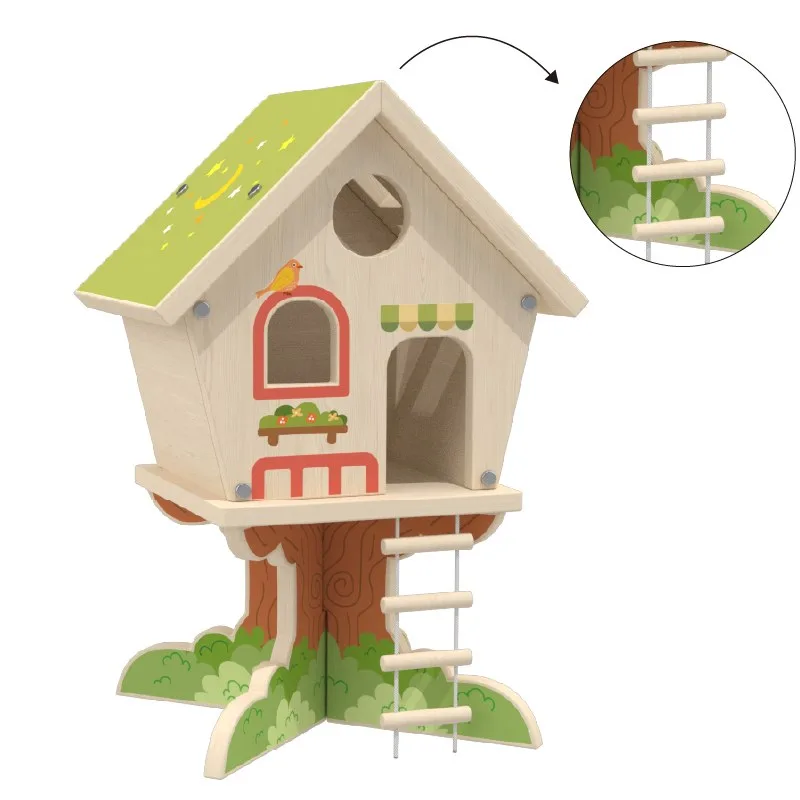
Scale changes the math. A wooden dollhouse or a full-height play kitchen carries structure, weight and freight consequences that a flat-packed catalogue item does not. At KIDMERRY, for example, large structural pieces such as a custom forest treehouse wooden doll house for pretend play sit in the MOQ tier of 500 pieces per style, because the investment in structure, packaging and freight justification deserves a product you fully control. When every unit is that substantial, the margin you lose to an intermediary is measured in real money per carton.
OEM kitchen and role-play programs
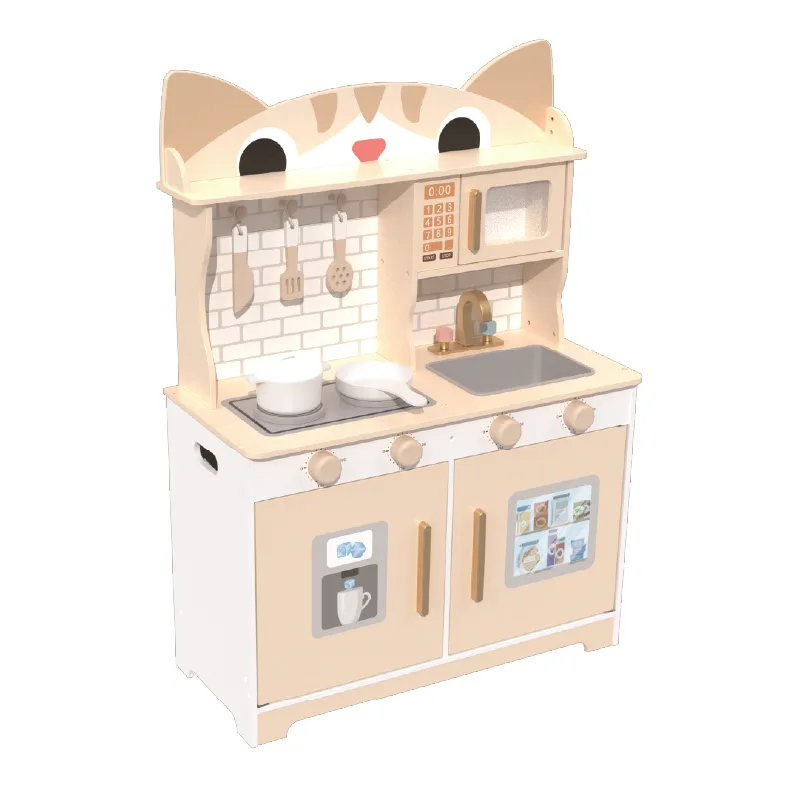
Branded kitchen programs show the same logic. A custom cat-shaped wooden play kitchen with stove and sink, built under OEM involves shaped panels, printed graphics, accessory sets and safety-driven edge work — decisions that loop between design file and machine. Products with high plastic accessory ratios typically carry a 1,000 pieces per style MOQ, because the accessory supply chain, not the wood, sets the minimum. A factory quotes those numbers from its own BOM; a relay quotes them from someone else's answer. For buyers extending a kitchen line into furniture or complementary structures, the same factory relationship that made the kitchen will quote the follow-on with the tolerances already known.
Programs where documents carry weight
If your customers are EU or US retail chains, documentation is part of the product. Certifications and compliance frameworks such as EN 71-3 heavy-migration limits, CPSC oversight under ASTM F963, ISO 9001:2015 quality systems, BSCI and Sedex (SMETA) social audits, and FSC chain-of-custody for wooden products all attach most cleanly to the entity that physically makes the goods. A factory supplies reports per product and per order and can walk an auditor through the line that produced them. That is also why the deeper questions — which EN 71 documents importers need from a manufacturer — are best asked directly to the producer.
When a supplier route is genuinely the better tool
Fairness cuts both ways. If you are replenishing catalogue items in small volumes across many categories, if you need one consolidated shipment from five producers, or if you are testing a market before committing to per-style MOQs, a trading supplier can be the cheaper way to learn. The mistake is not using one; it is expecting one to behave like a factory when the work turns custom.
How to Verify Product and Service Claims
Whoever you talk to, verify the claim before you wire the deposit. Three checks separate a real manufacturing partner from a well-designed website.
Verify the building and the machines
Ask for a live video walk-through, not a showreel: the CNC area, the finishing line, the assembly stations and the warehouse, in one uncut pass. A factory running its own production shows you machines with wear on them and WIP on the benches. This is also the moment to confirm machining claims with specifics — what spindle count runs the shaping, what tolerance the routing holds (a realistic in-house figure is ±0.1 to 0.2 mm on machining, which is a machine capability, not a finished-product guarantee), and which file formats the engineering desk accepts. A factory that programs its own toolpaths can usually work from DXF or STL files and build toolpaths even from hand sketches.
Verify the people and the process
Ask who will answer your technical questions and what happens between your email and the workshop. In a factory program there is a named engineer or project manager — at KIDMERRY, for instance, OEM and ODM projects run through a dedicated project manager who sits between the customer and production — and a sample process with stages: quote, sample, written approval, batch. Ask which certifications the facility holds for its own operations (ISO 9001:2015 for the quality system, BSCI and Sedex SMETA for social compliance, FSC CoC for the wood chain) and ask to see the certificates with scope and validity dates. Then check whether the scope actually covers your SKU — an FSC certificate covers defined product categories, and a careful buyer confirms the match before writing it into a listing.
Verify the documents, not the logos
Logos are marketing; documents are evidence. For any product you intend to ship to the EU or US, request: the EN 71 test report for that product family, the Declaration of Conformity, ASTM F963 documentation for the US route, and the material certificates behind any FSC or food-contact claim. Match report numbers to product names. A factory that made the goods produces these from its own records; a relay requests them upward, and occasionally discovers the report does not exist. The ten minutes spent matching numbers to SKUs has saved more launches than any negotiation tactic.
Choosing the Right Sourcing Route for Your Pretend Play Line
Distill everything above into five questions and answer them honestly before you send the next RFQ.
How custom is the product? Catalogue item with a logo → supplier route can work. OEM/ODM structure, graphics or mechanism → factory or manufacturing partner.
How technical is the failure mode? If a wrong hinge or a cracked tenon can sink the launch, shorten the distance between you and the bench.
What does the calendar require? Sampling and bulk windows are factory-floor facts; whoever cannot commit to them in writing is not the one controlling them.
Which documents must travel with the goods? Match certificates to the producing entity before the PO, not after the audit request.
Where will the second order come from? Reorders reward the route that kept your tooling, your sample archive and your batch records — normally the factory.
One more commercial note belongs here, because it is where routes differ most visibly in the contract. Direct factories typically work on a T/T structure — a 30% deposit with the balance paid against a copy of the bill of lading — or accept an L/C at sight, with sample fees settled separately and often credited back once volume materializes: at KIDMERRY, base sampling fees are credited against the bulk order or refunded when the same style reaches 5,000 pieces in cumulative production with written sample approval. Intermediary terms vary more, because each layer adds its own payment conditions. Read the payment clause the way you read the spec sheet: it tells you who actually carries the order.
If the five questions point you toward a manufacturing partner, the practical next step is small: send one pretend play SKU and ask for a sample-first quotation. How artwork becomes a priced custom prototype walks through what that exchange looks like on the factory side, and the same logic applies across kitchen and role-play programs.
FAQ
Frequently Asked Questions
Is buying from a trading supplier always worse than buying from a wooden toy factory?
How can I verify that a company is a real wooden toy factory and not a reseller with a factory-looking website?
What MOQ should I expect from a direct wooden toy factory for pretend play products?
Who provides the safety and compliance documents for wooden pretend play toys?
Discuss Your Pretend Play Sourcing Plan
About Kidmerry: Yunhe Kidmerry Toys Co., Ltd is a wooden toy manufacturer in Yunhe, Zhejiang, China, with in-house CNC machining, finishing and assembly, and FSC-certified board available on request.
Request a Quotation