


How Does Your Artwork Become a Priced Custom Puzzle Prototype?
For toy brands, importers and product developers holding original artwork, the distance between a finished illustration and a priced custom wooden puzzle prototype is longer than it looks — and most of that distance is specification, not design.
The core point, stated up front: artwork alone is not enough for an accurate quotation. Puzzle dimensions, piece count, cutting layout, board material, surface finishing and packaging all shape product development and cost. The same illustration can become a chunky toddler tray puzzle, an interlocking floor set or a multi-component matching game, and each is a different quote.
A custom wooden puzzle manufacturer can assess feasibility quickly — but only from a specification, not from an image alone. A recent inquiry shows the pattern. A buyer sent a single email asking for prices on custom puzzles, with images attached and no dimensions, quantities or market information. The only honest reply was a question list — not because the factory was stalling, but because an image file does not yet describe a product. This guide covers the five specification gaps that stall custom puzzle projects, the configurations that drive cost, the five decisions to settle before requesting a quotation, and how to judge whether a prototype is ready for mass production.
Artwork alone is not enough for an accurate quotation. Send print-capable files at final dimensions, mark the elements cut lines must not cross, and settle size, piece count, material and packaging before requesting prices. At KIDMERRY, custom wooden puzzles carry an MOQ of 1,000 pcs per style, and base sampling fees are credited against the bulk order or refunded once the same style reaches 5,000 pcs in cumulative production with written sample approval.
What This Guide Covers
1. Common Challenges When Turning Artwork into Custom Wooden Puzzles
Five issues account for most of the back-and-forth between a first artwork submission and a workable quotation. None of them is exotic; all of them are cheaper to fix before sampling than after.
Low-resolution artwork and unclear print quality
Buyers often send screen-resolution images — files that look sharp on a monitor but lack the pixel density for print at the intended size. On wood, the problem compounds: the substrate is less forgiving than coated paper, and fine lines or small text can soften or fill in. What it costs: a redraw round, a delayed color proof, or a prototype that has to be reprinted. What to confirm early: ask the manufacturer what file resolution it needs at the finished puzzle dimensions — the requirement scales with size, so the same file may pass at 20 cm and fail at 40 cm.
Important image details crossing puzzle cutting lines
A character's face split across two pieces, text severed mid-word, a logo sliced through — these are the complaints that surface after a prototype is already built. Buyers commission artwork for full-size viewing and rarely mark which elements must stay inside a single piece. Confirm early: identify the elements that must not be crossed, and require a cut-path overlay on your artwork for approval before tooling.
Piece count specified without confirming finished dimensions
Piece count and puzzle size are locked together. A 48-piece design at one size produces pieces of a workable handling size; the same 48 pieces on a smaller board become fiddly or fragile, and on a larger board become trivially easy. Buyers who fix the piece count first and the dimensions later often force a compromise in one of them. Confirm both together, along with the age grade — piece size is a safety variable, not just a difficulty setting.
Material and thickness not defined
"Puzzle" does not specify a material. Plywood, MDF and solid-wood components print, cut and wear differently, and thickness drives cutting time, edge finishing, perceived quality and freight weight. A specification that omits material invites the factory to quote an assumption — and the quote and the sample may then disagree. Confirm the substrate and thickness explicitly, or ask the factory to propose options with the trade-offs stated.
Packaging requirements considered too late
Retail packaging carries its own minimums from the packaging supplier, its own artwork, and sometimes its own language requirements. One buyer planning bilingual packaging for the Canadian market raised it only after sampling — repackaging the decision cost weeks. Product development and packaging development run on separate clocks; start both at the same time.
2. Key Product Configurations and Their Cost Implications
Wooden puzzles are not one product type. The configuration a buyer chooses is the first cost driver, before material or quantity enter the calculation.
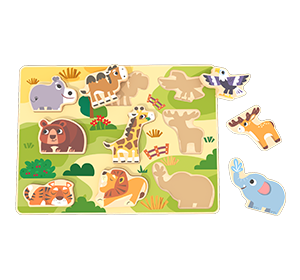
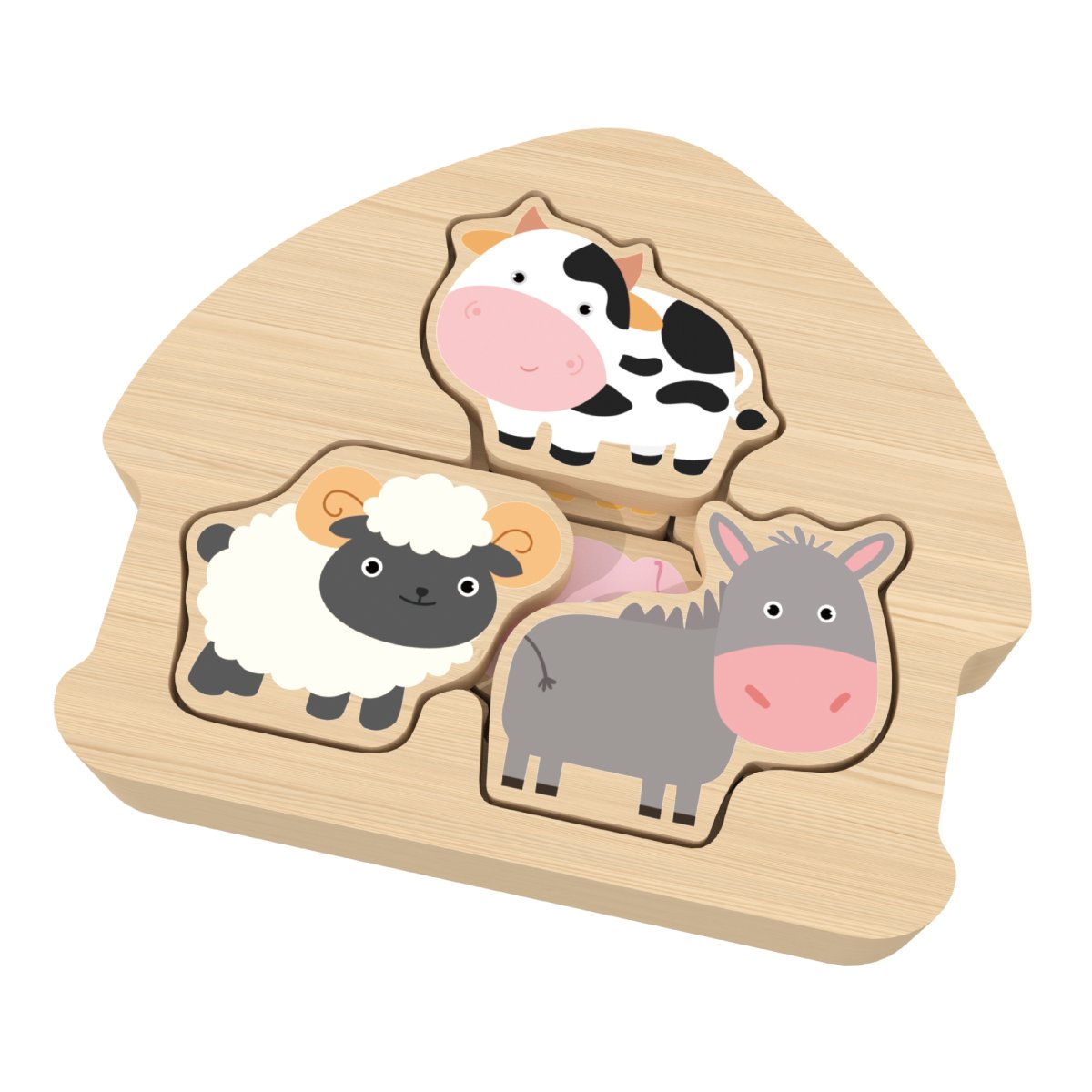
Standard tray and peg puzzles. A board with recessed or printed cavities and lift-out pieces — the format behind most wooden peg puzzles in early-learning ranges. The structure is proven and the tooling scope is limited, which makes it the most quote-friendly starting point for custom artwork. Cost rises mainly with piece count, print coverage and any added elements such as pegs.
Custom-shaped and interlocking designs. Pieces cut to the artwork's own outline — an animal silhouette, a road segment that connects to its neighbors, a shaped board. These demand profile cutting rather than a standard grid, so cutting time, fixture work and edge finishing all increase. They are entirely feasible with CNC profile cutting, but the cutting layout has to be engineered around the artwork rather than laid over it, which is why cut-line review matters more for this configuration than any other.
Classic interlocking jigsaw grids. A traditional jigsaw — a single printed sheet divided into an interlocking grid of 100 or more pieces — is also a configuration KIDMERRY accepts for custom artwork. Grid layouts at higher piece counts put the heaviest demands on the artwork-to-cut-line relationship: pieces are small, tabs and sockets must interlock, and any detail a buyer wants kept whole has to be planned into the grid before the tool path is set. If this is the target format, state the piece count and finished dimensions together at the first inquiry — the two values determine whether the artwork works at grid scale or needs adjustment first.
Multi-component puzzle sets. A puzzle plus reference cards, a storage box, mix-and-match piece families, or an electronic sound module. Every added component adds a specification line, a packing check and a supplier minimum — and a sound module brings electronics into what was a woodworking project, with the compliance scope that follows it. One recent set of puzzles built around a storage box and multiple piece families was quoted on a very different clock from a single-board design, simply because the component list was longer.
| Configuration | Example in our range | What drives the cost |
|---|---|---|
| Standard tray / peg puzzle | Farm animal peg puzzle | Piece count, print coverage and any added elements such as pegs — the most quote-friendly starting point |
| Custom-shaped / interlocking | City road track puzzle, 90×70 cm | CNC profile cutting: cutting time, fixture work and edge finishing all increase |
| Classic interlocking jigsaw grid (100+ pieces) | Quoted to artwork — piece count and finished dimensions decide feasibility | Artwork-to-cut-line planning before the tool path is set |
| Multi-component set | Quoted to the component list | Each component adds a specification line, a packing check and a supplier minimum |
Swipe sideways to view the full table →
A buyer who knows which configuration they want can get a meaningful quotation early. A buyer who says only "custom puzzle" gets a clarifying question instead.
3. Five Technical Decisions Before Requesting a Quotation
A quotation is an answer to a specification. These five decisions decide how accurate that answer can be — and how well it matches what a custom wooden toy manufacturer can actually run in production.
1. Artwork quality, dimensions and cutting-line coordination. Send print-capable files at the final dimensions, list the elements that must not be crossed by cut lines, and confirm who prepares the cut-path layout. Artwork submitted without these three answers cannot be priced beyond a rough range.
2. Puzzle size and piece count. Together, they fix piece size, cutting time and material yield — three cost lines in one decision. They also set the handling experience and interact with the age grade: the grasp-and-fit difficulty a Montessori educational toy supplier has to engineer for lives in these two values, not in the artwork. State both, and state which one may flex if the other proves impractical.
3. Wood material and thickness. Substrate choice affects print behavior, edge quality, weight and cost. Thickness interacts with the tray or baseboard depth and with freight. Ask for the factory's recommendation with reasons rather than fixing a value blindly — but do require that the quoted specification is the one the sample is built to.
4. Printing and surface finishing. Direct print, printed-paper lamination and other methods differ in setup cost, durability under abrasion and behavior at low volume. Finishing — coatings, lacquers — affects both appearance and the testing scope for coated parts. Ask which method is proposed and why; the answer shows where the supplier expects wear.
5. Packaging and included components. Retail box or export pack, printed inserts, cards, bags, labels — each is a line item with its own minimum and its own artwork. Confirming packaging at quotation stage protects the landed-cost calculation from a late surprise.
None of these decisions requires design work to be finished. All of them require a decision to exist.
4. Artwork and Cutting Layout: Why They Must Be Reviewed Together
This is the most technical section of the guide, and the one that saves the most rework.
Artwork designed for full-size viewing and a cutting layout that divides that artwork into pieces are two different layers, and they cannot be finalized independently. A cut line is a physical path a tool follows; once it is set, the illustration has to live with it. The elements most exposed are exactly the ones buyers care most about: faces, text, logos, fine outlines, and any detail whose meaning depends on staying whole.
Three practices keep the two layers aligned:
- Mark the protected elements. Before layout work starts, list which parts of the artwork must remain inside a single piece. This converts an aesthetic judgment into an input the factory can engineer around.
- Require a cut-path overlay for approval before sampling. Ask the factory to return the artwork with the proposed cut lines drawn on it. Reviewing that overlay is the cheapest moment to discover that a piece is too small, a bridge is too thin, or a detail is severed. After tooling or program setup exists, the same discovery costs a rebuild.
- Check the prototype against the overlay, not against the artwork alone. A sample can look attractive and still fail the layout test — a piece that fits poorly, an element cut awkwardly, a color band that straddles two pieces unevenly. Approve the sample against the approved cut-path drawing, because that drawing is what mass production will follow.
For custom-shaped designs, this review is not optional. When the piece outline is the design, the cut-line layout is the product's core engineering document, and approving it before sampling is what separates a prototype from a lucky guess.

5. How to Evaluate a Custom Wooden Puzzle Prototype
A prototype is a specification audit, not a photo opportunity. Six checks, in the order a buyer should run them:
- Artwork placement and printing quality. Colors against the approved proof, fine lines intact, text readable, print registration acceptable across all pieces — not just the ones photographed.
- Finished dimensions and piece layout. Measure the assembled puzzle against the specification, and compare the piece layout with the approved cut-path overlay.
- Piece fit and assembly experience. Pieces should seat without force and stay without wobble. Fit that is too tight warps or jams in humid markets; too loose reads as cheap within a week of retail.
- Wood quality, thickness and cutting edges. Edges should be smooth and consistently finished; thickness uniform across pieces; no splintering at corners. These are the points a retail customer touches first.
- Surface finishing. Coating evenness, abrasion behavior on printed surfaces, and the smell and feel of the finish — a strong odor is a coating problem, not a personality trait.
- Packaging and component completeness. Every component against the packing list: cards, pegs, spare parts, instructions, box print quality. A prototype that packs wrong will mass-produce wrong.
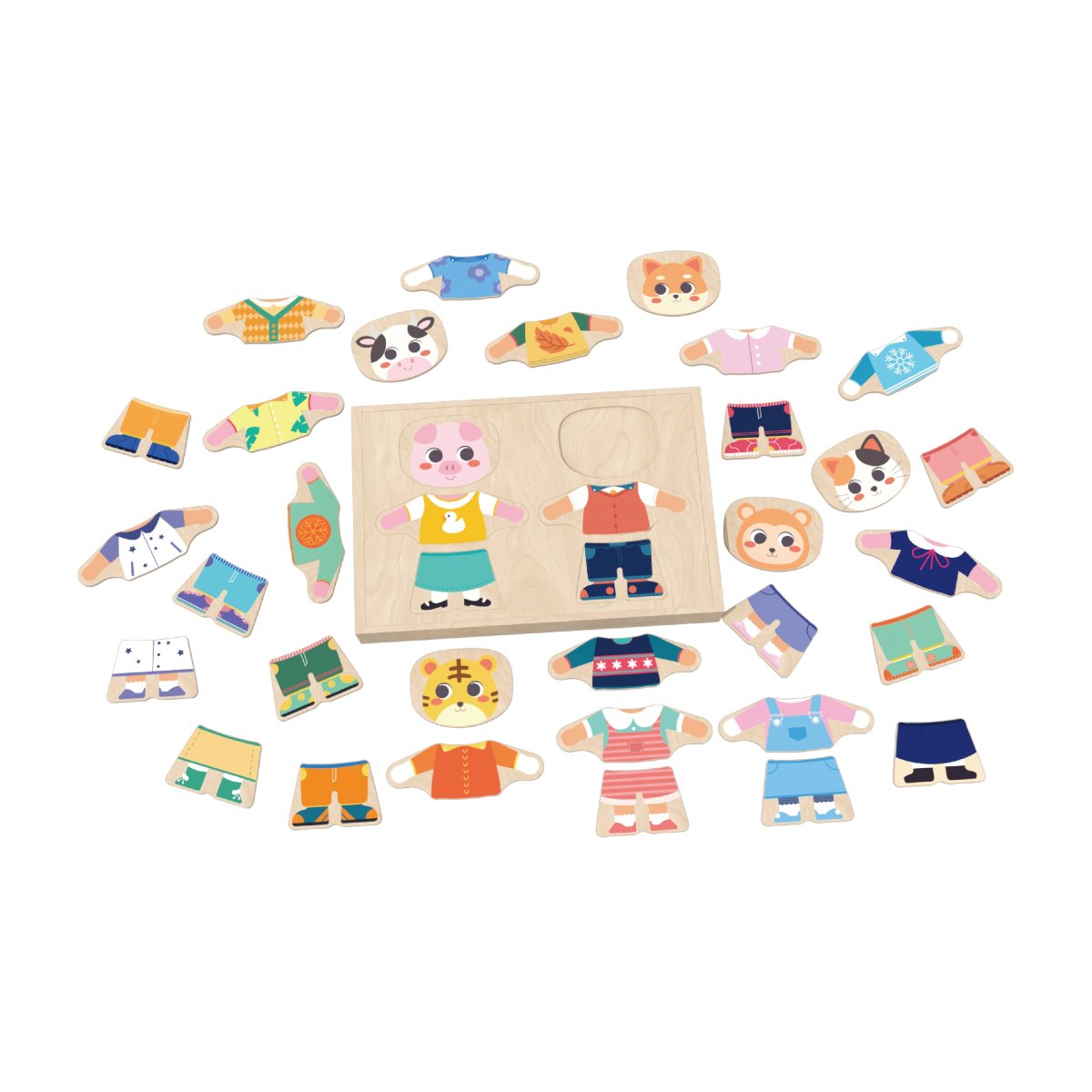
Two discipline points matter more than any single check. First, log the results in writing — an approved sample is only useful if the reasons for approval are recorded. Second, treat the approved sample as the mass-production reference: retained by both sides, and cited in the purchase order as the standard for appearance, fit and finish. Consistency between sample and shipment is a contract question, not an assumption.
6. What to Include in a Custom Puzzle Tech Pack
A tech pack converts the five decisions above into a document a factory can quote from. Ten items:
- Artwork files and version — file formats, resolution, version number, and which file is current.
- Finished product dimensions — assembled size, board size, tolerances if any exist.
- Target piece count — and whether it is firm or indicative.
- Puzzle shape and cutting layout requirements — standard grid, custom outline, protected elements.
- Wood material and thickness — substrate per component, not just for the board.
- Printing and finishing requirements — method, color references, coating.
- Packaging and labeling requirements — retail box or export pack, languages, barcodes.
- Included accessories or components — cards, pegs, spare pieces, bags, instructions.
- Target market and intended age group — this drives the applicable requirements, not just the warnings.
- Estimated order quantity — per style, since minimums are assessed per style rather than per order.
If the pack is incomplete, not everything stalls. Artwork quality, dimensions, piece count and configuration can usually be assessed early for feasibility and a quotation range. Material confirmation, finishing specifics, packaging engineering and compliance scope require the remaining items — and a firm wooden puzzle quotation requires all of them.
7. What Determines the Cost of a Custom Wooden Puzzle Prototype?
Prototype pricing follows the work the prototype actually requires. Seven factors:
| Cost factor | What it covers |
|---|---|
| Artwork preparation | File conversion, cut-path layout, color separation for the substrate |
| Product structure and dimensions | A new cut layout is engineering time before it is cutting time |
| Material and thickness | Substrate cost and machining behavior |
| Cutting complexity and processing | Piece count, outline complexity, fixture work |
| Printing and finishing | Method setup, color proofing, coating trials on the actual board |
| Packaging and additional components | Box prototyping, card printing, inserts |
| Prototype quantity and development requirements | One display sample and a signing sample are different jobs |
Swipe sideways to view the full table →
Three cost categories should never be quoted as one number. Prototype development cost covers the work above. Tooling or setup costs, where a design requires them, are separate one-time items whose amortization belongs in the mass-production conversation. Mass-production unit cost is a function of quantity, and should be quoted at defined quantity breaks. A quotation that merges the three will not survive contact with a purchase order, and a buyer who asks for them separately will get answers that can actually be compared across suppliers.
Sample lead time follows the same logic. For this product class, an existing design samples in 7–10 working days, and a new sample developed from buyer drawings in 15–20 working days, excluding courier transit. These are factory-level planning figures, not industry statistics, and they assume the specification is complete — an undefined cut layout is the most common reason a sample schedule slips.
8. Two Important Considerations Before Moving to Mass Production
Product safety and target-market compliance
Requirements attach to the product and the market, not to the category. A wooden puzzle for toddlers under three faces small-parts requirements that a 3+ puzzle does not, and coated parts bring chemical requirements into scope that uncoated ones may not carry. The workable position for a buyer: define the target market and age grade before tooling, ask which parts of EN 71 (EU) and ASTM F963 / CPSIA requirements (US) apply to this specific configuration, and confirm that test reports are issued per product and per order — not as a blanket certificate for a range. In the US, the Children's Product Certificate is issued by the importer of record; in the EU, the document set is in transition — the toy safety regulation adopted in 2025 applies from 1 August 2030 and introduces a digital product passport that replaces the declaration of conformity, so buyers developing products with long retail lives should ask what product data their supplier can structure now.
Artwork ownership, licensing and version control
Custom puzzle artwork is usually the buyer's asset, and for buyers building private label programs with a private label wooden toy manufacturer, the artwork is often the core of the brand — but ownership has to be established in writing — including fonts and any third-party elements embedded in the illustration. Licences for manufactured goods are broader than licences for viewing a file. Version control is the quieter risk: the artwork file that ships to retail must be traceable to the version approved on the sample, and retained by both sides for repeat orders. A reorder placed eighteen months later should reference a version number, not a memory.
FAQ
Frequently Asked Questions
What Artwork Files Are Required for Custom Wooden Puzzles?
Can Manufacturers Turn Original Artwork into Custom Wooden Puzzles?
How Do Puzzle Size and Piece Count Affect Custom Wooden Puzzle Costs?
What Is the MOQ for Custom Wooden Puzzles, and How Does Order Quantity Affect Unit Cost?
What Determines the Cost of a Custom Wooden Puzzle Prototype?
What Should Buyers Check Before Approving a Custom Wooden Puzzle Sample?
Have Your Puzzle Artwork Ready?
The path from artwork to a priced, production-ready puzzle runs through six confirmations: print-capable files at final dimensions, protected elements marked, size and piece count settled, material and thickness defined, finishing specified, and packaging started early. None of them requires finished design work — all of them require a decision.
Send KIDMERRY your artwork, reference images and initial requirements through our contact page, and the first review will confirm feasibility, the configuration options, and the sampling schedule for your design. Quotation structure, payment terms and document flow are set out in the wooden toy purchasing guide.
---
Turn Your Artwork into a Priced Puzzle Prototype
About Kidmerry: Yunhe Kidmerry Toys Co., Ltd is a wooden toy manufacturer in Yunhe, Zhejiang, China, with in-house CNC machining, finishing and assembly, and FSC-certified board available on request.
Request a Quotation