



What Makes a Reliable Wooden Toy Factory for Global Buyers?
A factory tour tells you what a wooden toy plant owns. It rarely tells you what a wooden toy plant does when a paint batch drifts, a shipment slips, or an auditor asks for last quarter's inspection records. This guide is written for importers, brand owners and retail buyers who need to judge reliability before approving a supplier — through manufacturing signals, quality-control evidence, export documentation and the way a factory communicates when something goes wrong.
What This Guide Covers
A reliable wooden toy factory is one whose results are systematic rather than situational: the same specification produces the same product across batches, quality is inspected and recorded at defined stages rather than checked at the end, compliance and traceability documents exist per product and per order, and problems are escalated with facts — dates, photos, root cause — instead of being absorbed silently. Capacity tells you how much a factory can make; these four signals tell you whether it can make the same thing correctly, repeatedly, and on a schedule you can plan a retail season around.

1. Reliability Is More Than Production Capacity
When buyers evaluate a wooden toy supplier, the first questions usually settle on visible scale: how many machines, how many workers, how many pieces per month. Those numbers matter — but they answer the wrong question for most sourcing decisions. Capacity describes how much a factory can produce in ideal conditions.
Reliability describes what happens in the conditions your order will actually encounter: a custom specification, a first production run, a mid-run colour adjustment, a document request from a customs broker or a retailer's compliance team.
The distinction matters because wooden toys concentrate several failure modes that scale does not solve. Wood is a natural material — grain direction, moisture content and board selection change between batches even when the design does not. Colour is mixed in batches, not printed from a file. Fit and finish depend on tooling that wears. A factory can therefore own impressive equipment and still ship a second order that does not match the first, or a bulk run that does not match the approved sample. Buyers who discovered this after their first shipment did not lack a large supplier; they lacked a systematic one.
| Situation | What capacity tells you | What reliability tells you |
|---|---|---|
| Standard volume | Maximum pieces per month under ideal conditions. | Whether planned output actually ships on the confirmed date, order after order. |
| Custom designs | That the factory can make toys. | Whether drawings become toolpaths, fixtures and an approved specification before production starts. |
| Material variation | Nothing — capacity does not address wood movement between batches. | How board grading, moisture control and material traceability keep batches within the approved standard. |
| Colour and coating | Nothing — capacity does not address batch mixing. | How paint batches, colour standards and retained reference samples keep bulk consistent with the sample. |
| Schedule pressure | That a big run is theoretically possible. | How delays are reported, re-sequenced and communicated before they reach your launch calendar. |
For global buyers, reliability shows up in four places: how the factory engineers a product before production, how it controls quality during production, how it documents and exports the result, and how it communicates when a step does not go to plan. Each of the following sections turns one of those into observable, verifiable checks — the same logic we apply when how wooden toy production is controlled is explained to buyers evaluating our own plant.
2. Manufacturing and Engineering Signals
Reliability begins before mass production, at the point where a design becomes a manufacturable specification. The factories that produce consistent bulk runs are the ones that invest in engineering inputs: precise machining, controlled material selection, and a development process that converts drawings into toolpaths and fixtures rather than improvising on the shop floor.
2.1 What to look for in machining and material control
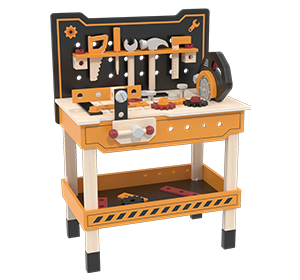
Ask how the factory cuts, shapes and joints wood — not which machines it owns, but what those machines are used for. In our own plant, an in-house CNC workshop runs multi-head wood routing centres, including twin-spindle machines and multi-tool auto-change engravers with central dust extraction, covering panel cutting, contour cutting, mortise-and-tenon joinery, relief engraving and one-pass rounding of safety edges. The machining precision is ±0.1–0.2 mm — a figure that describes machining accuracy, not a finished-product tolerance, because assembly, coating and wood movement all add variation afterwards. A factory that can distinguish those two things is more trustworthy than one that quotes a single impressive number. Product-level examples make the distinction concrete: a wooden tool bench workbench playset needs accurate mortise fits and rounded safety edges on dozens of small parts, not just on the main body.
Material control is the second half of the same signal. Ask which species and boards the factory routinely works with — beech, maple, birch, basswood, pine, multi-ply plywood and MDF cover most wooden toy applications — and how board quality is graded at incoming inspection. If your programme requires certified material, ask how FSC-certified boards are segregated and traced through the shop floor; availability should be described as on request and confirmed per SKU, not assumed across a catalogue.
Engineering capability also shows in how a factory receives your design. A supplier that accepts DXF or STL files and can build toolpaths from them — even from a hand sketch, in early-stage projects — is telling you that development runs through engineering, not around it. For buyers planning custom products, this is where an OEM/ODM development process either exists or does not.

3. Quality Control and Batch Traceability
Quality control is where reliability claims meet evidence. The question to ask a supplier is not "do you inspect?" — every factory says yes — but "at which stages, against which documents, and what records does it leave behind?"
3.1 Incoming, in-process and outgoing QC
A systematic factory inspects at three defined stages. Incoming (IQC) covers materials and components before they enter production: board grading, moisture checks, hardware and packaging verification against the bill of materials. In-process (IPQC) covers the production line itself: machining dimensions, sanding and edge quality, coating thickness and colour against the approved standard, assembly fit. Outgoing (FQC/OQC) covers finished goods before packing — function, appearance, carton drop testing and quantity verification against the packing list. You can see how this workflow is structured on our inspection and quality page.
| Stage | What is checked | Record produced |
|---|---|---|
| IQC Incoming | Board species and grade, moisture content, hardware and packaging components verified against the bill of materials. | Incoming inspection record tied to the material lot or order number. |
| IPQC In-process | Machining dimensions, sanding and edge quality, coating thickness and colour against the approved standard, assembly fit. | In-process checkpoint record tied to the production batch. |
| FQC / OQC Outgoing | Finished-goods function and appearance, safety features, carton drop performance, quantity verified against the packing list. | Final inspection report and loading record for the shipped order. |
What separates a systematic factory from a slogan is the record each stage produces.
Ask a candidate supplier three specific questions: which checkpoint produces a written record; whether the record references the batch or order number; and whether you, the buyer, can request that record for your shipment. A factory that inspects but cannot show records is running quality on memory — and memory does not survive a staff rotation or a peak-season rush.
3.2 Sample-to-batch consistency
The most common reliability failure in wooden toys is the gap between the approved sample and the bulk shipment. It happens when the two are produced under different conditions — different tooling, a different paint batch, a different coating line speed — and it is preventable only by process, not by promises. Sets with many repeated parts expose any drift fastest — a 26-piece Nordic ABC block set shows a colour or size deviation immediately, because the pieces sit side by side on the shelf.
Buyers can test for this during supplier evaluation with concrete questions. How is the pre-production sample approved, and by whom? What locks the specification after approval — colour standards, coating steps, tooling settings — so the bulk run starts from the same conditions the sample ended on? If a colour drifts or a fit loosens mid-run, at what point is the buyer informed, and what evidence accompanies the notification? A reliable factory answers these with named mechanisms: retained reference samples, batch numbers on paint lots, first-article checks at the start of each production run.
A factory that answers "we always do our best" has told you something important.
4. Packaging, Documentation and Export Coordination
Global buyers do not take delivery at the factory gate. Between finished goods and your warehouse sit retail packaging, compliance documents, container loading and destination-market paperwork — and reliability failures in this layer are just as expensive as defects, because they surface at customs, at a retailer's compliance desk or in a launch calendar.
4.1 Documentation that travels with the product
Ask what documentation the factory provides per order, and verify that the answer distinguishes between document types instead of lumping them together. For wooden toys sold into the EU and US, a credible supplier's documentation covers EN 71-3 (migration of certain elements), ASTM F963 and CPSC requirements for the US market, together with quality-management and audit frameworks such as ISO 9001:2015, BSCI and Sedex/SMETA — and, where certified material is requested, FSC chain-of-custody documents. Two precision points matter here. First, test reports are issued per product and per order; a certificate on a website is not compliance evidence for your SKU. Second, FSC is a chain-of-custody certification, not a product-safety certification, and its scope covers defined product categories — buyers should confirm their specific SKU falls within the certificate scope. The fundamentals behind these documents are explained in our guide to wooden toy export certifications.
4.2 Packaging, loading and shipment coordination
Packaging is where production reliability becomes visible to your customers, and export handling is where it becomes measurable in costs. Evaluate whether the factory develops retail-ready packaging against a dieline approved before printing, whether master cartons are specified for stacking and drop performance rather than just fitting the product, and whether palletisation and container loading are planned — including how mixed-SKU loads are counted and verified at loading. For solid-wood packaging, ask who handles ISPM 15 heat treatment or fumigation and who issues the declaration; plywood and MDF packaging typically does not require it.
4.3 Communication and escalation
The last coordination signal is behavioural, and it is the one buyers under-weight. Every factory communicates well when nothing goes wrong. Reliability is measured by what happens when something slips: whether delays are reported with a revised date and cause before your follow-up email, whether quality findings arrive with photos and a proposed correction rather than being silently reworked, and whether one named contact owns your order from sampling through shipment. A practical test costs nothing: during quotation, ask the supplier to describe the last time a production problem affected a customer's shipment, what they told the customer, and when. The structure of the answer — candid, specific, with a timeline — predicts your future experience better than any brochure.

5. A Practical Factory Evaluation Checklist
The signals above compress into a checklist you can run across several suppliers in a single RFQ round. Ten items, each answerable in writing — send the middle column to each candidate supplier and score the responses:
| Checklist item | Ask the supplier | A credible answer includes |
|---|---|---|
| Engineering input | Which file formats do you accept, and who develops toolpaths and fixtures before sampling? | DXF/STL intake, in-house toolpath modelling, fixture planning named as a pre-sampling step. |
| Machining precision | What machining accuracy do you quote? | A stated figure that distinguishes machining accuracy from finished-product tolerance. |
| Material control | Which species and boards do you stock, and how is incoming material graded? | A named species/board list, incoming grading criteria, and traceable handling of FSC boards when requested. |
| QC stages | Do IQC, IPQC and FQC/OQC each produce a written record? | Yes — with records tied to batch or order numbers, available to the buyer on request. |
| Sample approval | How is the pre-production sample approved, and what is frozen afterwards? | A named approval step, retained reference sample, and a frozen specification for bulk. |
| Batch consistency | How do you keep bulk consistent with the approved sample? | Paint batch control, colour standards, first-article checks at the start of each run. |
| Documentation | Which documents do you issue per product and per order? | Test reports against the destination market's requirements, shipping documents — and honesty about what is not included. |
| Packaging development | How are retail packaging and master cartons specified? | Dieline approval before printing, carton stacking/drop specification, component protection. |
| Export handling | How are containers loaded and verified? | Loading plans, mixed-SKU count verification, solid-wood packaging treatment (ISPM 15) when applicable. |
| Lead-time honesty | What are your sampling and production lead times? | Figures stated with conditions — working days, "after sample approval", peak-season ranges, excluding shipping, confirmed per project. |
A useful way to score the answers: a supplier that answers eight or more items with specific, verifiable mechanisms is worth a sampling investment. A supplier that answers in generalities is telling you its system has not been built yet — and you would be funding the build with your first order. Our own published planning figures illustrate what a conditioned answer looks like: samples of existing designs are typically ready in 7–10 working days, samples developed from your drawings in 15–20 working days, and bulk production takes about 30–45 days after sample approval (45–60 days in the Q2–Q3 peak) — all stated before shipping time and confirmed per project rather than quoted as guarantees. For the full sourcing framework, our wooden toy purchasing guide covers materials, cost structure and the ordering process in detail.
6. How KIDMERRY Builds Reliability Into Orders
We describe our own operation in the same terms this guide asks you to verify, because we would rather be checked than trusted. KIDMERRY is a wooden toy manufacturer based in Yunhe, Zhejiang — a cluster specialising in wooden toy production. Our in-house CNC workshop, staged inspection workflow and per-order documentation practice are described on the manufacturing capability and inspection pages linked above, and we welcome buyers who arrive with this checklist: the questions it contains are ones we answer in writing, per project. The same discipline carries across product groups — our educational & learning toys range is built and documented under this same workflow.
If you are evaluating factories for an upcoming programme — a custom range, a private-label line or a seasonal expansion — send us your product list and target market, and we will walk through capability, documentation and lead-time planning against your specification. Start the conversation through our contact page, or request a factory capability discussion with your RFQ.
Request a Factory Capability Discussion →
7. Frequently Asked Questions
What is the difference between a factory's capacity and its reliability?
Capacity is how much a factory can produce under ideal conditions — machines, staff and floor space. Reliability is whether it produces the same approved specification correctly and on schedule under real conditions: custom designs, first runs, material variation and peak-season pressure, when bulk lead times stretch from 30–45 days toward 45–60 days. Capacity is visible on a tour; reliability has to be verified through QC records, sample-to-batch controls and documentation practice.
How can I verify a wooden toy factory's quality control before ordering?
Ask which inspection stages produce written records (incoming materials, in-process checks, outgoing finished goods), whether those records reference batch or order numbers, and whether you can receive copies for your shipment. Then ask how the approved sample is protected during mass production — reference samples, paint batch control and first-article checks are the mechanisms that keep bulk consistent with the sample you signed off — and the inspection plan should be a real plan, naming an AQL such as 0.65 for major defects under ISO 2859-1, not a general quality assurance claim.
Which documents should a reliable wooden toy supplier provide per order?
At minimum: test reports issued for your product against the destination market's requirements (such as EN 71-3 for the EU and ASTM F963 / CPSC requirements for the US), shipping and packing documentation, and — where applicable — FSC chain-of-custody documents for certified material. Test reports are issued per product and per order; a certificate displayed on a supplier's website is not evidence for your specific SKU.
How do I test a supplier's communication before committing an order?
Watch how the supplier answers questions that have no marketing answer: ask them to describe a past production problem and what they told the customer, ask who owns your order end to end, and ask what happens when a date slips. Specific, dated, candid answers predict future behaviour — a factory that plans sampling honestly will quote 7–10 working days for an existing style and 15–20 for a custom drawing, not a vague fast-sample promise; polished generalities predict silence when something goes wrong.
A reliable wooden toy factory is defined by systematic, repeatable execution rather than visible capacity. The four signals worth verifying are engineering input before production, staged quality control with written batch-level records, documentation issued per product and per order, and candid escalation when a step slips. Sample-to-batch consistency is the most common failure point in wooden toys — and the most preventable through process. Buyers can evaluate all four signals with written questions before spending anything on sampling, and a supplier's answers predict the ordering experience more accurately than its brochure.
Start Your Wooden Toy Project With a Factory You Can Check
About Kidmerry: Yunhe Kidmerry Toys Co., Ltd is a wooden toy manufacturer based in Yunhe, Zhejiang, China. The factory runs in-house CNC machining, finishing and assembly, and holds ISO 9001:2015 certification, with FSC-certified board available on request. Sampling takes 7–10 working days for existing styles and 15–20 working days for custom drawings; bulk production runs 30–45 days after sample approval. Ask Kidmerry for a quotation, a sample set and third-party test reports before your next development cycle.
Request a Quotation