



Which Open-and-Close Design Fits Your Wooden Toy?
Most wooden toys are designed as one fixed volume: a shape that cannot be opened, rearranged or entered. The moment a design gains a door, a lid, a drawer or a hinged panel, it stops being a static object and becomes a mechanism — with everything that implies for play value, tooling, assembly, quality control and freight. Buyers who specify that mechanism early make better products and better margins; buyers who add it late usually pay for it twice, once in retooling and once in returns.
Once a wooden toy gains a door, lid or drawer it becomes a mechanism — the hinge-versus-pin-axle decision, the clearance tolerances and the finger-gap rules decide both play value and mechanical compliance, because a gap that traps fingers fails EN 71-1 and ASTM F963-23 long before a paint test matters. Fix the mechanism and its hardware before the panel breakdown, hold machining to ±0.1–0.2 mm on the cut part — a capability figure on the component, not a guarantee on the assembled unit — and expect door gaps to be inspected within tenths of a millimetre of the drawing. If the concept must fold, prototype the lock and hinge first: they drive the 15–20 working days a custom-drawing sample takes.
This guide is written for toy brands, importers, wholesalers and product developers evaluating an open-and-close design for the first time or auditing one that already exists. It covers which categories genuinely benefit from openings, which mechanism fits which product, how moving parts change material and manufacturing decisions, and what to confirm before a sample becomes a purchase order. The category discussion draws on a pretend play wooden toys range that includes houses, kitchens, carry-case sets and activity boards.
What this guide covers
- Why Opening and Closing Features Matter in Wooden Toy Design
- Which Wooden Toy Categories Benefit from Open-and-Close Designs?
- Choosing the Right Opening Mechanism
- Moving Parts vs. Fixed Structures: What Should Buyers Choose?
- How Opening Mechanisms Affect Materials and Manufacturing
- Balancing Play Value, Durability and Cost
- From Product Concept to Production Sample
- What Buyers Should Confirm Before Mass Production
- FAQ
- Develop Your Custom Wooden Toy with KIDMERRY
Why Opening and Closing Features Matter in Wooden Toy Design
What an opening actually does in play value terms
An opening earns its place when it creates a repeatable, verifiable loop: the child opens something, discovers or loads something, and closes it again. That loop is the difference between decoration and play. A barn door that lets animals be loaded, a case that closes between play sessions and keeps its parts together, a drawer that hides pieces for a child to find again — each supports play that lasts beyond the first impression. A panel that opens onto nothing, or a lid that reveals a printed picture once, rarely survives the second week on the shelf.
What it does commercially
Openings carry three commercial effects that matter to a buyer as much as to a child. First, the reveal is a retail asset: a customer who can open a small door in-store is doing your demonstration for you. Second, the closed state is a logistics asset — a house that closes into a case, or a play set whose lid doubles as the box, ships in a fraction of the volume of its open footprint, and carton size is what freight is quoted on. Third, an opening platform extends: one carry-case structure can host several themed sets, which spreads tooling cost across a range instead of a single SKU.
Open-and-close is not fold-away
Open-and-close describes any designed opening: hinged doors, lift-up lids, sliding panels, drawers, flip panels and removable parts. Fold-away is narrower — a structure that collapses toward flat or compact for storage, as some climbing frames and panel houses do. Every fold-away toy opens and closes, but almost no open-and-close toy folds away. Treating the two as the same thing leads to wrong specifications: a buyer who asks for "foldable" when the design intent is a hinged two-room house will get quotes for a very different structure, with very different hardware.
Which Wooden Toy Categories Benefit from Open-and-Close Designs?
Dollhouses and play houses
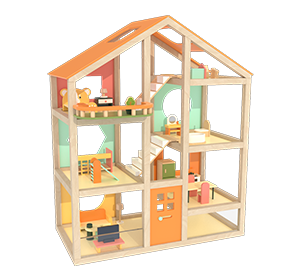
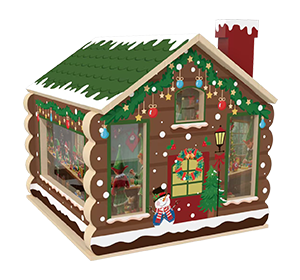
Dollhouses benefit from openings in two distinct ways, and they are not interchangeable. A hinged house that opens along a spine into two furnished rooms turns storage into part of the product — the closed case is compact, and the opening is the reveal. A front-opening house with door panels, by contrast, keeps the volume fixed and the opening becomes an access point for play inside. The first suits ranges where freight and shelf space dominate; the second suits larger houses where interior access matters more than closed size. A current example of the open-into-play approach is our wooden forest gnome house that opens into two rooms — the split shell is the play feature, not just the access route.
Barns and farm sets
Barns are the classic opening toy, and for good reason: the loading loop — open the doors, move the animals in, close up for the night — is the entire story of the product. Movable fencing extends the same logic outdoors of the building, letting the child arrange enclosures rather than accept a fixed yard. In trade ranges, barn doors are close to a category convention; a barn without working doors reads as incomplete to retail buyers.
Garages and vehicle sets
Garages work because they complete a vehicle loop: the car drives in, the gate closes, the ramp releases it again. A lift gate or ramp adds a mechanism a child can operate, and parking space gives the vehicles a home between sessions, which also cuts the loose-parts complaints that come back through retail. For a buyer whose range already includes vehicles and carriers, a garage set is the natural opening-feature extension; it reuses existing vehicle tooling and adds one structure.
Kitchens and pretend-play stations
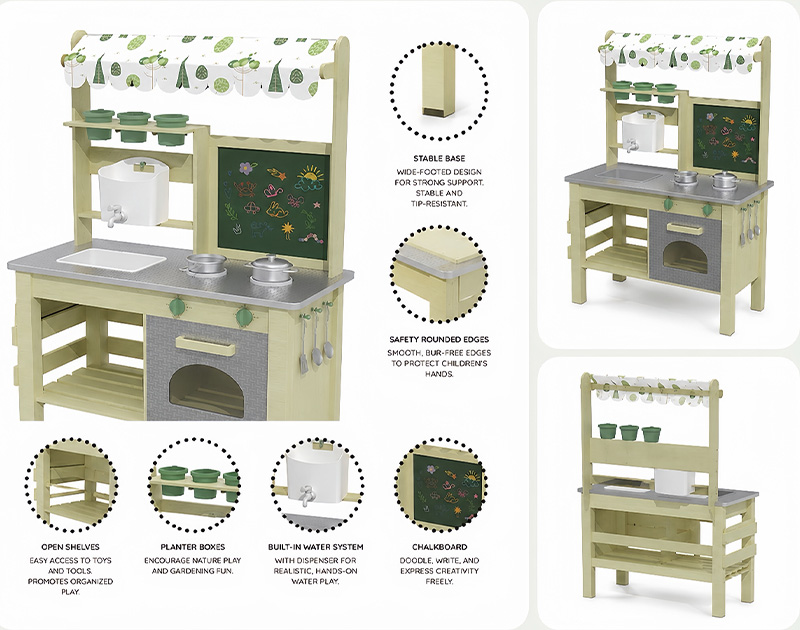
Kitchens and play stations need openings because the category convention demands them. An oven door, a refrigerator door, a sink cabinet and a drawer of utensils are not optional extras; a fixed kitchen with painted-on appliances reads as a lesser product at retail. The same applies to doctor stations and shop counters, where a storage compartment under the counter is part of the role play. This is also the category where openings multiply fastest — a single kitchen can carry four or more moving parts, each adding assembly content — so the mechanism choices in the next section matter most here. Our play kitchen with opening doors and a blackboard side is a worked example — oven door, cupboard doors and a flip-out surface, each with its own hinge and clearance call.
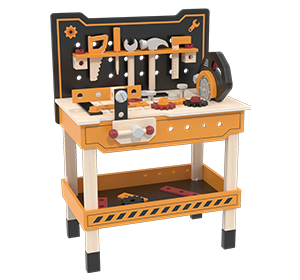
Tool boxes, carry cases and storage-based sets
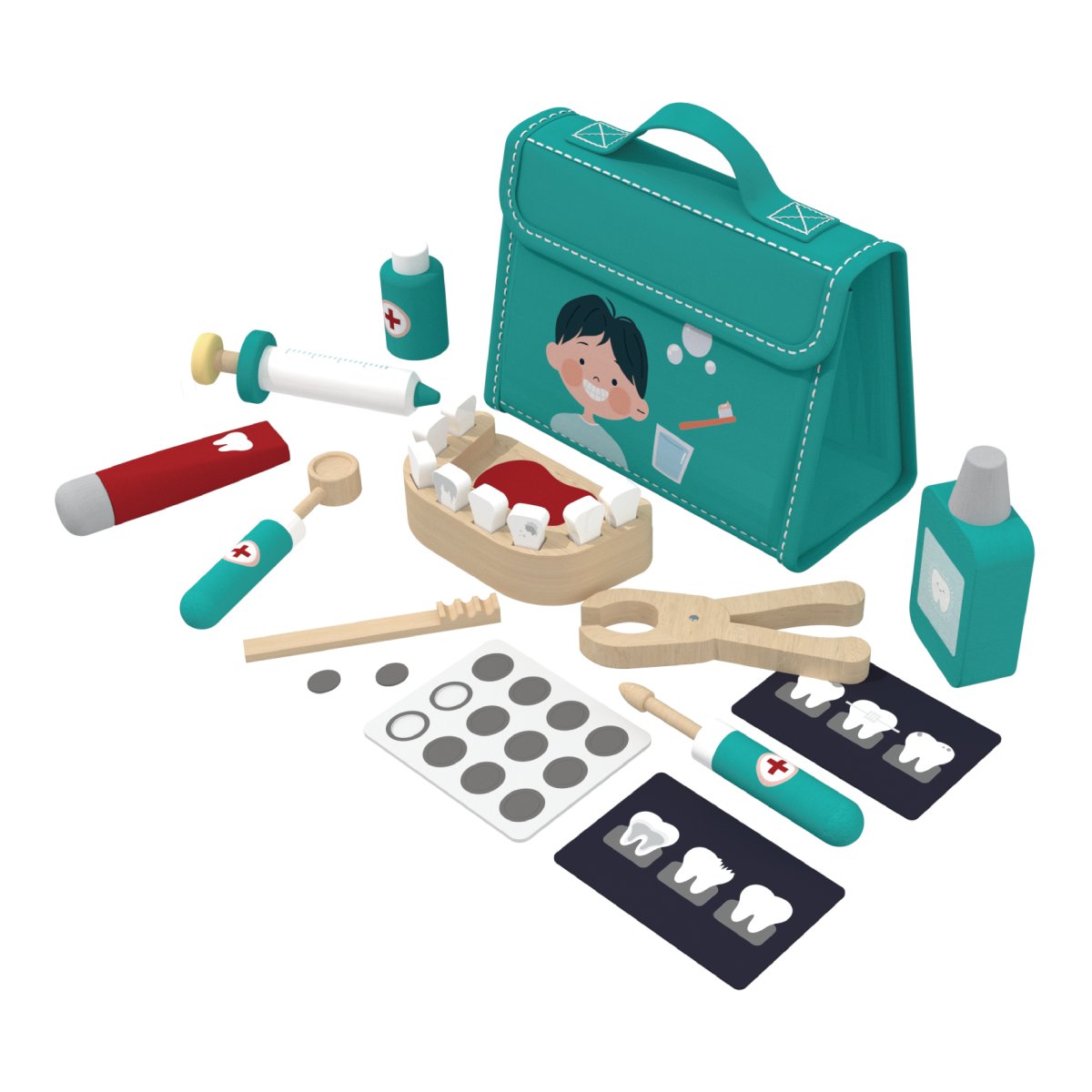
Carry-case sets are the most efficient open-and-close format in wooden pretend play, because the structure does three jobs at once: the case is the packaging, the closed box is the carrying handle version of the product, and the open lid doubles as the play mat. For brand owners, this format is also where private label programs tend to start, since the same case structure can carry different printed themes with minimal tooling change. The trade-off is that the case must close squarely and hold shut — a case that gapes at the spine fails both the retail shelf test and the freight test.
Activity toys and busy boards
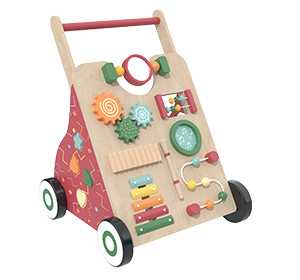
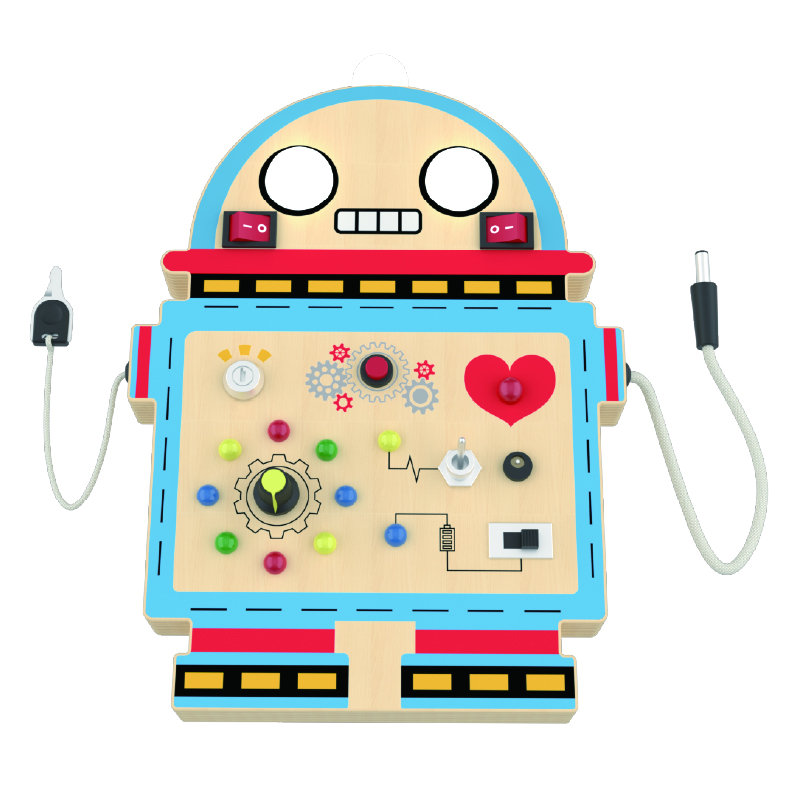
Busy boards are the category where openings are not a feature but the toy itself. Latches to flip, doors to open, buckles to thread and panels to slide are the entire play content, which changes the specification conversation: the question is not whether to add a mechanism but how many, of which type, and against which age grade. Fine-motor demands concentrate in exactly the parts a buyer cannot see on a render — spring tension, catch depth, edge radii — so sample review matters more here than in any other category.
A summary decision table
Swipe sideways to see the full table
| Category | Typical opening | Play value | Added complexity | Strong fit when |
|---|---|---|---|---|
| Dollhouse / play house | Hinged two-half body; door panels | Reveal + interior access | Hinge alignment; closed-case squareness | Freight or shelf volume is a constraint |
| Barn / farm set | Double doors; movable fences | Loading loop | Door gap control; fence parts count | Range already has figures to load |
| Garage / vehicle set | Lift gate; ramp; parking bays | Vehicle loop | Moving gate; ramp load | Vehicles exist and need tooling reuse |
| Kitchen / play station | Oven and fridge doors; drawers | Category convention | Highest parts count per product | The range competes on realism |
| Carry case / storage set | Lid with closure; rope or clasp | Case = packaging = play mat | Squareness; closure durability | A themed series is planned on one platform |
| Busy board / activity panel | Latches, flip panels, small doors | Openings are the toy | Fine-motor tuning per element | Age grade is 18m+ and skill-building is the brief |
Choosing the Right Opening Mechanism
Hinged doors and panels
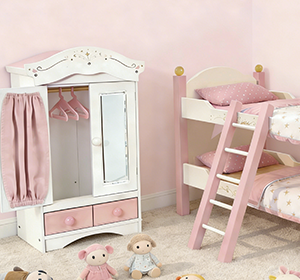
Hinges are the default choice when an edge should swing: house doors, barn doors, wardrobe fronts, oven doors. They are mature, inexpensive per unit and understood by every assembly line. Their weakness is structural, not mechanical: the hinge line is where the panel loads concentrate, and screws driven into plywood edge grain hold less than screws into face grain. A hinge is also the point where paint film is stressed, so colour and adhesion checks concentrate there. For anything that swings repeatedly, the hinge specification deserves more attention than the panel it carries. Which board species survives that repeated stress best — and why material choice differs by product type — is set out in our guide to how to choose the best wood for wooden toys.
Flip-open panels and lift-up lids
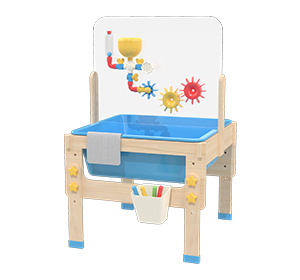
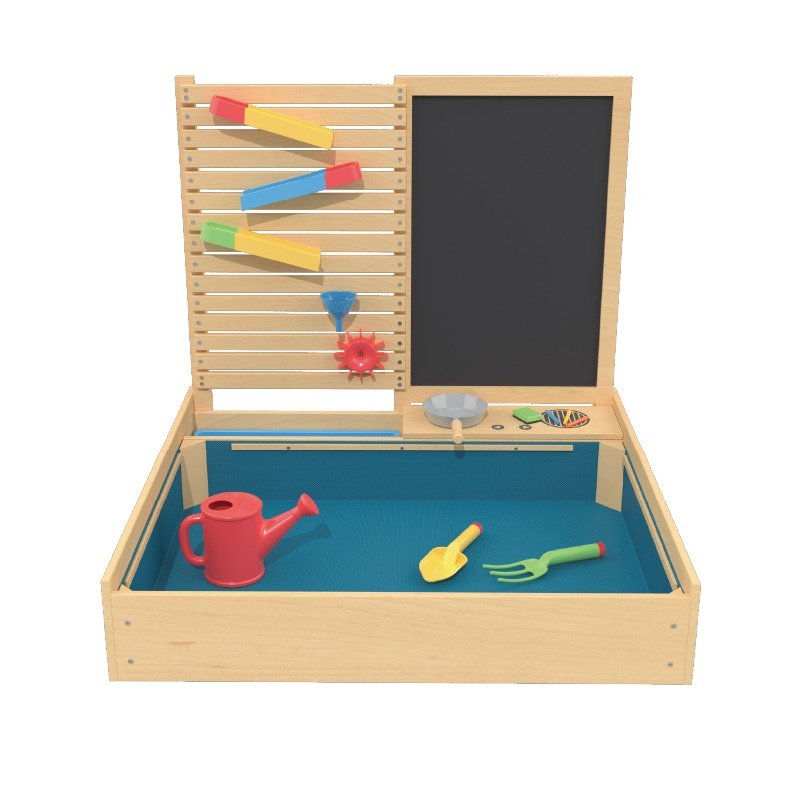
Flip panels and lift lids suit horizontal access: the lid of a storage case, the chalkboard lid of a sand-and-water table, the small flaps of an activity board. The mechanism decisions are support and stop — whether the lid stays open on its own, opens flat, or detaches — and each answer changes the parts list. A lid that must hold open needs a stay or a designed rest position; a lid that detaches becomes a loose part and follows the small-parts rules of the declared age grade. Pinch protection is the other hard requirement: edges that close onto each other must not produce accessible gaps that a child's finger can enter.
Sliding panels and opening compartments
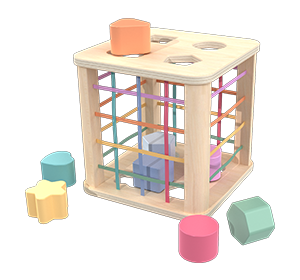
Sliding panels and drawers reward products where space is tight or the motion itself is part of the realism — a garage gate that rolls, a drawer that pulls from a shop counter, a sorting box with a slot-and-tray system. They cost more than hinges to get right: slides need parallel grooves, clearance that survives humidity-driven board movement, and stops that prevent the panel from lifting out. Drawers in particular are the most parts-intensive opening in wooden toys — drawer, runner, stop, pull — and their common failure is not breakage but feel: a drawer that needs force on day one will be abandoned by month three.
Folding and removable structures
Folding structures suit products whose open footprint is a problem — climbing frames that collapse for storage, panel houses that close into a case. Folding concentrates load in its lock, so the locking mechanism, not the panel, is the durability question; a folding joint that slackens after repeated cycles turns a compact product into a wobbly one. Removable panels — detachable roofs, pull-out fences, lift-off lids — are the simplest mechanism on the machine and the most complex in the warehouse: every removable part must be counted, bagged, replaced when lost, and dimensioned against the age grade.
Mechanism comparison table
Swipe sideways to see the full table
| Mechanism | Best for | Main difficulty | Relative cost | Play return |
|---|---|---|---|---|
| Hinged doors/panels | House, barn, wardrobe, oven doors | Hinge-line load; edge-grain screws | Low–medium | High — core loop |
| Flip panels / lift lids | Cases, tables, busy boards | Support, stop, pinch control | Low–medium | High where reveal matters |
| Sliding panels | Garage gates, tight spaces | Track precision; humidity clearance | Medium | Medium–high, realism |
| Compartments / drawers | Kitchens, counters, sorters | Parts count; slide feel | Medium–high | High, role-play realism |
| Folding structures | Climbing frames, panel houses | Lock durability over cycles | Medium–high | Storage economics |
| Removable panels | Fences, roofs, accessories | Counting, bagging, spares | Low per part | Layout freedom |
Moving Parts vs. Fixed Structures: What Should Buyers Choose?
A four-question test
Four questions settle most open-or-fixed decisions before any drawing is made. What does the opening do in play — is there a loop, or just an image? Does the target age grade allow the mechanism's parts and clearances? Will the added parts, assembly and inspection content survive the target retail price? And does the closed state earn its keep — as compact freight, as storage, as a carrying format? If two or more answers are weak, the opening is a cost without a function, and a fixed structure will outperform it on margin.
When a fixed structure is the better decision
Fixed structures win in three situations. The first is low age grades, where small parts and finger-clearance rules remove most mechanism options anyway. The second is price-sensitive SKUs where every screw station is measured against a price point that cannot move. The third is products whose category convention is fixed volume — puzzles, stacking sets, bead mazes — where an added door would read as novelty rather than function. A fixed toy with excellent finish outsells a mechanism toy with a sloppy hinge every time; complexity only pays when it is executed well.
Age-grade and safety limits that decide for you
Some decisions are not commercial. Small-parts requirements follow the declared age grade, so a mechanism's removable figures and lids must be dimensioned for the market the toy is sold into, not the other way round. Standards such as EN 71 and ASTM F963 restrict accessible gaps and pinch points on moving parts, which constrains hinge choice and edge design before cost is even discussed. Compliance documentation is issued per product and per order, and the specific test scope for an opening-feature toy should be confirmed with the factory before the design is frozen — retrofitting a mechanism around a safety finding is one of the most expensive ways to learn this.
How Opening Mechanisms Affect Materials and Manufacturing
Board selection for moving panels
Moving panels want plywood, and it is not a compromise. Solid wood moves with humidity, and the wider the panel the more it moves; on a door or lid that must stay square enough to close, that movement shows up as a warp, a sticking edge or a gap at the hinge line. Multi-ply plywood is dimensionally stable in the plane that matters. MDF machines cleanly and takes paint well but is heavier — in a product meant to be carried, weight is a design property — and it needs sealed or banded edges. Small figures and loose parts stay solid wood for feel and durability.
Hinges, hardware and the parts that wear
The hardware list is where opening designs quietly grow. Hinges, catches, magnets, clasps, rope handles and drawer stops each add a purchasing line, a drilling position and an assembly station. Two details decide most of the durability: how fasteners hold in the panel they enter — edge-grain screws in plywood are the classic weak point — and how the moving joint tolerates repeated cycles without slackening. Hardware sourced from stock keeps lead times predictable; a special hinge sourced for one project adds procurement time to the critical path.
What CNC work has to happen before finishing
Opening mechanisms are decided in the toolpaths, not at assembly. Hinge recesses, sliding grooves, drawer runners, lid stops and safety radii must be located in the cut file, because correcting a hinge position after finishing means refinishing a painted panel. Machining on multi-head routing centres holds a tolerance of plus or minus 0.1 to 0.2 mm on the cut part — a figure on the cut component, not a guarantee on the assembled product, which also depends on board stability, hardware and packing. This is the stage where a wooden toy OEM manufacturer earns its keep, and it is why the panel breakdown in the next section cannot be rushed.
Assembly and finish on parts that move
Assembly content rises with every moving part, and so does the opportunity for inconsistency. Panels that are painted separately must match across the hinge line; paint adhesion is checked where the film is stressed — at folds, hinges and frequently touched edges — and water-based finishes are standard on our lines. Two assembly checks catch most early failures: parts that fit without force, and moving parts that still move the same way after a full open-close cycle as they did on the bench.
Balancing Play Value, Durability and Cost
Where the cost actually adds up
Opening features add cost in four buckets, and buyers should ask for all four in a quotation. Components: hardware and extra panel parts. Process: drilling positions, assembly stations and finishing steps. Tooling and fixtures: jigs for hinge alignment, fixtures for drawer slots. Quality control: cycle checks, gap checks and part counts that a static toy simply does not need. None of these buckets is individually large, but together they decide whether an opening design hits its target price — and the earlier the mechanism is fixed in the drawing, the cheaper every bucket stays.
Durability checkpoints for moving joints
The first sample of an opening toy is judged on a specific set of checks, not on appearance:
Swipe sideways to see the full table
| Check | What to look for | Why it matters |
|---|---|---|
| Open-close cycle | Repeated cycles, no slackening, no screw taking load | The joint is the weakest structural line |
| Gap and edges | Nothing catches a fingertip; gaps even; radii consistent | A safety question, and the first thing to drift with tooling wear |
| Fixings | Screws and inserts hold without cracking the panel | Edge-grain fixing is the classic failure in moving panels |
| Stability | Pushed from the side, tipped when open | A product that tips during play is a design fault |
| Loose parts | Figures and lids dimensioned to the declared age grade | Small-parts decisions follow the age grade |
| Finish | Adhesion at hinge and fold edges; colour match across panels | The closing line is where the film is stressed |
| Assembly | Parts fit without force and stay fitted after a cycle | A tight fit on day one is loose by month six |
| Closed state | Closes square, holds shut, no gap along the closing line | The state that ships, and the one no drawing shows |
| Carton fit | Product and accessories fit with intended void fill | The carton is what freight is quoted on |
Packaging and freight implications
The closed state is the packaging state, and that is where opening designs pay for themselves. A house that closes into a case, or a set whose lid is the box, quotes freight on its compact footprint instead of its play footprint. Buyers should still check two things: that the closed product survives the distribution environment with its intended void fill, and that dimensional-weight rules — carriers assess against volume as well as actual weight, taking the higher value — are applied to the carton, not the product. For flat or nesting designs the saving is systematic; for rigid closed cases it is still real, just smaller.
From Product Concept to Production Sample
From sketch or DXF/STL to cut file
Everything before the cut file is translation; everything after it is arithmetic on board sheets. A dimensioned DXF or STL is the fastest start, because geometry arrives defined; a hand sketch works too — sketches are modelled into toolpaths in the workshop, and many projects begin that way; a reference product or marked-up photograph is usable provided the changes are stated rather than implied. What cannot be used is a sketch with no dimensions and no stated intent — that is a different brief. For opening designs specifically, the concept stage must fix the mechanism, because the panel breakdown translates the opening into flat parts with their hinges, grooves and stops, and a footprint that changes after the breakdown restarts the geometry. How custom programs are structured — who owns the design, who proposes the mechanism — is set out on the OEM and ODM customisation page.
What the first sample has to prove
A first article is judged on process, not appearance: it should come off the same tooling, jigs and finishing sequence as production, because a hand-finished sample proves nothing about month six. The durability checkpoints above are the review agenda, and two further questions belong in the sample meeting: has the carton been through a recognised distribution test series or only an internal drop check, and does the sample match the declared age grade for every loose part. The factory behind this process and its certification scope are described on the about us page.
Per-style minimums and timing
Minimums and timing for opening-feature toys follow the same logic as any custom wooden toy: minimums are assessed per style and driven mainly by whether new tooling, jigs or special hardware are required, so a design built on stock hinges and existing case hardware starts closer to zero than one that sources a special catch. As factory-level planning figures, not industry statistics: samples of existing styles typically run seven to ten working days, custom samples from buyer drawings fifteen to twenty working days, and bulk production thirty to forty-five days after sample approval — extending to forty-five to sixty in the second and third quarter peak. Opening mechanisms rarely change these ranges when the hardware is specified early; they change them reliably when the mechanism is still moving during sampling.
What Buyers Should Confirm Before Mass Production
A pre-production checklist for opening features
Before approving a sample for production, buyers of opening-feature toys should confirm a short, specific list. The open-close cycle count used in review, and whether it matches any internal or customer standard. Gap and pinch clearances on every closing line, checked against the applicable standard for the destination market. The closure method of lids and cases — what holds them shut in the carton and on the shelf. The parts-count plan: what is bagged, what is counted, and what happens when a customer loses a part. And the carton specification, including void fill, because the carton is what freight is quoted on and what the retailer judges first. The commercial terms around these confirmations — quotation structure, payment terms, document flow — are set out in the wooden toy purchasing guide.
Compliance documents to match the goods
Documentation should be confirmed per product and per market, in writing. For the EU, EN 71-3 heavy-migration testing applies alongside the mechanical and safety requirements of the EN 71 series for moving parts; for the US, ASTM F963 governs the mechanical questions and the CPSIA tracking-label duty sits with the importer of record. FSC chain-of-custody covers the wood input and should be matched against the certificate scope — wooden children's toys, building blocks, educational aids, wooden crafts, wooden packaging boxes, and matching paper gift packaging — with the buyer's SKU checked against that scope before the claim goes on the box. None of these documents is generic: the report you receive should be the report for your item.
FAQ
What are open-and-close wooden toys?
Open and close wooden toys are toys whose design includes a purpose-built opening — hinged doors, lift-up lids, sliding panels, drawers, flip panels or removable parts — where the opening serves play, storage or packaging rather than decoration. A single play kitchen can carry 10 or more such openings — doors, oven, drawers, flip panels — which is why the mechanism deserves its own engineering pass.
Which wooden toy categories benefit most from opening features?
Categories with a loading, hiding or reveal loop: barns, garages, kitchens, doctor and shop stations, carry-case sets and busy boards — a busy board can carry six or more latches and doors on a single panel. Dollhouses benefit when the opening turns storage into part of the product.
Is an open-and-close design harder to develop than a fixed wooden toy?
Yes, modestly: it adds hardware, panel breakdown work, assembly content and inspection checks. The development timeline stays similar when the mechanism and its hardware are fixed before the panel breakdown; from approved drawings a custom sample then takes the usual 15–20 working days.
Does adding doors and lids always increase cost?
It always adds parts, assembly and QC content; whether it increases net cost depends on what the opening replaces. It does add inspection content: door gaps and clearances have to sit within tenths of a millimetre of the drawing, and machining is held to ±0.1–0.2 mm on the cut part. A case that is also the packaging can reduce total cost, while a decorative door always increases it.
Are moving parts a safety risk for younger children?
They can be, which is why small-parts dimensions and finger-clearance rules are set against the declared age grade. Mechanism choice should follow the age grade, and the mechanical test scope — EN 71-1 in the EU, ASTM F963-23 in the US — should be confirmed per market before the design freezes.
How does an open-and-close design differ from a fold-away design?
Fold-away is one direction inside the open-and-close family: a structure that collapses toward flat for storage. Most open-and-close toys — doors, lids, drawers, flip panels — never fold at all; if your concept does need a fold, prototype the lock and hinge first, because they drive the 15–20 working days a custom-drawing sample takes.
Develop Your Custom Wooden Toy with KIDMERRY
An opening is a decision, not a decoration: the right mechanism, fixed early in the drawing, adds play value and freight economics for a controlled increase in parts and process. If you are evaluating an open-and-close design — a house that closes for freight, a case that is its own packaging, a board whose latches are the toy — send the sketch, reference product or DXF/STL with the target age grade and market, and the mechanism options can be compared against your price point before any board is cut. Start the discussion through our contact page, and the first review will focus on the four questions that decide whether your opening earns its place.
---
Develop an Open-and-Close Wooden Toy
About Kidmerry: Yunhe Kidmerry Toys Co., Ltd is a wooden toy manufacturer based in Yunhe, Zhejiang, China. The factory runs in-house CNC machining, finishing and assembly, and holds ISO 9001:2015 certification, with FSC-certified board available on request. Sampling takes 7–10 working days for existing styles and 15–20 working days for custom drawings; bulk production runs 30–45 days after sample approval. Ask Kidmerry for a quotation, a sample set and third-party test reports before your next development cycle.
Request a Quotation