


Which Wood Should You Choose for Wooden Toys? A Guide by Product Type
The wood specified for a wooden toy quietly decides everything downstream: how the product feels in a child's hand, how it holds up after months of daily play, what it costs to produce and ship, and whether it clears chemical testing. For importers and brand owners, this single decision separates a premium line from a commodity one. This guide compares pine, beech and birch on the properties that actually affect a purchase order, then matches materials to product types — from play kitchens to building blocks — and sets out how to specify wood so that what you approve is what you receive.
Choose the wood by the part's job, not by species ranking: beech for high-contact parts that must resist denting, birch — solid or plywood — for panels and trays, and 4–6 mm birch plywood for flat puzzle boards, where symmetric plywood stays flat while thin solid stock cups as humidity changes. On modern CNC equipment holding ±0.1–0.2 mm, a dense, uniform species is what lets that accuracy hold across a run, and anything expected to be chewed belongs in a tested coating system regardless of species. Commercially the species choice is free: minimums do not vary by wood — 500 pieces per style for large structural and all-wood products, 1,000 for small items or high-plastic designs — and a new design samples in 15–20 working days with 30–45 days of bulk after approval.
What This Guide Covers
- Why Wood Selection Matters in Wooden Toy Manufacturing
- Pine vs Beech vs Birch: Understanding the Differences
- How Wood Properties Affect Manufacturing Cost and Quality
- Solid Wood, Plywood or MDF? Choosing by Product Structure
- Best Wood for Different Types of Wooden Toys
- How to Choose Wood Based on Product Structure and Target Cost
- Wood Selection, Coatings and Toy Safety Compliance
- How to Specify Wood in a Wooden Toy Purchase Order
- Frequently Asked Questions
- Get Professional Wood Selection Advice from KIDMERRY
Why Wood Selection Matters in Wooden Toy Manufacturing
In a factory context, species selection is rarely treated as a materials question alone. It is a commercial decision with four consequences, and all four land on the same purchase order.
Durability sets the price ceiling. Harder woods resist denting and edge rounding — the two forms of wear a customer perceives as "getting old" after a season of use. A product that arrives looking tired cannot hold a premium price, no matter how good it looked on day one.
Grain sets the finish cost. Open or uneven grain absorbs more coating and produces a less uniform surface. That is a materials cost, a labor cost and — where a large flat panel has to look even across a batch — a rejection-rate cost.
Density sets the freight cost. Wood is bought and shipped by volume and weight. Over a full container of a dense species, the freight difference is real money, and it is often larger than the difference in material price between two species.
Availability sets the documentation path. Where a chain-of-custody claim is required, availability within the certified scope has to be confirmed for the specific SKU. That is a scheduling item, not a technical one, and it belongs early in the program.
These four consequences are also why this guide treats species, board form and coating system as one connected decision rather than three separate line items — and why the sections that follow translate wood properties into cost, quality and compliance outcomes instead of botanical descriptions.
Pine vs Beech vs Birch: Understanding the Differences
Pine
Pine is a softwood: light in weight and color, with visible grain and frequent knots. It is the least expensive of the three and the most variable. Its advantages are genuine — low material cost, low weight, easy machining and a pale surface that takes stain readily. Its disadvantages are equally real: it dents and scratches more easily, and grain variation can make a painted surface look uneven across a production batch. Knots deserve particular attention on light- or clear-coated work: the resin around them can bleed through a coating system over time, which is why pine parts destined for pale finishes are typically sealed, or graded to keep knots off visible surfaces.
Pine suits budget educational items, frames and large lightweight structures where weight matters more than hardness. It is a poor choice for small parts that will be dropped repeatedly or for surfaces that must look perfectly uniform under a light-colored finish.
Beech
Beech is a dense hardwood with a fine, tight, uniform grain and a pale, slightly pink tone. It is the reference material for items where edge quality and finish uniformity matter: puzzles, blocks and activity components. It machines cleanly, holds a crisp engraved edge, takes water-based color evenly and resists the kind of edge damage that makes a toy look old.
The trade-offs are cost and weight, both of which show up in a landed-cost comparison rather than only in the material line. Beech also places a premium on correct drying and conditioning: like most dense hardwoods, poorly conditioned stock can move after machining. That is a process-control issue rather than a species defect, but it is worth confirming how a supplier conditions material before it reaches the cutting line.
Birch
Birch sits between the two. It is a hardwood with fine, straight, subtle grain and a pale tone slightly warmer than beech. It machines well, finishes evenly, and is lighter than beech while being considerably harder than pine. Birch plywood is also the standard substrate for larger panel structures, which makes birch the natural choice where a program spans both small parts and large panels.
That is why birch is often the best default when a range includes several product types: solid birch and birch plywood share a visual language and can be finished with the same system. Its limitations are availability and cost in some markets, and a subtler grain that gives less visual character where a visible grain is part of the design intent.
Comparison Summary
| Property | Pine | Beech | Birch |
|---|---|---|---|
| Hardness | Soft; dents readily | Hard; high dent resistance | Hard; close to beech |
| Grain | Visible; knots common | Fine, tight, uniform | Fine, straight, subtle |
| Relative cost | Low | Medium to high | Medium |
| Density and weight | Light | Heavy | Medium |
| Finishing behavior | Absorbs coating unevenly | Excellent, smooth result | Excellent, even coats |
| Engraving quality | Fair; grain can break the edge | Excellent, crisp | Excellent, clean |
How to read the numbers: hardness figures published for timber species — commonly expressed as Janka hardness, with common pine species falling roughly between 400 and 700 lbf and beech and birch clustering around 1,200 to 1,300 lbf — are general reference values that vary with species, origin, growing conditions and the source consulted. They are useful for ranking species, not for specifying a product. Confirm the actual species, grade, moisture content and finish system for your own product in your order documentation.
How Wood Properties Affect Manufacturing Cost and Quality
Hardness and Durability
Hardness determines how a part fails in service. Soft species yield by denting and edge rounding; dense species resist both. The distinction matters most at contact points — edges a child grips, corners that hit the floor, surfaces that take repeated impact. A Janka figure will tell you that beech outlasts pine at a stressed edge. It will not tell you whether the stock was dried correctly, or whether the grade you paid for is free of the defects that actually cause returns. Put the requirement on grade and moisture content, where a supplier can be held to it.
Grain and Finishing Behavior
Two products of identical geometry in two species can require different coating systems and different numbers of coats to reach the same appearance. A dense, fine-grained species reaches a uniform surface with less material and fewer passes; an open-grained softwood absorbs more and may need a sealer before a topcoat. That difference is a unit cost, a cycle time and — where color is critical — a color-matching risk.
It is also a compliance item. The coating system is what chemical testing is performed against, so a change of species that forces a change of coating means re-testing. Lock the species and the coating together, at the same time, before the test sample is submitted.
Machining and Material Yield
Material price per cubic meter is the least useful number in a species comparison. Three other factors usually dominate:
- Yield. Knots, splits and grain defects reduce the usable yield per board. A cheaper species with a higher defect rate can cost more per finished part than a more expensive one with clean, predictable stock.
- Machining behavior. Consistent density produces consistent chip formation, cleaner edges and less sanding. Variable stock produces tear-out and hard spots, which show up as labor time and as rejection.
- Tool wear. Denser species wear cutting tools faster. This is a real cost but a small one next to yield and labor, and it should not drive the decision on its own.
On modern CNC equipment — machining accuracy in the range of ±0.1 to 0.2 mm — a dense, uniform species is what allows that consistency to hold across a whole batch rather than only on the first parts. The figure describes machining capability, not a finished-part tolerance guarantee.
Weight and Transportation Cost
Density also decides freight. Wood is shipped by volume and weight, and on a full container the difference between a light and a heavy species can exceed the difference in material price. The same logic applies to engineered boards, and it matters most when comparing panel materials: at the same thickness, MDF is noticeably denser and heavier than birch plywood, so a large-panel product built in MDF pays a freight penalty that a plywood build does not. For panel-heavy items such as play kitchens or dollhouses, this weight difference belongs in the landed-cost comparison alongside the material price — not after the goods are booked.
Solid Wood, Plywood or MDF? Choosing by Product Structure
Wood selection fails most often at the point where a buyer specifies a species but not a board. Solid wood, plywood and MDF behave differently enough that they should be treated as three separate material families, not three price points of the same thing.
Solid wood is one species through the full section, with the grain running in a single direction. It takes threads, glue and edge profiles well, and it is the right answer wherever a part is thin, slender or repeatedly struck. Its weakness is scale: a wide panel moves differently along and across the grain and will cup, which is why large solid panels need battens, frames or a design that accepts movement.
Plywood is built from an odd number of veneers laminated with alternating grain direction. That cross-lamination is what holds a panel flat, and it is the reason thin plywood works where thin solid stock will not. Screws hold well in the face and poorly in the edge; cut edges expose plies and need banding, sealing or a design that makes the laminate edge intentional.
MDF is uniform fibre with no grain direction at all. It gives the best printed and painted surface of the three and machines to a consistent edge, but it holds screws weakly, particularly in the edge, swells if water reaches an unsealed face, and is the heaviest option per panel. Its adhesive also makes board emission class a purchasing item rather than a technical footnote.
Read as a table, the choice comes down to what the part has to do:
| Part and duty | Specify | Why |
|---|---|---|
| Small part under repeated impact — pegs, hammer heads, wheels | Solid beech | Impact fails softwood around holes; a dense uniform grain keeps the hole round |
| Small part with a precision fit — axle holes, puzzle slots, threads | Solid beech or birch | Tolerances hold across a batch, and threads survive repeated assembly |
| Large panel carrying load — carcass, dollhouse floors | Birch plywood | Cross-lamination holds the plane where a solid board cups |
| Large panel carrying print — door faces, busy board backs | MDF, edges sealed, inserts at fastener points | A grain-free surface prints evenly, provided fixings are designed for it |
| Thin flat part — 4 to 6 mm puzzle board | Birch plywood | Flatness at thin sections, with a knot-free face |
| Slender structural member — axle, rail, push handle | Solid stock only | Plywood and MDF have poor edge and end strength |
Best Wood for Different Types of Wooden Toys
The recommendations below are made part by part rather than product by product, because the best wood for wooden toys is usually a combination of materials rather than a single species. In almost every category, the panel or frame that carries the load and the small part that takes the wear are different materials, and whether a product holds its price and its return rate depends on how well that split is made.
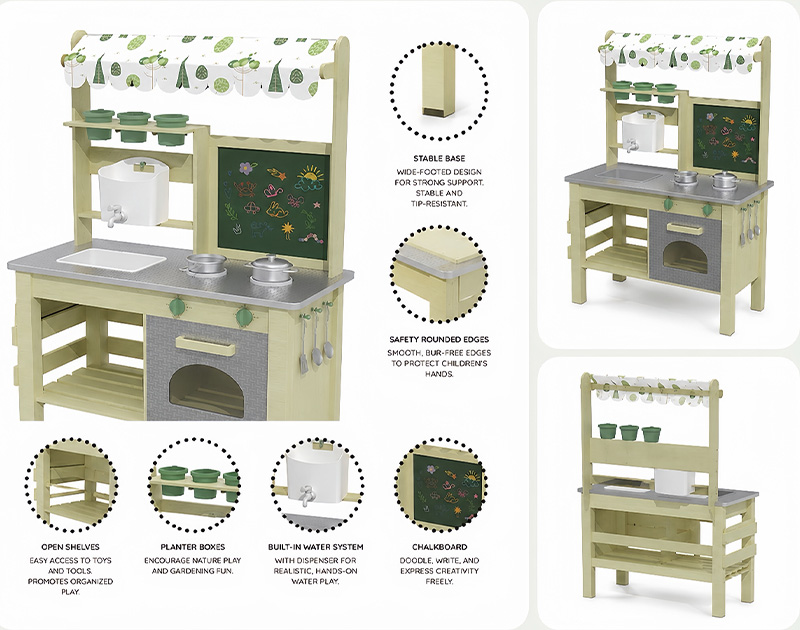
Wooden Play Kitchens and Pretend Play Furniture
Recommended wood: birch plywood for carcass panels, worktops and shelves, with MDF acceptable for printed door faces, and solid beech reserved for handles, knobs and tap bodies. Alternative wood: MDF across the full panel set for a lower-cost printed line, or solid birch and rubberwood for simple ranges without printed faces.
A play kitchen is the most heavily loaded item in pretend play: children lean on it, stand on open doors and cycle the hinges hundreds of times. Large solid boards move with humidity and take hinges poorly, while plywood holds its plane; knot-free face grades also yield far better on wide panels than solid stock, which is the practical reason this category moved to engineered boards.
Hinges and cam fittings are the weak point rather than the panels. Hinge seats in MDF need pre-drilling and, on a door that is opened constantly, an insert. Cut edges on plywood and MDF expose the core and have to be banded or sealed, including the sink cut-out and hob holes.
MDF costs less per panel and saves surface preparation, but it is denser than plywood, and on a full container that weight becomes a freight line of its own; for large items a plywood build often wins on landed cost even at a higher panel price. If the range is sold on a natural, unpainted look, a solid birch or rubberwood carcass is viable on smaller items; for a lightweight promotional line, a thinner plywood with a printed wrap is usually sufficient.
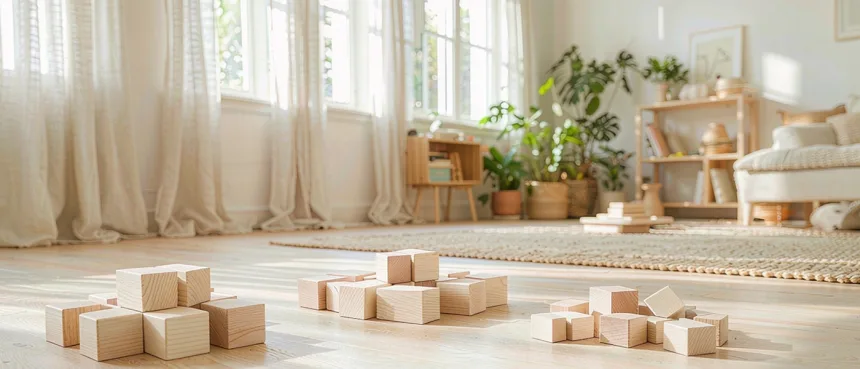
Wooden Building Blocks and Stacking Toys
Recommended wood: solid beech, which remains the industry default. Alternative wood: solid birch for mid-cost ranges, hard maple for premium lines, rubberwood where cost drives the program.
Blocks are used hard from the first day: thrown, knocked together, walked on and chewed. The failure mode is denting and edge rounding rather than breakage, and stacking stability is a tolerance question. A uniform-density species machines and sands to consistent dimensions, while knots create hard and soft spots that surface later as a tower that will not sit straight.
Chamfering is where quality shows. A clean chamfer on a tight, uniform grain needs no rework; on an interlocked softwood grain the same cut tears and goes back to sanding, which is where the material saving disappears. Coating also carries more weight here than substrate choice, because the youngest age band puts mouthing contact directly on the finish.
Block stock is small-part stock, so yield matters less than sanding labor, and a cheaper species frequently returns its material saving as finishing time. Weight becomes a freight factor only on large sets. Decorative or oversized stacking pieces that are not meant to be knocked about can move to birch or pine; anything expected to be chewed belongs in a tested coating system regardless of species.
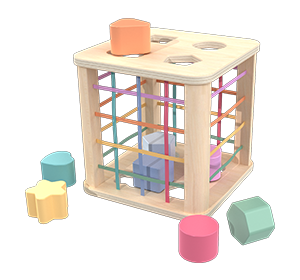
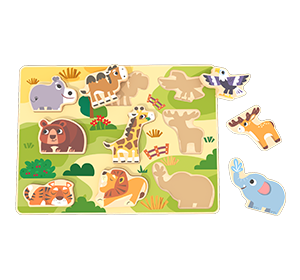
Wooden Puzzles and Shape Sorters
Recommended wood: 4–6 mm birch plywood for flat puzzle boards and pieces, with solid beech or birch for chunky puzzles, knobs and shape-sorter pieces. Alternative wood: basswood plywood where a very fine, pale face is wanted, MDF for sorter bases, hard maple at the top of the range.
The most common complaint in flat puzzles is warping: pieces no longer seat. Thin solid stock cups as humidity changes across the day, while symmetric plywood stays flat at 4–6 mm. The printed face must also be knot-free, which plywood can hold consistently from batch to batch and solid stock rarely can at a sensible yield.
Piece-to-slot tolerance is effectively the product. A homogeneous core keeps saw and laser paths stable across a run, where variable stock drifts. Cut edges show plies, and are either sealed or accepted as a visible laminate edge, a decision worth making at design stage rather than after the first sample.
This category is yield economics at its most extreme: a knot-free printed face is what makes solid stock uncompetitive for flat puzzles. Chunky pieces go the other way, because at grip thickness plywood becomes expensive and a solid blank is cheaper. When the puzzle is really a grip-and-drop toy, the parts are dropped and mouthed and should be solid; when a natural edge is part of the design, the laminate edge becomes a feature to specify rather than a defect to hide.
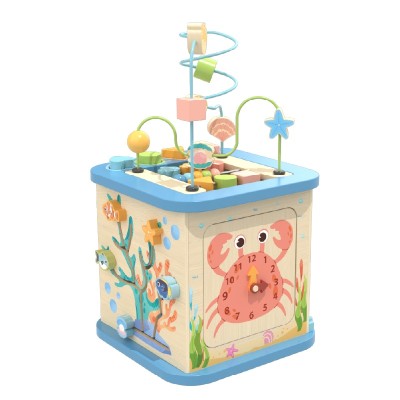
Wooden Busy Boards and Activity Cubes
Recommended wood: birch plywood or MDF for the printed back panel, with solid beech for every moving part — dials, latches, sliding doors and gears. Alternative wood: basswood plywood for a lighter panel, solid birch for lower-cost moving parts, MDF for the printed faces of an activity cube.
This category holds two conflicting requirements in one product. The panel wants to be flat, light and printable; the operating parts want hardness and axle holes that stay round after thousands of operations. No single material is best at both, which is why mixed construction is the norm rather than a cost compromise.
Screw holding decides whether the board survives. MDF grips threaded fasteners poorly, particularly in its edge and face, so any part that is repeatedly pulled or twisted should sit on an insert or on a plywood patch. Thin plywood used for a moving part can delaminate at the axle hole. On cubes, the corner posts carry the load and belong in solid stock; the printed faces do not.
A printed MDF panel is the cheapest route to a graphics-rich face: one pass, no labeling step. On a compact activity cube the weight penalty is minor; on a wall-mounted board, panel size and thickness drive cost and shipping weight together, and plywood is usually the better balance. For a classroom board that is mounted and removed repeatedly, weight and fixing strength matter more than the panel price.
Wooden Hammering Toys
Recommended wood: solid beech for every impact-loaded part — bench top, pegs, ball and hammer head. Alternative wood: solid birch for the frame and handle, hard maple for the hammer head on premium lines.
Hammering is cyclic impact rather than static load, and softwoods tend to fail by splitting radially around the peg hole instead of wearing down. Once that crack opens, the toy is finished. A dense, uniform species keeps the hole round and holds the glued frame tight under vibration, which is why hardness redundancy here is usually cheaper than field returns.
The design lives or dies on peg-to-hole clearance: too tight and the peg will not drive, too loose and it drops out on the first strike. Material solves the splitting, not the fit, and the glue joint between top and frame takes the same vibration as the pegs.
Total material volume is small, so the absolute difference between beech and pine is modest while the difference in return rate is not. A purely decorative tap-and-roll toy with no real peg travel can use a lighter frame and a birch handle; once real pegs are driven, nothing in the impact path should be specified in softwood.
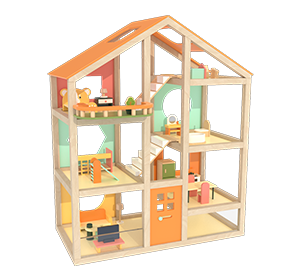
Wooden Dollhouses
Recommended wood: birch plywood or printed MDF for walls, floors and roofs, with solid beech or birch for stairs, railings, fences and miniature furniture. Alternative wood: basswood plywood for lightweight lines, and thick plywood for hinged book-style houses.
Dollhouses carry more large flat parts than any other category, so panel instability is multiplied by part count: one warped floor and the house will not close. Freight follows the same arithmetic, since panel density times panel area is the shipping weight.
What loosens is the joint between floor and wall, not the panel itself, so screw holding and glue area at panel edges decide longevity. Thin rails and stair strings are a breakage and pinch-point risk and should stay solid, with section sized for a child leaning on them. MDF edges must be sealed for the same reason, since a chipped edge within reach is a sharp point.
Printed MDF is the lowest-cost wall, but the weight it adds can erase the saving on a full container, and flat-pack design reduces both freight and exposure to movement in transit. A compact tabletop house can justify solid panels; a collector model sold on print quality can choose panels on graphics rather than durability.
Wooden Pull-Along and Push Toys
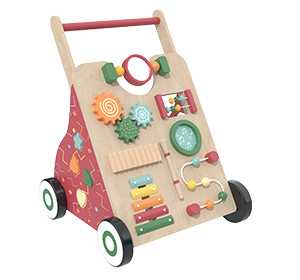
Recommended wood: solid beech for axles and wheels, solid birch or beech for the body, with plywood acceptable for a large flat body panel. Alternative wood: hard maple for axles on premium lines, rubberwood for bodies where cost dominates.
The rotating joint fails first. An axle is a thin bar in bending, a bearing surface and the part that takes every door sill and threshold hit; in a softer species it wears oval inside the wheel and the toy starts to wobble. Wheels add rim impact, and the body mostly carries pull force and, in ride-on styles, a child's weight.
Axle-to-wheel fit and hole roundness are the assembly quality gate, and consistent moisture content in the axle stock keeps that interference fit stable after a sea freight cycle. The cord anchor needs a solid cross-section rather than a panel edge, and cord length is a separate safety requirement that material choice does not address.
Wheels and axles are small parts, so moving them to beech is a small share of unit cost, while the body panel is where species choice actually moves the price. Plywood wheels are a genuine low-cost option but seat the axle less firmly; a lightweight body is defensible for a decorative push toy that rarely leaves a carpeted floor.
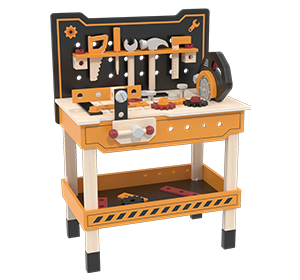
Wooden Tool Benches and Construction Toys
Recommended wood: thick birch plywood or a solid beech glue-up for the worktop, solid beech for tools, pegs, bolts and nuts, and solid beech or birch for legs and frame. Alternative wood: an MDF worktop for a role-play line without real striking, and rubberwood frames on cost-driven programs.
A tool bench stacks three failure modes in one product: impact at the top, repeated operation at the vise and moving parts, and thread wear at the wooden bolts. Threaded parts are a pure hardness question — beech threads survive repeated assembly while softwood threads strip after a few cycles, and the bench then loses the feature that sold it.
The worktop follows the same logic as a kitchen carcass in wanting engineered board, but the striking zone pushes toward a thicker section, a solid glue-up or a plywood core with a hardwood face. Frame joints carry the whole bench, so screw holding in the leg material has to be adequate before anything else is specified.
The mixed build — plywood or beech top with beech tools and threads — is the balance point between life and price, and an all-beech bench is a premium-line decision rather than a default. Where the hammer is not really used to strike, an MDF top with a printed surface is defensible; once real pegs are driven and bolts are turned, the top and the threaded parts are the two places not to downgrade.
Selection Summary by Product Type
| Product type | Large panels and frames | Load-bearing and impact parts | Cost-down option |
|---|---|---|---|
| Play kitchens | Birch plywood; MDF for printed doors | Solid beech handles and knobs | MDF panels, printed wrap |
| Building blocks | — | Solid beech | Solid birch, rubberwood |
| Puzzles and sorters | 4–6 mm birch plywood (flat puzzles) | Solid beech or birch (chunky parts) | Basswood plywood |
| Busy boards and activity cubes | Birch plywood or MDF back panel | Solid beech moving parts | MDF faces, birch moving parts |
| Hammering toys | Solid birch or beech frame | Solid beech top, pegs, hammer | Birch frame and handle |
| Dollhouses | Birch plywood or printed MDF | Solid beech or birch stairs, rails | Basswood plywood, flat-pack |
| Pull-along and push toys | Plywood body panel where flat | Solid beech axles and wheels | Rubberwood body, plywood wheels |
| Tool benches | Thick birch plywood or beech glue-up top | Solid beech tools, bolts, threads | MDF top for role-play only |
How to Choose Wood Based on Product Structure and Target Cost
Everything above describes what each part needs. Target cost then decides how far a program can move within those requirements. At the premium end, hard maple or beech with generous sections and more machining is defensible because the product is sold on feel and longevity. In the middle, a birch-based specification — solid birch for parts, birch plywood for panels, one coating system across the range — is usually the most efficient place to sit. At the budget end, the savings should come from parts that are neither struck nor threaded: decorative panels, printed faces, non-structural trim. Downgrading anything in the impact path, a threaded part, an axle hole or a panel joint is not a cost reduction, it is a deferral of the return.
Standardizing a range on one species and one finish system is a separate lever. It consolidates purchasing, simplifies coating inventory, stabilizes color matching between items and usually reduces the number of test submissions — which is why birch, available as both solid stock and plywood, so often becomes the default for a multi-SKU program.
Wood Selection, Coatings and Toy Safety Compliance
Species choice does not change the legal framework, but it changes where the compliance work sits. For a wooden toy, the item that chemical testing is actually performed against is the coating and the printed surface, not the substrate. The wood determines how much coating a part absorbs, how many passes it takes to reach a uniform film, and therefore what the tested system looks like.

In the EU, mechanical and physical properties, flammability and migration of certain elements are addressed by the EN 71 series, with EN 71-3 covering migration and being the part most directly tied to coating and print chemistry. Toys are currently placed on the market under Directive 2009/48/EC. Regulation (EU) 2025/2509, adopted on 26 November 2025 and in force since 1 January 2026, applies from 1 August 2030 and repeals the Directive; it introduces a digital product passport and tightens chemical limits, including formaldehyde, which is directly relevant to MDF and to the adhesives in plywood. In the US, ASTM F963 is mandatory through 16 CFR Part 1250, CPSIA limits apply to substrate and coating alike, and the Children's Product Certificate is issued by the importer.
The practical consequence is a lock: if a change of species forces a change of coating, the test result no longer covers the product, and re-testing is generally required. Decide both before the sample goes to the lab, because the re-test is triggered by the coating, not by the wood. For panel-based products, ask for the board's declared emission class and its supporting test report rather than a marketing grade, and confirm how cut edges and drilled holes are sealed.
FSC deserves a separate note because it is frequently misread. Chain of custody is a traceability claim about fibre origin with a defined product scope. It is not a safety certification and not a quality mark. Where a claim is printed, confirm that the specific SKU and every claimed component fall inside the certified scope — and confirm it before artwork is approved, not after.
How to Specify Wood in a Wooden Toy Purchase Order
Most disputes about material are specification disputes, not quality disputes: both sides believed something different, and neither wrote it down. Six items belong in a purchase order for a wooden product.
- Species and form. Name the species and whether it is solid wood, plywood or another engineered board. "Wood" is not a specification.
- Grade and acceptable defects. State what is acceptable on visible surfaces: knots, splits, color variation, sapwood. This is the item most often omitted and most often disputed.
- Moisture content and conditioning. Material that is not conditioned to its destination climate can move after machining. State the requirement — an industry reference range of roughly 8 to 12 percent, adjusted for the destination market, is a starting point rather than a universal answer.
- Finish system and color reference. Name the coating type and provide a physical or standard color reference. This is the item that testing is performed against.
- Sanding sequence and edge radius. Specify the finishing standard, not just "smooth". These are the two details a customer feels most directly.
- Documentation scope. State which certificates and reports ship with the goods, and confirm any origin claim against the certificate's product scope before artwork is printed.
Two further clauses are worth adding for panel-based products: which edges and drilled holes are sealed, and which fastener points require inserts. Both are routinely assumed by one side and omitted by the other.
Commercial terms do not vary by species: 500 pieces per style for large structural items and all-wood products, and 1,000 pieces per style for small items and designs with a high proportion of plastic components, applied per style rather than per order. Sampling a new design takes 15 to 20 working days, and mass production runs 30 to 45 days after sample approval, extending to 45 to 60 days in the Q2 to Q3 peak season.
Frequently Asked Questions
Which wood is best for wooden toys overall?
There is no single best wood for wooden toys. Beech and birch suit parts where edge quality, engraving and finish uniformity matter; pine works where cost dominates and grain variation is acceptable; birch plywood or MDF suits large panel structures. The decision belongs at part level, not product level.
Are published hardness values reliable enough to specify?
They rank species reliably enough; they do not describe the board in front of you. Published figures move with species, origin and growing conditions, so put the requirement on grade, moisture content and finish system instead.
Does changing the wood species require re-testing?
If the change also changes the coating system or the print, generally yes. Chemical testing is performed against the coating and color set, so lock species and finish together before submitting the sample.
Is FSC certification a quality or safety mark?
No. FSC chain of custody records where the fibre came from, within a scope the certificate defines. It is neither a safety certification nor a quality mark, so confirm that your SKU and each claimed component sit inside that scope before artwork is printed.
What wood is best for a wooden play kitchen?
Birch plywood for the carcass, worktop and shelves, MDF where a printed door face is wanted, and solid beech for handles, knobs and tap bodies. Large solid panels are rarely the right choice for a kitchen body, because they move and take hinges poorly.
Why is beech used for building blocks?
Because the category is judged on three things a dense, uniform grain delivers: resistance to denting when blocks are thrown and knocked, chamfers that cut clean without tearing, and dimensions consistent enough across a batch that a tower stands straight.
Is birch plywood safe for children's toys?
The substrate is not usually the risk driver; the adhesive's emission class and the coating system are. Specify the board's declared emission class with its test report, confirm the coating is tested against the destination market's requirements, and seal cut edges and drilled holes.
Is rubberwood a good material for wooden toys?
It is a workable mid-hardness option with good dimensional stability and screw holding, available as a by-product of plantation renewal, and it normally requires boron-based preservation treatment after sawing. It is an indoor material and is a poor fit for high-wear rotating parts such as axles.
Get Professional Wood Selection Advice from KIDMERRY
Species choice is one of the few decisions in a wooden toy program that is cheap to get right and expensive to get wrong, because it propagates into cost, compliance, freight and perceived quality at the same time. The most reliable way to settle it is to hold two or three physical samples made in different species with the same finish, and compare them by hand rather than on a spec sheet.
If you are specifying a new range, send us your target price, age range and destination markets along with the product drawings or reference samples, and we will come back with a species, board form and coating recommendation for each part — through our OEM and ODM customization route where tooling, packaging or a retail-ready program is involved.
Species characteristics described here reflect general industry knowledge and are not specifications for any KIDMERRY product. Published hardness values are reference figures and vary by source. Confirm species, grade, moisture content, finish system and documentation scope for your own product in your order confirmation.
Frequently Asked Questions
Which wood should I use for wooden puzzle boards?
Flat puzzle boards and pieces work in 4–6 mm birch plywood: symmetric plywood stays flat while thin solid stock cups as humidity changes across the day, and the printed face must be knot-free, which plywood holds consistently. For chunky puzzles with knobs and handles, move up to solid beech or birch.
Does the wood species change the MOQ or the lead time?
No — commercial terms do not vary by species: 500 pieces per style for large structural items and all-wood products, and 1,000 pieces per style for small items and designs with a high proportion of plastic components, applied per style rather than per order. A new design samples in 15–20 working days, with bulk production 30–45 days after approval, extending to 45–60 days in the Q2–Q3 peak.
What machining accuracy should I expect on wooden parts?
Modern CNC equipment works to roughly ±0.1–0.2 mm on routed parts — a machining capability on the cut component, not a guarantee on the finished product. A dense, uniform species is what lets that consistency hold across a run; on loose-grain stock the same program can drift.
Which wood is safe for parts that will be mouthed?
Beech for high-contact parts that must resist denting is the usual answer, and anything expected to be chewed belongs in a tested coating system regardless of species — the coating, not the wood, carries the EN 71-3 migration scope. Specify the sanding sequence and edge radius along with the species.
Choose the Right Wood with KIDMERRY
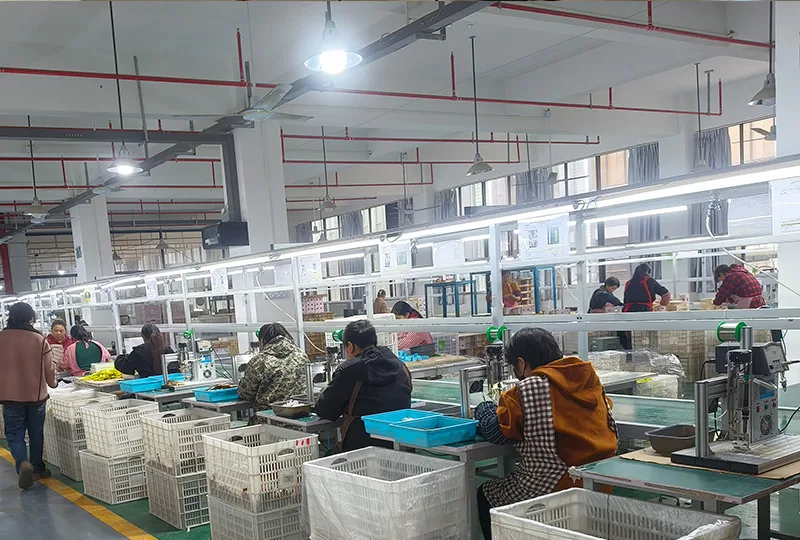
About Kidmerry: Yunhe Kidmerry Toys Co., Ltd is a wooden toy manufacturer based in Yunhe, Zhejiang, China. The factory runs in-house CNC machining, finishing and assembly, and holds ISO 9001:2015 certification, with FSC-certified board available on request. Sampling takes 7–10 working days for existing styles and 15–20 working days for custom drawings; bulk production runs 30–45 days after sample approval. Ask Kidmerry for a quotation, a sample set and third-party test reports before your next development cycle.
Request a Quotation