Pretend Play and Role Play Wooden Toys: A Sourcing Guide for Buyers
Role play is the most commercially complex category in wooden toys. A single kitchen SKU can carry forty components, three materials, a printed scene and a carton that costs more than some entire products in a buyer’s range. This guide is written for sourcing and category managers planning a pretend play programme, and it focuses on the decisions that decide margin: structure, component count, materials mix, carton efficiency and compliance scope.
What this guide covers
- What makes role play different from every other wooden category
- From play pattern to structure: kitchens, clinics, food sets and doll houses
- Materials, panels and finishes for large-format items
- Components, mixed materials and what they do to cost and compliance
- Dimensions, flat-pack decisions and carton efficiency
- Colour, scene graphics and regional adaptation
- Age grading, MOQ, QC, certification and shipping
- Frequently asked questions
What makes role play different from every other wooden category
A block set is one material, one process and one carton. A play kitchen is a structure, a mechanism set, a component set and a graphics job. That difference drives four commercial consequences that buyers routinely underestimate.
First, component count becomes the dominant cost and risk driver, not board area. Twenty plastic accessories can cost more than the cabinet they ship with, and each one is a separate tool, a separate colour approval and a separate compliance item. Second, the carton is a design problem: large hollow items ship air unless the pack is engineered. Third, assembly method determines whether the item ships flat or assembled, which changes freight, warehouse handling and the return rate. Fourth, the printed scene carries the market adaptation — a kitchen that reads correctly in one region may read wrong in another, and reprinting artwork is expensive and slow.
Approach the category as a small engineering programme rather than as a product purchase. The buyers who do well here are the ones who freeze the component list and the artwork early, then let the factory engineer around those two fixed points.
From play pattern to structure: kitchens, clinics, food sets and doll houses
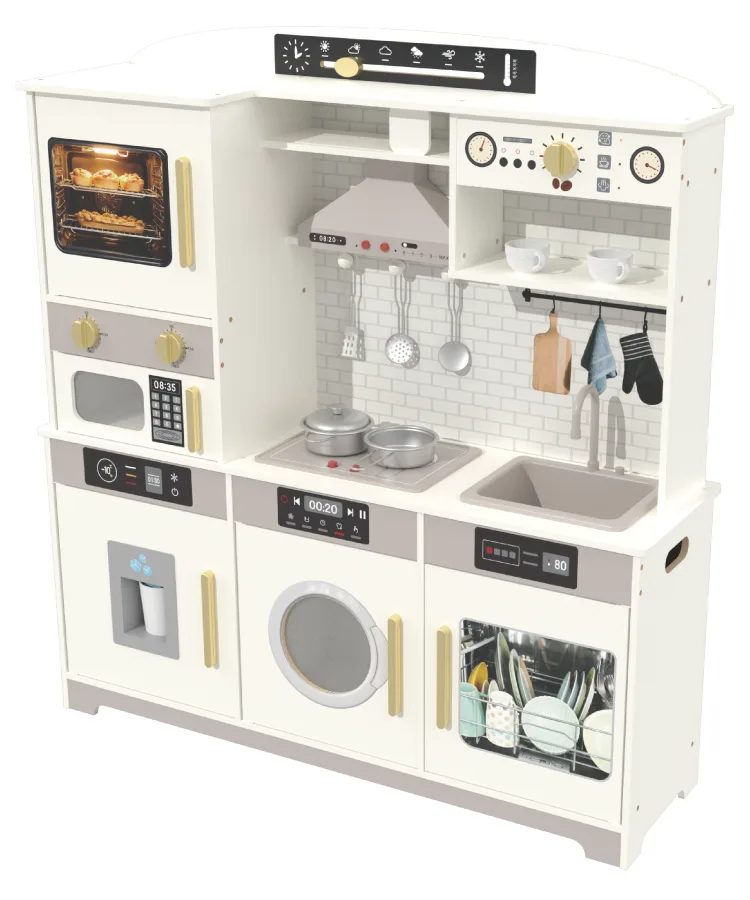
Kitchens and shops
The play pattern is sequence: take, prepare, serve, pay. Structurally that means a work surface at the right height for the age band, storage that a child can open, and controls that turn with real resistance. The engineering risks are hinge life, door sag, and the stability requirement — a child will lean on an open door or a pulled-out drawer, so tip-over and stability testing matter as much as they do for furniture. Ask what the factory tests and at what load.
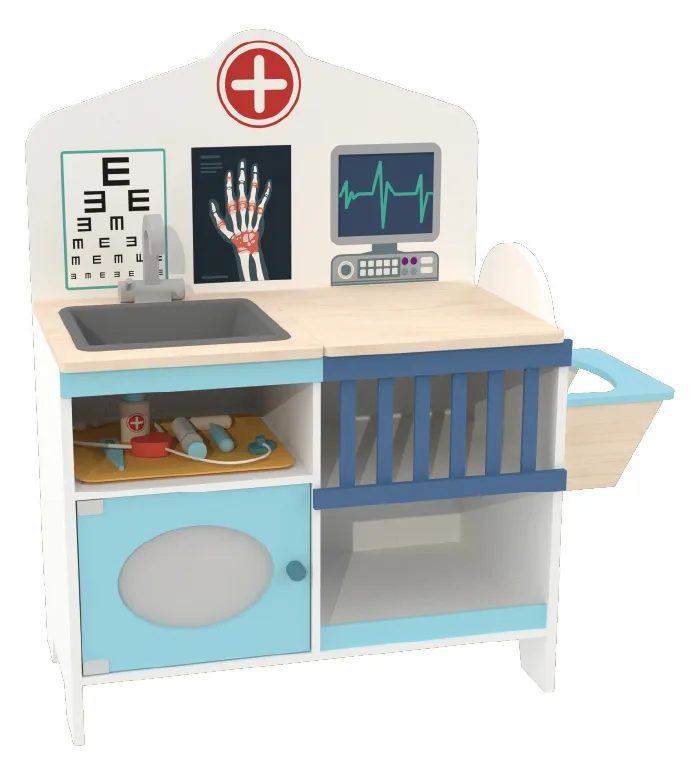
Clinics and service sets
The pattern is care and procedure, which in product terms means identifiable props and storage. Storage is the commercial point: a set that loses pieces stops being used, and a set with a home for every piece stays in a nursery for years. Design the storage as deliberately as the props, and specify the retention method for small items.
Food and cutting sets
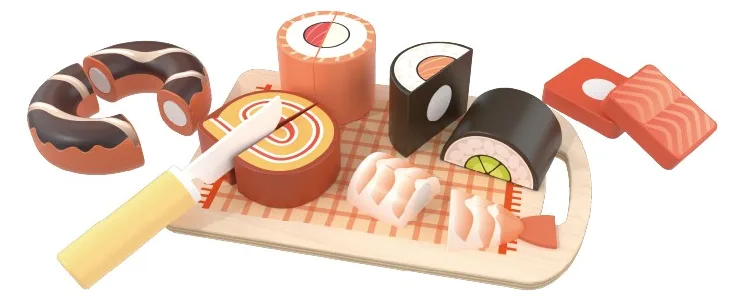
The pattern is fine motor plus counting plus serving. These sets are usually mixed-material — wood board, wooden knife, and layered food pieces joined with hook-and-loop tape or magnets. The specification questions are the joining method’s cycle life, whether the joining material is captured in the compliance test, and how the pieces are graded for size against the lowest age in the range.
Doll houses and carry-along sets
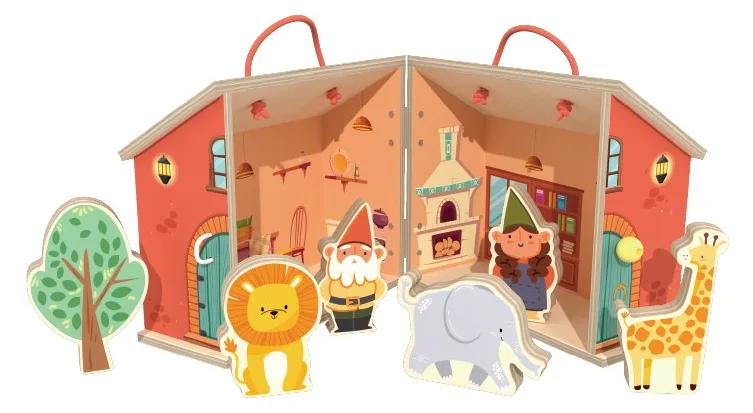
The pattern is narrative, and the structural choice is between rigid and foldable. Foldable designs cut carton volume dramatically and open a travel gifting channel, but they add hinge hardware, fabric handles and a folding tolerance stack that has to be right or the house will not close flat. Ask for a sample that has been folded and unfolded the number of cycles you expect in the product’s life, not one that has been opened twice.
Materials, panels and finishes for large-format items
Large-format role play items rarely use a single species across the whole product. A typical construction uses birch plywood or MDF for panels, solid wood for frames, handles and turned details, and sometimes a printed or laminated surface for the scene. Each choice has a consequence.
| Part | Typical material | Why | What to specify |
|---|---|---|---|
| Large panels, backs, shelves | Birch plywood or MDF | Dimensional stability, flatness, takes a clean finish | Thickness, grade, edge treatment, formaldehyde emission class where the market requires it |
| Frames, legs, handles, turned parts | Solid wood (pine, beech, birch) | Strength at joints, machined detail, repairability | Species, moisture content at assembly, joint type |
| Scene and decorative surfaces | Print, laminate or water-based paint | Graphics fidelity and abrasion resistance | Print method, abrasion test, colour reference on the real substrate |
| Hardware | Hinges, screws, magnets, hook-and-loop | Function and service life | Cycle life, corrosion resistance, secure fixing, capture in the compliance test |
KIDMERRY applies FSC-certified material where a project calls for it. FSC at our end is a chain-of-custody certificate with a defined product scope, not a blanket statement covering every item, so if your programme needs to print an FSC claim, confirm the specific SKU against the certificate scope before artwork goes to print. Finishes are water-based, and the properties worth naming in the specification are abrasion resistance for surfaces that get dragged across a floor, and saliva and sweat resistance for anything a younger child will mouth.
Discuss your custom wood and finish. Send the construction you have in mind, the market and the finish expectation, and we will come back with a build proposal, a materials schedule and the test evidence available for that configuration.
Discuss Your Custom Wood / FinishComponents, mixed materials and what they do to cost and compliance
Component count is where role play programmes lose money. Three rules keep it under control. Freeze the component list before tooling rather than adding pieces during sampling. Standardise fixings across the range so that one screw type serves five SKUs. And treat every plastic or metal component as a compliance item in its own right — coatings, substrates and magnets all need to be captured in the test scope for the target market.
The materials mix also moves the commercial terms. At KIDMERRY, MOQ is 500 pieces per style for large structural products such as doll houses, play kitchens and outdoor climbing frames, and for all-wood designs; where the plastic component share is high, and for small-item designs, the starting point is 1,000 pieces per style. A kitchen with a large plastic accessory pack can therefore fall into the higher band, and that is a design decision as much as a purchasing one — simplifying the accessory pack can move the whole SKU into a lower MOQ.
Dimensions, flat-pack decisions and carton efficiency
Freight is the hidden line item in role play. A large cabinet shipped assembled can cost more to move than to make. The decision framework:
- Ship assembled when the item is rigid, when the retail channel expects a ready-to-display unit, and when the carton can be sized tightly around the product.
- Ship flat-pack when the item is large and hollow, when the channel can accept assembly, and when the assembly instructions can be made unambiguous.
- Ship semi-assembled when a sub-assembly carries the tolerance-critical joints — doors, drawers, hinges — and the remainder is simple panel assembly.
Whichever route you choose, require the factory to state the packed carton dimensions and the units-per-container figure, because that is the number that decides landed cost. Also specify the carton grade and internal protection for the actual pack configuration, and require drop and vibration evidence on the packed unit rather than on the bare product. Print minimums on packaging frequently exceed the product MOQ, so ask for both numbers separately before setting the order quantity.
Colour, scene graphics and regional adaptation
Role play carries more printed surface than any other wooden category, and wood is a demanding substrate: it moves, it varies in tone, and it absorbs coating differently across grain direction. Specify colours as physical references, approve on the real substrate in the real coating, and keep fine text above the size the print method can hold.
Regional adaptation is the expensive part. If a scene needs to change for a market — a food set’s contents, a shop’s signage, a clinic’s wording — treat the artwork as a separate work package with its own approval loop and its own lead time. A private label wooden toy manufacturer can run artwork in parallel with sample development, but only if the artwork is frozen early. In practice, artwork approval is the most common cause of a role play launch slipping a season.
Age grading, MOQ, QC, certification and shipping
Age grading should be fixed before design freeze, because it drives small-part limits for accessories, warning text, stability requirements and the claims you can make. Role play ranges often span eighteen months to eight years, and the constraints that apply to the youngest band in the range apply to the whole set unless the items are clearly separated in packaging and marking.
Quality control for multi-component sets
Standard AQL on the main item is not enough here. Add a component-completeness check: every carton should be verified against the component list, because a missing accessory is the single most common complaint in this category and the most expensive to resolve after shipment. Ask for the packing-line check method, and for the instruction sheet and hardware pack to be included in the verification.
KIDMERRY operates under ISO 9001:2015 and holds BSCI and Sedex (SMETA) registrations, with EN 71-3 and CPSC / ASTM F963 on the certificate list. Certificates are issued to a legal entity and a defined scope; the test reports that matter for a shipment are the ones issued for that product and that order. For role play specifically, confirm that accessories, coatings and hardware are inside the tested scope rather than assumed.
Certification and market access
For the EU, shipments are currently assessed under the Toy Safety Directive 2009/48/EC. A new Regulation, (EU) 2025/2509, was published in the Official Journal on 12 December 2025, enters into force on 1 January 2026 and applies from 1 August 2030, bringing a digital product passport and wider chemical restrictions. Plan artwork and documentation against the directive now and track the transition; do not claim conformity to obligations that are not yet applicable.
For the US, ASTM F963-23 is the mandatory version under 16 CFR 1250 from 20 April 2024, determined by date of manufacture rather than date of import, with certain flammability provisions excluded by 16 CFR 1250.2(b). CPSIA limits to know: 100 ppm total lead in substrate, 90 ppm in coatings under 16 CFR 1303, 0.1% for certain phthalates under 16 CFR 1307, plus tracking labels. The Children’s Product Certificate is issued by the importer or a US domestic manufacturer, not by the overseas factory.
Sampling, bulk and shipping
Existing-style samples take about 7–10 working days; new items from your drawings take about 15–20 working days, because tool paths, fixtures and first-article inspection must be created. Both are factory working days and exclude courier time. After approval, mass production runs about 30–45 days, extending to 45–60 days in the second and third quarter peak, starting at approval and excluding sea transit. On the shipping side, confirm whether any solid-wood crating or pallets need ISPM 15 treatment — plywood and MDF panels are normally exempt, solid wood is not. Payment terms: T/T with a 30% deposit, L/C at sight, PayPal for samples.
Frequently asked questions
Why is MOQ higher for some role play sets than for others?
Because MOQ follows changeover time, board yield and component sourcing, and because the materials mix matters. All-wood designs and large structural products start at 500 pieces per style; where the plastic component share is high, and for small-item designs, the starting point is 1,000 pieces per style. Simplifying an accessory pack can move a SKU into the lower band.
Should a play kitchen ship assembled or flat-packed?
It depends on carton volume, channel expectations and assembly tolerance. Compare the packed carton dimensions and units-per-container for both routes, and require drop and vibration evidence on the packed configuration. Semi-assembly is often the best compromise when doors and hinges carry the tolerance-critical joints.
How do I stop accessory pieces going missing?
Design storage into the product and add a component-completeness check on the packing line. Verify every carton against the component list, including the instruction sheet and hardware pack. Standard AQL on the main item does not cover completeness.
Can I print an FSC claim on a role play carton?
Only where the specific product is within the chain-of-custody certificate scope and your own arrangements support the claim. FSC at KIDMERRY is a chain-of-custody certificate with a defined product scope, not a statement about every item. Check the SKU before committing artwork.
What compliance items are easy to miss on mixed-material sets?
Accessories, coatings and hardware. Every plastic part, magnet, textile and hook-and-loop element needs to be inside the tested scope for the target market, not assumed to be covered by the main item’s report.
How long does a new role play programme take?
Budget 15–20 working days for a custom sample from your drawings, then 30–45 days for bulk production after approval, extending to 45–60 days in the Q2–Q3 peak. Artwork approval usually runs in parallel and is the most common cause of a slipped launch, so freeze it early.
Ask about MOQ and packaging. Send the play pattern, the age band, the market and the quantity per style. We will propose a construction, quote MOQ and sampling time, and set out packaging and carton options.
Ask About MOQ and PackagingPlanning a pretend play range?
Role play rewards early decisions: freeze the component list, freeze the artwork, choose the shipping configuration before the structure is final, and put the compliance scope in writing including accessories. If you are building a range, send the play pattern, the age band, the target market and the quantity per style.
We will come back with a construction proposal, a sampling plan, MOQ and packaging options, and a production window — plus the questions we still need before we can quote. Our OEM and ODM customisation service explains how a concept moves into tooling, and the industry development page tracks the category trends behind these decisions.
Contact KIDMERRY for wholesale supply
Tell us the product, the market, the age grade and the quantity per style. We will come back with MOQ, a sampling schedule, packaging options and a production slot — and the documents we can supply for that market.
Contact KIDMERRY for Wholesale Supply