

How Can Unique Custom Toys Open a Local Market? A Customer Story
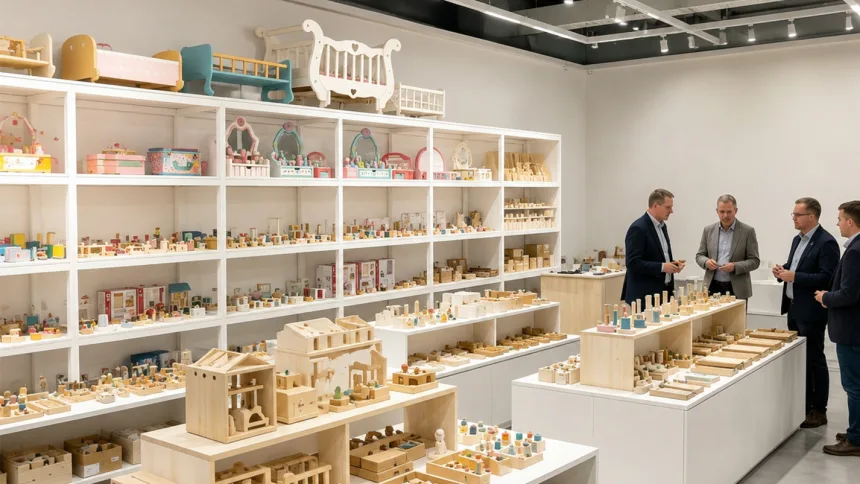
A well-run independent toy store was losing foot traffic to online discounts and big-box pricing. Their shelves looked like every other store's shelves, and every product on them had a comparison price one search away. The turning point was a simple strategic insight: a local retailer cannot win on price, but it can own products that nobody else is able to sell. This is how that was turned into an exclusive wooden toy line.
Exclusive custom toys open a local market when the theme has durable demand and the commercial terms work for the manufacturer — and the exclusivity that matters is enforced through locked artwork and specifications, not promises. Plan the front end honestly: theme development and artwork sit in front of sampling, then a new custom design takes 15–20 working days and mass production runs 30–45 days after approval. For decoration, engraving reproduces fine line work more cleanly at toy scale and removes a print station and drying cycle; judge every exclusive design against its approved sample before bulk. Minimums: 500 pieces per style for large structural and all-wood products, 1,000 for small items or high-plastic designs, applied per style rather than per order.
- The Price War Independent Retailers Cannot Win
- The Strategy: Exclusive Product Instead of Better Pricing
- Choosing a Theme Only This Retailer Could Own
- Turning a Local Story Into a Manufacturable Range
- Small Batches and a Fast Restock Cycle
- What Changed on the Shelf
- How to Build Your Own Exclusive Line
What This Guide Covers
- The Price War Independent Retailers Cannot Win
- The Strategy: Exclusive Product Instead of Better Pricing
- Choosing a Theme Only This Retailer Could Own
- Turning a Local Story Into a Manufacturable Range
- Small Batches and a Fast Restock Cycle
- What Changed on the Shelf
- How to Build Your Own Exclusive Line
- Thinking About an Exclusive Range for Your Store?
The Price War Independent Retailers Cannot Win
The mechanics of the problem are straightforward. When a store sells a product that is also listed by national chains and online marketplaces, the customer's decision reduces to price, delivery speed and convenience. On all three, an independent retailer with one location loses. Discounting does not change the structure; it compresses margin without changing the comparison.
There is a second effect that is less visible in the accounts. When the assortment is undifferentiated, the store becomes a showroom: customers come in to see the product, then buy it online. Foot traffic stays stable while conversion falls, which is a particularly difficult pattern to diagnose because the shop still looks busy.
There is a third effect that shows up in the buying rather than in the sales. When an assortment is undifferentiated, the buyer's negotiating position weakens year on year, because every supplier knows the store has alternatives and every alternative is the same product. Differentiation restores that position: a retailer with a range that cannot be sourced elsewhere is a retailer that suppliers want to keep.
The strategic answer is not a better buying deal. It is to remove the comparison entirely. A product that exists in one shop has no online price, no marketplace listing, and no competitor discount. The conversation moves from "how much is it" to "where can I get one", and that is a conversation no chain store can have.
The Strategy: Exclusive Product Instead of Better Pricing
Exclusivity is easier to want than to buy. Most manufacturers will not grant it for a small-volume retailer unless the commercial terms work for them, and the reason is simple: exclusive designs tie up development work that could otherwise be sold repeatedly. The negotiation has to be structured so both sides win.
Three elements made it workable here.
- Design rights agreed in writing. Each design in the collection was licensed to the store alone, with the term, territory and renewal conditions stated on paper rather than assumed. This is the single most important item and the one most often skipped.
- A theme with commercial life beyond one season. A collection built around a region's identity sells to residents and to visitors, in season and out of it. That durability is what justifies the development work on the manufacturing side.
- A product category that suits the retailer's price architecture. Wooden toys carry a higher ticket than the store's existing imported lines, and the quality is visible without explanation. The margin structure supported the strategy rather than fighting it.
Choosing a Theme Only This Retailer Could Own
The theme selection was the part of the project that could not be outsourced. A good exclusive theme has four properties: it is genuinely local, it is visually distinctive at toy scale, it is appropriate for children, and it has gifting value — meaning an adult will buy it as a present and not only for a child in their own household.
For this store, the theme was built around regional animals, landmarks and folk motifs. That combination works because it satisfies all four properties simultaneously: the animals are recognisable and appealing to children, the landmarks give adults a reason to buy as a souvenir, and the folk motifs give the packaging a story that justifies a premium price.
The practical test we apply to a proposed theme is simple: could a competitor in the next town credibly sell this? If the answer is yes, the theme is not exclusive enough to carry the strategy. If the answer is no, the collection has a defensible position.
A caution on the fourth property, gifting value. It is the one most often overlooked, and it is the one that determines whether the range has a second demand stream. A toy bought for a child in the household is a considered purchase with a price ceiling. The same toy bought as a present for someone else's child, or as a souvenir of a place, is bought on sentiment and carries a materially higher ceiling. Designing for both is what turns a local theme into a commercially durable range.
Turning a Local Story Into a Manufacturable Range
A theme is a marketing asset; a product range is a manufacturing programme. Converting one into the other is where most exclusive-product projects stall, because the decoration method that best expresses the theme is often the one that is hardest to produce.
Laser engraving as the decoration method
The collection used laser engraving into FSC-certified birch. Engraving was chosen over printing for two reasons. It reproduces fine line work — animal outlines, building silhouettes, folk patterns — more cleanly than most printing routes at this scale, and it removes a print station and drying cycle from the process, which matters when runs are short and set-up time is a real cost.
The design constraint is worth stating: engraving is monochrome. The collection therefore used wood tone and clear finish as the colour, with colour introduced through painted elements on specific pieces rather than through the engraved artwork. This is a design decision, not a compromise — and it is one that has to be made before the artwork is drawn.
Range architecture
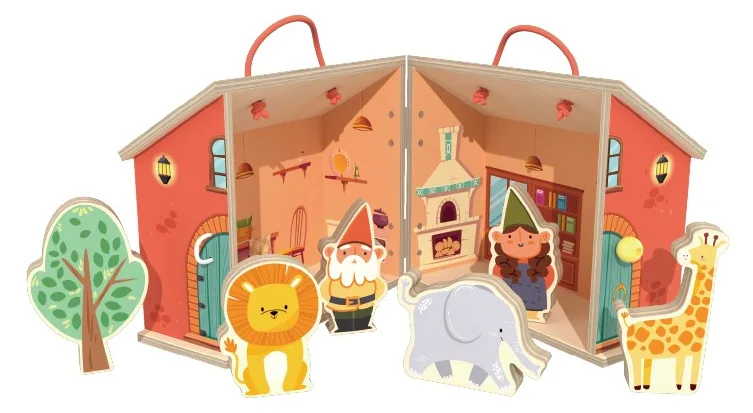
The line comprised stacking toys, puzzles and a signature building set. That structure is deliberate and worth copying: a low-price entry item that almost anyone will buy, a mid-price core item that carries most of the volume, and a higher-price signature item that defines the range and earns the display space. Three price points also mean the collection can occupy a wall rather than a shelf.
| Tier in the range | Role the tier plays |
|---|---|
| Low-price entry item | Almost anyone will buy it — the low-risk first purchase |
| Mid-price core item | Carries most of the volume |
| Higher-price signature item | Defines the range and earns the display space |
Shared visual system
All pieces used the store's own colours and a consistent finish system. Consistency is what makes a small exclusive range read as a collection rather than as three unrelated products, and it is what makes a dedicated display wall look intentional.
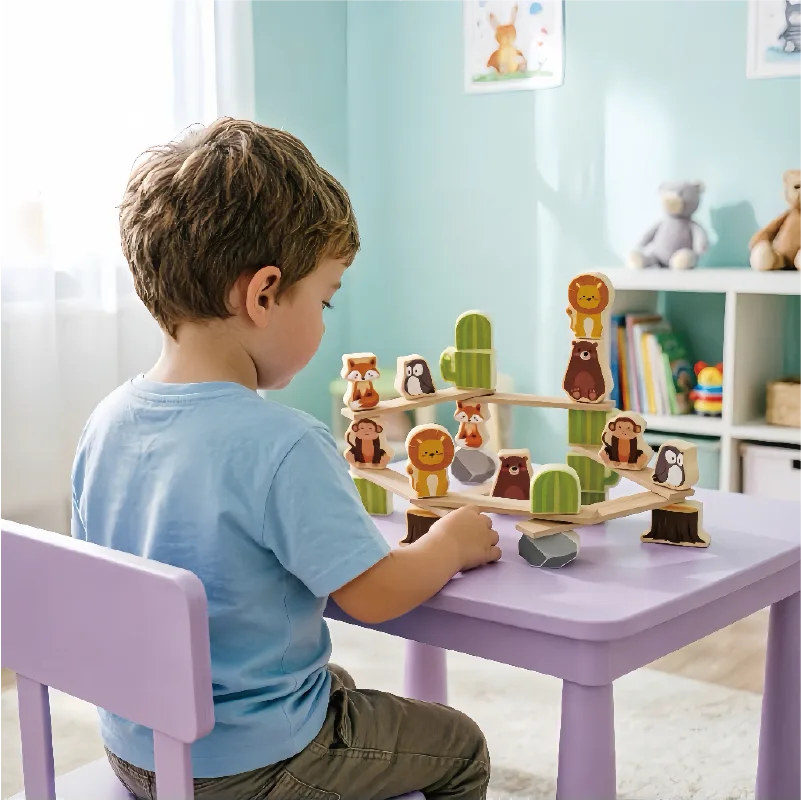
One further decision deserves attention because it is where exclusive ranges most often go wrong: complexity. A themed range is tempting to over-design, because every motif suggests another piece. In practice the first collection should be small enough that every piece earns its place on the wall and simple enough that every piece can be produced on standard processes. Bespoke fixtures and unusual board sizes are the two things that turn a promising exclusive range into an expensive one, and neither is visible to the customer.
Small Batches and a Fast Restock Cycle
The supply model mattered as much as the product. An exclusive range for a single store does not justify a warehouse; it justifies a reorder rhythm.
Production ran in small batches sized to seasonal demand, with a restock cycle short enough that a successful line could be replenished within the same season. The commercial mechanics: our standard minimum is 500 pieces per style for large structural items and all-wood products, and 1,000 pieces per style for small items and designs with a high proportion of plastic components, applied per style rather than per order. Planning a range against those thresholds, SKU by SKU, is what keeps the working capital requirement realistic for a single-store retailer.
The advantage of this model is that it converts inventory risk into information. A retailer who buys one large batch learns nothing until it has sold or not sold. A retailer who buys a small batch and reorders learns the sell-through rate early and can respond to it. Over two seasons, that difference is usually worth more than the unit-cost saving from a larger first order.
What Changed on the Shelf
Within two seasons the custom line moved from a single display shelf to a dedicated wall. Three distinct demand streams developed, which is the outcome the strategy was designed to produce.
- Tourists bought the regional sets as gifts. These customers were not comparing price; they were buying a souvenir that happened to be a toy. Gifting demand is largely price-insensitive and largely online-resistant.
- Local parents bought them as keepsakes. A product connected to a place the family lives has a different value proposition from a generic toy, and it is bought with less deliberation.
- Local press featured the store as a destination. An exclusive range is a story, and a story is what gets a small retailer covered. That coverage brought in customers who then bought the rest of the assortment as well.
The line carried a higher price than anything else in the store and sold faster. That combination — higher margin and higher velocity — is the whole point of the strategy, and it is only achievable when the product cannot be compared.
One operational detail made the difference between a good first season and a good second one. The first season's sell-through data was reviewed SKU by SKU before the reorder was placed, and two slower designs were retired rather than carried. Retiring a design is emotionally harder than reordering it, but an exclusive range is only exclusive while it stays current; a wall of last season's designs becomes a display rather than a destination. The second season replaced those two designs with new motifs in the same visual system, which kept the wall fresh without rebuilding the range.
Do you have a local story worth building a range around? Tell us the theme and we will tell you what it would take to turn it into an exclusive wooden toy collection.
Start Designing Your Exclusive Line Custom for Brand Owners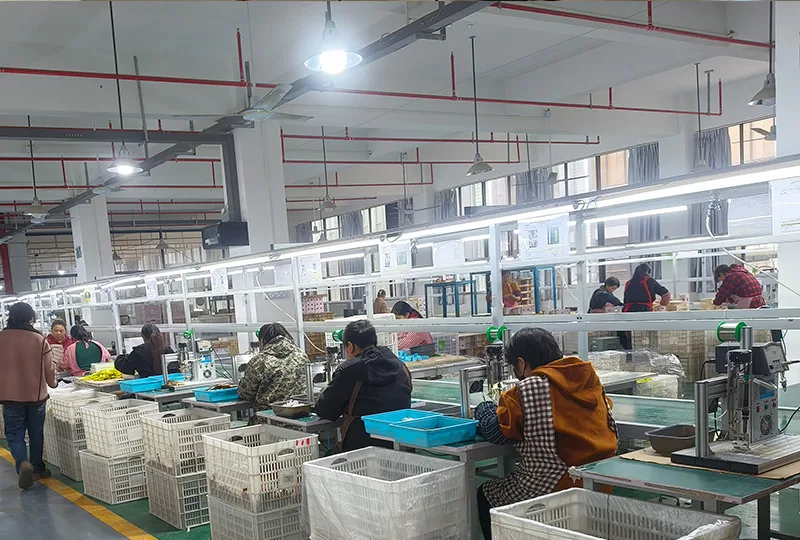
How to Build Your Own Exclusive Line
The sequence that worked here is repeatable, and it is worth following in this order because each step depends on the previous one.
- Find your story. The theme only you can tell: a region, a heritage, a local landmark, a niche hobby. Test it with the question above — could the shop in the next town credibly sell this?
- Protect it in writing. Request exclusive design rights with the term, territory and renewal conditions stated. Verbal assurances of exclusivity are worth nothing once a design proves successful.
- Choose the decoration method before the artwork. Engraving is monochrome and excels at line work; printing handles colour and gradients. Deciding after the artwork is drawn guarantees rework.
- Design a three-tier range. An entry item, a core item and a signature item. Three price points justify a wall and let you learn which tier your customers actually want.
- Start small and restock fast. Size each SKU against seasonal demand within the applicable per-style minimum, and keep the reorder cycle short enough to respond inside the same season.
- Give the packaging the story. For a regional or heritage theme, the box is part of the product. It is also where the gifting value is created, and it is the cheapest place to add perceived value.
Two cautions are worth stating. First, exclusivity has a cost, and it is usually reflected in development work or in minimum commitment rather than in a headline unit price; ask what the exclusivity actually costs rather than assuming it is free. Second, exclusive does not mean unregulated: an exclusive design still has to meet every safety and labelling requirement of the market it is sold in, and that obligation does not move to the manufacturer just because the design is yours.
Thinking About an Exclusive Range for Your Store?
If your shelves currently look like everyone else's, the fastest diagnostic is to pick five products at random and search each one online. If all five return a lower price from a national retailer, the problem is the assortment, not the buying.
The custom wooden toy for brand owners page explains how exclusive programmes and design rights are handled, and the wooden toy purchasing guide covers commercial terms including minimum quantities. To discuss a theme, tell us your story and we will tell you what it would take.
Can a small retailer really get exclusive designs?
Minimums make that workable: 500 pieces per style for large structural and all-wood products, 1,000 for small items or high-plastic designs, quoted per style rather than per order.
Why laser engraving rather than printing for themed designs?
It also removes a print station and drying cycle from the schedule — sampling for a themed design runs 15–20 working days, so every skipped step counts.
What minimum quantities apply to an exclusive range?
Why start small and reorder rather than buying one large batch?
With 30–45 days of bulk production after sample approval, a reorder decision made on early sell-through data can still land inside the same season.
Does an exclusive design still need safety certification?
The rules do not shrink for exclusive runs: EN 71 applies in the EU and ASTM F963 under 16 CFR Part 1250 in the US, exactly as for open-range items.
How long does an exclusive range take to develop?
Build a Custom Toy Programme with KIDMERRY
About Kidmerry: Yunhe Kidmerry Toys Co., Ltd is a wooden toy manufacturer based in Yunhe, Zhejiang, China. The factory runs in-house CNC machining, finishing and assembly, and holds ISO 9001:2015 certification, with FSC-certified board available on request. Sampling takes 7–10 working days for existing styles and 15–20 working days for custom drawings; bulk production runs 30–45 days after sample approval. Ask Kidmerry for a quotation, a sample set and third-party test reports before your next development cycle.
Request a Quotation