Play Kitchens: Comparing MOQ, Tooling and Freight Across Suppliers
Play kitchens are among the least forgiving items in a wooden toy range: several materials in one carton, dozens of components, and a box sized by the assembled toy rather than the parts. This guide is written for sourcing and category managers holding two or three quotes for the same kitchen set, and it concentrates on the three lines that decide landed cost — the MOQ tier assumed, the one-time costs amortised, and the freight the carton produces.
What This Guide Covers
- Why a play kitchen resists unit-price comparison
- Layer one: the MOQ tier a price is quoted against
- Layer two: one-time costs and the material grade
- Layer three: freight is set by the carton
- Duty lines that still need reading
- The comparison sheet to send all three suppliers
- What a factory can and cannot answer before spec
- Frequently asked questions
Three quotes for the same wooden play kitchen land on your desk in the same week: USD 21.36 per set at 1,000, USD 19.58 at 2,000, USD 17.80 at 10,000. The instinct is to read those as three factories' efficiency and pick the middle one.
Then a detail surfaces: all three figures sit on the same published quantity ladder, same item, same source. The ranking you were about to build was ranking order sizes, not factories.
That is the problem with a per-unit price here. One figure carries three unrelated costs: where your order sits on a quantity ladder, what one-time work the project consumes, and what it costs to move a large light box across an ocean. Compress them into one line and it stops being comparable; separate them and the three quotes become a decision.
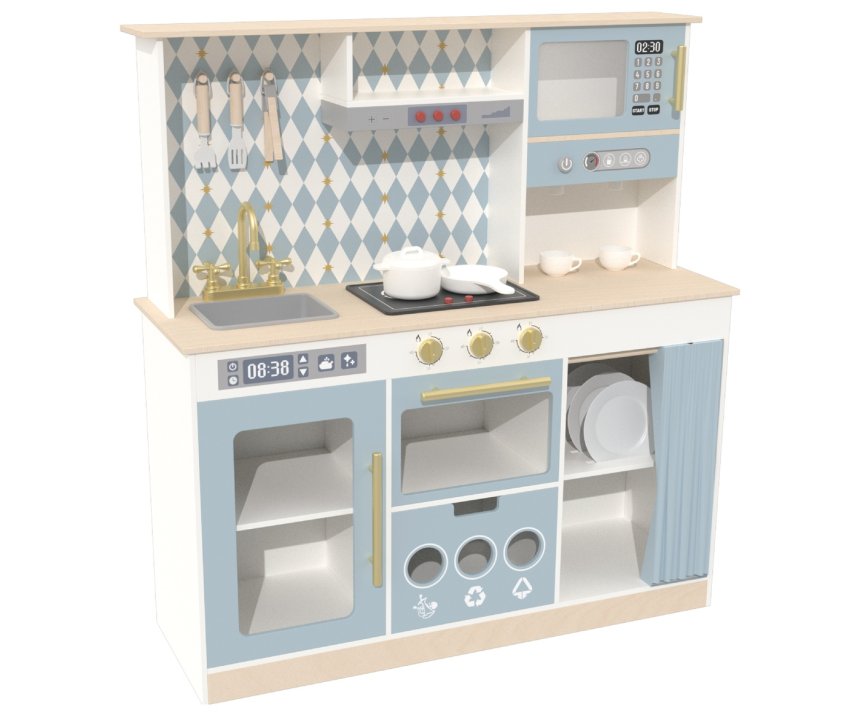
Why a play kitchen resists the usual price comparison
It is large and low-density. A kitchen is mostly air once assembled and mostly flat board once packed. Freight is priced on the space it occupies, not the mass it carries — a fact invisible in any FOB unit price, and one that moves more money than most buyers expect.
It is multi-material, and it has a retail function. Board, hardware, sometimes fabric, sometimes an electronic module, each with its own upstream minimum that resurfaces as a higher unit price or a longer lead time. And the carton has to survive a pallet stack while looking presentable on a shop floor, so packaging here is part of the product, not a protective afterthought.
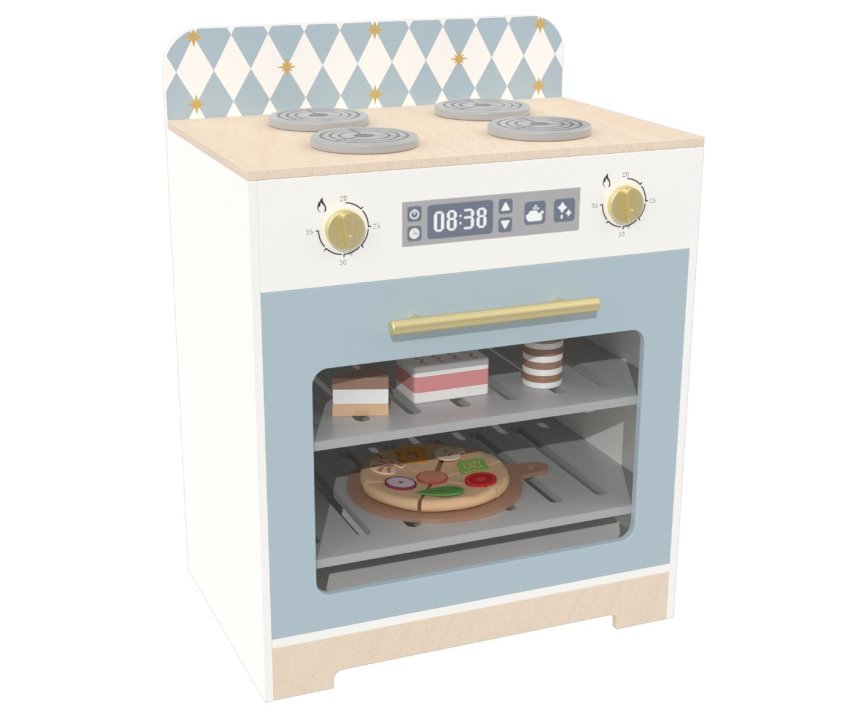
It is sold as a range, not a product. Brands carry a corner unit, a full unit, a compact stove, an accessory set — and the range is where the quantity goes. That is the point at which a per-style minimum stops being a footnote and starts deciding whether the order exists.
Layer one: what the MOQ figure is counted against
Quantity minimums on wooden toys are almost always counted per style, not per order. The distinction sounds pedantic until a real order arrives.
A buyer once sent a well-structured request: 2,000 kits, ten designs, 200 each. On paper, 2,000 units is a respectable first order. Counted per style it was ten quantities of 200 — and no factory tooling up ten designs treats 200 of each like 2,000 of one. The same document also asked for EXW and FOB split out, a DDP figure with the importer of record named, per-design minimums, sampling and tooling fees, carton dimensions in cubic metres, and a written approval gate before production. That buyer understood the problem better than most. The order still had to be re-scoped around per-style quantities.
Establish this in writing with every supplier: is the minimum per style, per order, or per shipment, and does it change when packaging is customised? If the answer is per style, the next question is what counts as a style — a different structure, or a different print and colourway on the same structure. The gap between those definitions can be the difference between one minimum and five.
Next, find where the ladder actually sits. Publicly listed tier pricing on a wooden play kitchen shows how wide the spread can be on one unchanged item: USD 21.36 per set at 1,000–1,999, USD 19.58 at 2,000–4,999, USD 18.69 at 5,000–9,999, USD 17.80 from 10,000 up. First tier to last is USD 3.56 on the identical item (published tier prices from a supplier product page, retrieved October 2026, used as an illustration of ladder shape, not as an industry average).
That spread is why a single quoted price is not comparable. "Around USD 20" does not say which tier the figure assumes, and moving from 1,000 to 10,000 changes the answer by more than the entire difference between some competing factories — so three quotes can easily be three quantity assumptions presented as a price gap.
The practical rule: ask every wooden play kitchen supplier for the same three quantity points, at the same packaging level. Otherwise you are ranking three different products. Our wooden toy purchasing guide sets out those three quantity points as a standard request format, which shortens the path to three answers you can put in one column.
Layer two: the one-time costs, and the material grade inside them
Buyers who come from plastics expect a mould. Wooden toys rarely have one, and the absence of a steel mould leads to a wrong conclusion — that wooden projects carry no meaningful one-time cost.
They do, and it is distributed rather than concentrated:
- Routing setup — new profiles and panel layouts need programming, first-article cutting and fit checks against the hardware.
- Fixtures and drilling jigs — hinge, handle and shelf-pin position is held by jigs, not operator judgement.
- First-article assembly — a kitchen is built once, completely, including bought-in parts.
- Printing and packaging setup — artwork, direct printing, die-cut inserts and custom cartons each carry development cost. On small projects the carton is often the largest single line.
- Sampling labour — pattern work, finishing and shipping the sample.
None of it appears on a per-unit price. All of it appears on an invoice. This is also where an existing platform earns its keep: if your concept can be built on a structure we already run — see the wooden pretend play range — several of those five lines shrink to a colourway and a print change.
Now the sample fee. Many suppliers publish a policy of the form: the sample cost is deducted from the order value once quantity reaches a stated minimum per item. That is not a discount but a conditional — the sample is free only if the order clears a threshold, per item, usually the same per-style minimum above. Ten designs at 200 each may never trigger it.
Ask three things and keep the answers with the quotation: what the sample charge covers (the sample, or development time); what exactly must be true for it to be credited, in quantity, per style or per order, order value and timing; and whether the sample is built on production tooling or in a separate model shop — which determines how much it proves.
On a wooden play kitchen, our own planning range is 7–10 working days for a sample on an existing structure with only print or finish changed, and 15–20 working days for development from your drawing or specification. Bulk production follows at 30–45 days after sample approval, extending to 45–60 days in the second and third quarter peak. These are factory-level planning figures, not industry statistics, and the project should re-confirm them at quotation — a new electronic module or a new carton structure moves them.
One further line behaves like a one-time cost although it is really a specification decision: the grade of the board. Kitchen carcasses are usually multi-layer plywood, and buyers often specify a low-emission grade by name and assume the compliance question is closed. It is not, because the restriction that applies in the European Union is written against the article, not the board. Commission Regulation (EU) 2023/1464 added entry 77 to Annex XVII of REACH: from 6 August 2026, articles must not be placed on the market if formaldehyde released from them exceeds 0.062 mg/m³ for furniture and wood-based articles, or 0.080 mg/m³ for other articles (OJ L 180, 17 July 2023, pp. 12–20). Toys are not outside this — the regulation's recitals state explicitly that toys for children of all ages fall within the restriction's scope. Measurement is made on the finished article in a test chamber under the reference conditions set out in Appendix 14 to that regulation, which fixes temperature, humidity, loading factor and air exchange rate; so the number that matters is the one on the assembled kitchen, edges, cut faces and glue lines included, not the one on the board supplier's certificate.
Two questions follow, and both belong on the comparison sheet. First, which of the two limits the supplier tested against, because a wooden kitchen can be classified either way and the classification decides whether 0.062 or 0.080 applies. Second, which article the release test was performed on — the assembled product, or the panel. A panel result is evidence about a raw material. It is not a statement about the kitchen you are importing.
Layer three: freight is decided by the carton, not by the toy
This layer decides more landed cost than the other two combined, and is the one most often left off the comparison sheet. Two published rules matter, both checkable.
Parcels. International express pricing uses dimensional weight: length × width × height in centimetres divided by 5,000, with the greater of actual and dimensional weight billed. UPS states this in its published shipping guidance (accessed October 2026), alongside a minimum billable weight on freight shipments and a rounding rule that lifts fractions to the next half kilogram. A kitchen packed into a carton with generous internal void is billed on the void; repacking the same product into a tighter carton is, in this one respect, a price reduction.
Ocean. Container freight is priced per container or per cubic metre, and it moves. The Freightos Baltic Index for China–East Asia to North America West Coast stood at USD 8,126 per forty-foot equivalent unit in the weekly index retrieved 23 October 2026, published with the Baltic Exchange. Whether that is high or low matters less than the fact that it changes weekly while a supplier's FOB price does not.
Two working consequences. First, ask every supplier for carton dimensions, units per carton, and net and gross weight per carton — not product dimensions, because only the carton lets you compute freight per unit. Second, ask for the named FOB port, since Ningbo, Shanghai and Shenzhen are not interchangeable for inland trucking, sailing schedules or surcharges. A lower unit price ex a less convenient port can lose on the total.
On a large flat-packed item, the gap between one carton design and another can exceed the whole spread between the cheapest and dearest tier. That is not an argument for under-packing — a crushed kitchen is a total loss — but for treating the carton as a costed design decision. If the carton is your open question, start with what can change before a die is cut: board grade, internal fitments, master carton count and artwork, the options set out under private label packaging.
Duty is not the differentiator, but two lines still need reading
Ask what duty applies to a wooden toy and most people answer from memory. The answers are worth checking, because they are lower than assumed — and because the assumption moves attention away from where the cost actually sits.
United States. In the Harmonized Tariff Schedule maintained by the US International Trade Commission, heading 9503.00.00 — toys, including puzzles and parts — carries a general rate of Free (retrieved October 2026). What is not zero is everything stacked on top by origin and entry date: Chapter 99 measures, exclusions, and whatever the current trade-policy layer happens to be. Those are not stable and they are not in a factory's FOB quote. Confirm the full picture with a customs broker for your origin and entry date.
European Union. The Commission's Access2Markets database returns a third-country duty of zero for toys of wood under heading 9503 from China into Germany, with the legal basis cited (retrieved October 2026).
One adjacent change is worth knowing, because it catches samples and small direct shipments rather than containers. Council Regulation (EU) 2026/382 removed the duty relief for consignments whose intrinsic value does not exceed EUR 150, and from 1 July 2026 to 1 July 2028 a temporary duty of EUR 3 per item applies in its place. Read the scope before applying it to yourself: per the Commission's guidance on the Access2Markets portal, that duty is written for distance sales of imported goods to consumers (B2C), and an "item" is each unit sharing the same tariff classification, description and origin on one declaration line. Ordinary commercial B2B imports fall outside it — the number matters to you only if samples or small orders ship direct to an EU consumer address instead of through your normal import route.
Neither fact makes duty the main variable — which is the point. At a near-zero base rate, a comparison built around "who has the better duty story" is comparing the wrong thing. The variables that matter are the ladder, the one-time costs and the carton.
The comparison sheet to send all three suppliers
Send the same sheet to every candidate and require written answers in the same units. Anything left blank is a finding, not a gap to be filled later by assumption.
| Line | What to require | Why it decides the comparison |
|---|---|---|
| Product definition | Reference SKU or drawing, dimensions, materials, finish, age grade | Without this, three quotes describe three products |
| Price tiers | Unit price at 1,000 / 3,000 / 10,000, same packaging level | Reveals which tier the headline price assumes |
| Minimum | Per style or per order, and what changes it | Decides whether the order exists at all |
| Sample charge | Amount, what it covers, credit conditions | A conditional credit is not a discount |
| One-time costs | Tooling, jigs, print setup, packaging die, itemised and separated | Separated, they can be amortised and compared |
| Carton data | L × W × H, units per carton, net and gross weight | The only route to freight per unit |
| FOB port | Named port, named Incoterm year | Ports are not interchangeable |
| Testing | Which tests, on which SKU, who arranges, who pays, report form | Compliance cost sits outside the unit price |
| Material release | Board grade, which REACH limit the test ran against, and whether it ran on the assembled article | A panel certificate and an article result are different evidence |
| Packaging | Retail carton, master carton, inserts, labels, barcodes | Frequently the largest delta between quotes |
| Lead time | Sample and bulk, with the peak-season statement | A cheap quote with an unstable date is not cheap |
| Payment | Deposit, balance trigger, instrument | Terms carry a financing cost |
| Change control | What happens to price and date when the spec changes | Protects both sides after approval |
Answer it per style, never in aggregate — an aggregate answer hides the number you need. Keep the sheets from suppliers you did not choose: when the specification changes three months later, the second sheet tells you whether the new number is a real change or a different assumption.
If you would rather see the sheet answered once as a benchmark before sending it to the others, that is a normal request and we answer in writing — the process behind those answers, from drawing to approved sample, is set out under OEM and ODM customisation.
What a factory can and cannot answer before it sees your specification
Often the buyer asks for a price, the factory gives a range, and both sides lose a month. Worth being explicit about the boundary.
Without your specification, a factory can answer: what minimums generally apply and what changes them; what the sampling sequence looks like and how long each stage takes; which carton and packaging options exist; which documents travel with an order and which are the importer's responsibility.
It cannot answer honestly: a firm unit price; the tooling cost; the carton dimensions and therefore freight per unit; whether the product will pass your market's testing. A supplier who gives all four immediately is guessing or quoting someone else's product.
So send a partial specification and ask for a bounded range with its assumptions stated, then compare ranges on the sheet above. A range with stated assumptions can be compared. A single number without them cannot.
FAQ
Is a lower MOQ always more expensive per unit?
Should I compare FOB or DDP?
Why do two suppliers quote the same kitchen far apart?
Does a low-emission board certificate settle compliance?
Can the sample fee be credited later?
If you have a play kitchen specification in progress, send what you have — a sketch, a reference product, the target age grade, the market, the packaging direction — and ask for a bounded range with its assumptions written down: minimum by style, sample route and timing, carton options, board grade with the article-level test position, and the documents that travel with the order. You can send it through our contact page, and we will answer the sheet line by line rather than with a headline price.