



Wooden or Plastic Play Kitchen: What Should Wholesale Buyers Choose?
Wooden play kitchens cost more per unit and need higher tooling input, but they win on durability, safety perception, retail pricing power, and sustainability storytelling. Plastic kitchens win on unit cost, weight, and color freedom. For wholesale buyers, the decision hinges on your price tier and brand promise: if you sell into the mid-to-premium segment — specialty retail, Montessori-style catalogs, gifting — a wooden kitchen from an experienced manufacturer justifies its cost with a higher retail price point and fewer safety-bearing sub-materials to test. If you sell mass-market volume through big-box channels, plastic still has a role. This guide compares both across material cost, compliance, freight, brand value, and production reality from a factory-floor perspective.
What this guide covers
- Why the wooden-vs-plastic decision matters more for kitchens than other toys
- Material cost and unit economics
- Safety and compliance: what differs between the two materials
- Durability, weight and freight economics
- Brand positioning, retail price and sustainability value
- Production reality: tooling, MOQ and lead times at KIDMERRY
- The side-by-side comparison and a pre-RFQ checklist
- FAQ
Why the wooden-vs-plastic decision matters more for kitchens than other toys
Play kitchens are the heaviest, most complex, and most expensive item in most wooden toy programs. A single kitchen set can involve 60 to 120 components — cabinets, doors, hinges, knobs, burners, sinks, taps, shelving, and a dozen or more accessory pieces. Compare that with a shape sorter or a stacking set, where a material swap changes a handful of parts. In a kitchen, the material decision cascades into every subsystem: how doors hinge, how knobs turn, how surfaces print, how the unit survives a drop from a distribution dock, and how the retail box is engineered.
This is also the category where buyers most often get caught in the middle. Your retail buyers ask for natural materials and FSC-certified board. Your finance team asks why the landed cost tripled. Your logistics provider asks why one carton now exceeds the dimensional weight threshold. All three pressures point back to the same root decision — wood or plastic — made at the RFQ stage, before any engineering starts. Buyers who treat the material choice as a line-item preference tend to rediscover it later as a cost problem; buyers who treat it as a program-level decision tend to ship on time and re-order.
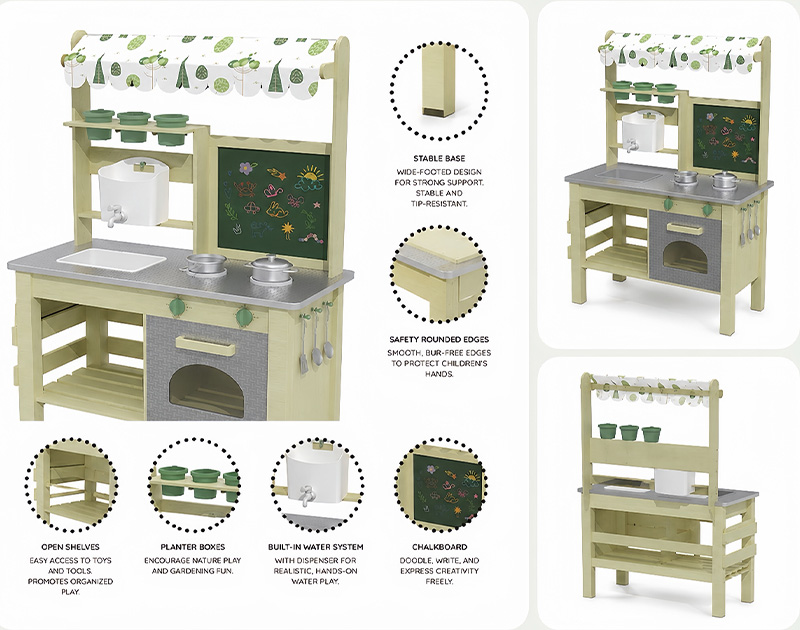
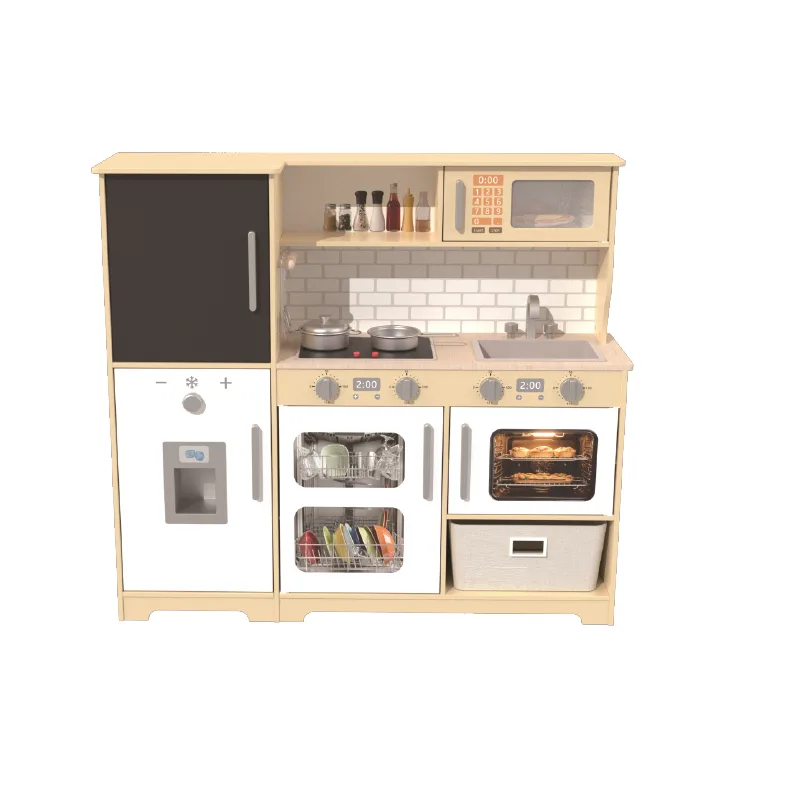
There is a third path worth naming before the head-to-head: hybrid construction. Many of the best-selling kitchens on the market pair a wooden cabinet body with select plastic or metal accessories — a plastic tap that actually turns, metal hinges that survive 5,000 open-close cycles, or plastic burner dials that click. The question is not always "all wood or all plastic"; it is which material carries which function. We will flag hybrids where they change the economics.
Material cost and unit economics
At the ex-factory level, a wooden play kitchen and a comparable plastic kitchen differ in cost structure, not merely in cost level. A plastic kitchen concentrates its cost in tooling: a full-size injection mold for cabinet panels runs tens of thousands of dollars before the first production unit, after which each unit is fast to mold and cheap to assemble. A wooden kitchen carries modest tooling cost — CNC fixtures, drilling jigs, printing plates — but each unit consumes board, cutting time, edge treatment, printing, and hands-on assembly.
The practical consequence is a different cost curve. Plastic wins decisively at high volume: once the mold is paid for, unit cost falls fast and stays low. Wooden cost declines more gently with volume because board and labor floor it. For a buyer ordering 1,000 to 3,000 units per style, a wooden kitchen typically lands at roughly 1.5 to 2.5 times the ex-factory price of a comparable plastic unit; below that volume the gap widens because wooden programs cannot amortize their fixed inputs. Above roughly 10,000 units per style, the gap narrows somewhat but rarely closes — wood does not become cheap, plastic simply becomes cheaper.
Two second-order cost items are easy to miss. First, finishing: a wooden kitchen's visual quality lives in its printing and coating, and buyers who economize here get a product that looks low-grade on shelf, undermining the entire material premium. Second, hardware: hinges, magnets, and turning knobs are shared cost drivers in both materials, but wooden kitchens typically use more of them (real opening doors), so the hardware line deserves its own RFQ line item rather than hiding inside "assembly".
| Cost dimension | Wooden play kitchen | Plastic play kitchen |
|---|---|---|
| Tooling investment | Low to moderate (fixtures, jigs, printing plates); reusable across styles | High (injection molds per panel design); style-specific |
| Unit cost at 2,000 pcs/style | Baseline; board + labor dominated | Roughly 40–60% lower where mold is amortized |
| Unit cost curve vs volume | Declines gently; board and labor floor it | Declines steeply after tooling payback |
| Style refresh cost | Low — new graphics and colorways on existing structure | High — new artwork needs new mold or costly tooling changes |
| Finishing sensitivity | High; print and coating quality define perceived grade | Moderate; in-mold color carries the look |
| Hardware content | Higher (functional doors, hinges, turning knobs) | Lower or integrated (molded snap features) |
One caveat buyers should apply to any supplier quote: compare kitchens at equal specification, not equal price. A wooden kitchen with MDF cabinet bodies, printed front panels, and four accessories is not comparable to a plastic kitchen with an electronic tap and a light-up burner — the specification gap will masquerade as a material gap in the quote comparison.
Safety and compliance: what differs between the two materials
Both materials can be fully compliant; neither is inherently "safer". What differs is where the compliance risk lives and how much of it you can see and control.
In a wooden kitchen, the risk-bearing surfaces are the coatings. Paints, inks, and lacquers must control heavy-metal migration — this is the core of EN 71-3, and it is the standard we test against for every wooden style we export to the EU. In a plastic kitchen, the watch items are different: plasticizers and other additives in the polymer, small-parts integrity of molded clips, and the behavior of decorative films. Neither list is longer or shorter in principle; the practical difference is that a wooden program concentrates testing on the finishing system, which a factory can standardize across its whole range, while a plastic program's risk profile is locked into the resin and masterbatch choices — which the buyer rarely sees.
There is also a structural difference in how failures present. Wood fails benignly — a corner chips, an edge scuffs, the unit remains a lump of solid material. Thin-wall plastic can crack into sharp fragments or shed small parts, which is why small-parts and impact testing carry so much weight in plastic programs. A responsible wooden manufacturer still designs for impact — rounded corners cut in one CNC pass, fixed shaker-style panels instead of thin membranes — but the material itself does not create shard hazards.
For program planning, assume both material paths need the same certificate architecture. Our export program runs against six credentials: EN 71-3 for heavy-metal migration (EU), CPSC / ASTM F963 for the US market, ISO 9001:2015 for the quality system, BSCI and Sedex (SMETA) for social compliance, and FSC CoC for chain-of-custody board. Test reports are issued per product (model/style), so a wooden kitchen and a plastic kitchen in the same program each carry their own report — the material choice does not reduce testing scope, and any supplier who tells you the material makes testing "simpler" is selling you a shortcut you will pay for at customs or at a retailer's audit.
Durability, weight and freight economics
Wood is heavier, and heavier is not automatically worse — it depends on who pays for what, and when.
A wooden kitchen typically weighs 40 to 80 percent more than a comparable plastic unit. In ocean freight under carton-volume billing, weight rarely dominates — most full-container kitchen programs are volume-constrained, not weight-constrained, so the extra kilograms are often absorbed without a freight-rate change. The freight penalty becomes real in air freight, in last-mile parcel programs (DTC brands shipping individual kitchens to consumers), and in any channel where dimensional-weight pricing applies.
Where wood quietly wins is survival and returns. Wooden cabinet structures resist compression stacking in the warehouse, tolerate rougher cross-dock handling, and arrive at retail in sellable condition at higher rates. Thin-wall plastic kitchens crack in transit more readily, and a cracked cabinet is a return, not a repair. For a wholesale buyer the damage rate shows up as a claims line and as shelf availability at your retail accounts; a two-point difference in transit damage across a 2,000-unit program is a noticeable number.
Packaging engineering deserves equal attention in both paths. A flat-pack wooden kitchen ships as 2–3 cartons with foam corners and edge protectors; the assembly burden moves to the consumer, which suits furniture-style retail. A plastic kitchen typically ships substantially assembled, which simplifies the consumer experience but consumes far more carton volume per unit — and carton volume, not weight, is what fills containers.
For a deeper dive into the freight-and-tooling trade-offs specific to this category, see our comparison of how play kitchen suppliers differ on MOQ, tooling and freight: How Do Play Kitchen Suppliers Compare on MOQ, Tooling and Freight?
Brand positioning, retail price and sustainability value
This is where wooden kitchens justify their cost premium, and it is the dimension plastic cannot easily copy.
In most developed markets, a wooden kitchen retails at two to four times the price of a comparable plastic unit. Buyers pay it for reasons that are only partly about the material itself: the weight and tactile quality read as "furniture, not toy"; the aesthetic integrates into living spaces parents photograph; and the product survives long enough to be handed down, resold, or donated — all of which feed the sustainability story. Retail buyers in specialty, catalog, and Montessori-adjacent channels increasingly specify wooden construction as a merchandising requirement, not a preference.
The sustainability claim needs discipline to be usable. FSC-certified board is available on request, within our FSC CoC scope covering wooden children's toys, building blocks, educational aids, wooden crafts, and wooden packaging boxes — buyers should confirm the specific SKU falls inside that scope before printing the claim on retail packaging. Wooden kitchens also lend themselves to honest material narratives (solid beech handles, birch ply cabinet bodies) that a plastic unit cannot match at any price point.
Plastic retains genuine brand advantages worth stating fairly: unlimited color freedom, integrated "wow" features (lights, sounds, running-water effects), and wipe-clean surfaces that some commercial settings — daycares, medical waiting rooms — explicitly require. The right question is which channel you sell into. A housewares retailer's toy endcap and a Montessori catalog are buying different products even when the floor plan is identical.
The macro trend favors wood: plastic-free positioning is now a measurable purchase driver in European and American parenting markets. We analyze this shift in our plastic-free toy trend analysis.
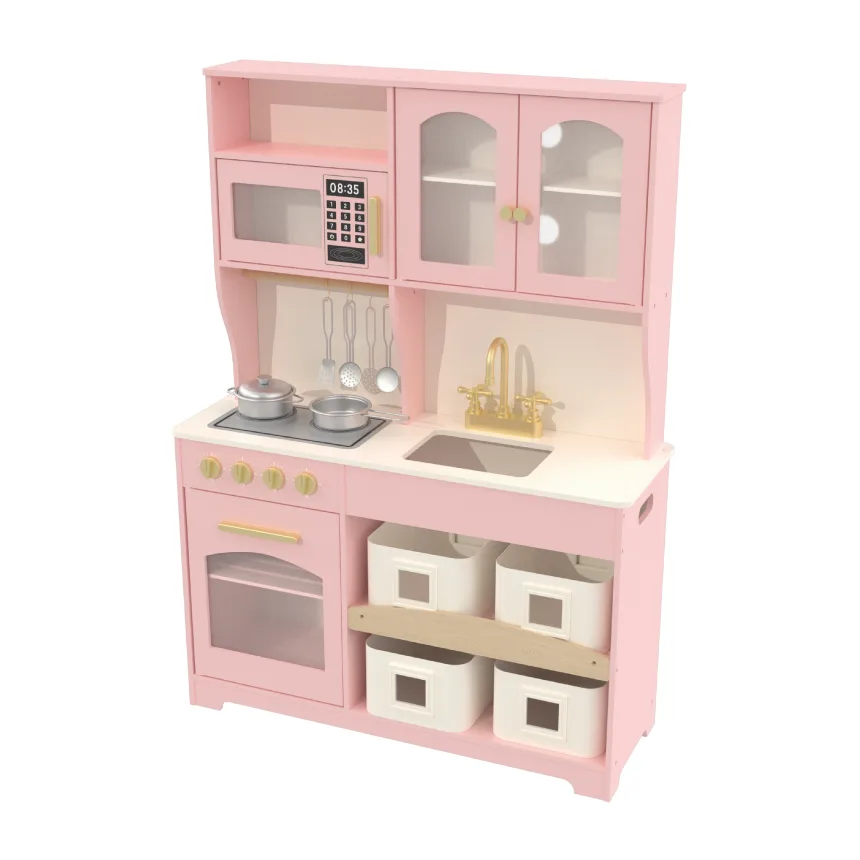
Assortment planning is where the two materials can work together instead of competing. Many buyers anchor the program with one or two hero wooden kitchens at a higher retail price, then extend the line with lower-priced add-on SKUs such as play food, utensils and accessory packs, so the shelf tells one coherent story. If you are building that anchor around a custom wooden pretend play toys program, confirm early how each add-on SKU matches the kitchen scale, the color story and the packaging format, because retrofitting an incompatible accessory line costs far more than planning it before sampling.
Production reality: tooling, MOQ and lead times
Buyers evaluating the wooden path should ground the decision in production facts, not catalog photos. Four numbers matter.
MOQ. Our MOQ structure is per style, not per order: large structural products — play kitchens, doll houses, outdoor climbing frames — and pure-wood products run at 500 pcs/style; products with a high proportion of plastic accessories and small items run at 1,000 pcs/style. A wooden kitchen with plastic taps and cookware accessories will typically be confirmed per SKU, because the accessory share moves the number. Confirm the exact figure per style before sampling — it is final at SKU level, not negotiable into a blended average.
Sampling. An existing-style sample takes 7–10 working days; a fully custom kitchen built to your drawings takes 15–20 working days, excluding courier time. Sample fees typically range from USD 200–500 per sample depending on product and process complexity, with the exact fee confirmed per design. If the approved design goes to mass production of 5,000 pieces or more for the same style, the basic sample fee is credited against the bulk payment or refunded, provided the sample was approved in writing.
Lead time. After sample approval, bulk production takes 30–45 days, extending to 45–60 days in the peak season (Q2–Q3) — and kitchens sit at the long end of both ranges because they concentrate finishing, sub-assembly, and packing labor. Neither figure includes ocean transit.
Precision. Our CNC cell — multi-spindle routers with automatic tool changers under central dust extraction — holds machining accuracy of ±0.1–0.2 mm. That number is a machining capability, not a finished-product tolerance promise; doors close flush because the panel, the hinge seat, and the edge banding are cut in coordinated passes. Accept DXF/STL files, or hand sketches that our engineers convert into tool paths.
Commercial terms follow our standard program: T/T with 30% deposit and the balance against copy of B/L, or irrevocable L/C at sight; samples via PayPal. If you are weighing supplier types rather than materials, the decision framework is the same one we lay out in Should You Buy Wooden Pretend Play Toys from a Supplier or a Factory?
The side-by-side comparison and a pre-RFQ checklist
| Decision factor | Wooden play kitchen | Plastic play kitchen | Advantage |
|---|---|---|---|
| Unit cost (mid volume) | Baseline | 40–60% lower (mold amortized) | Plastic |
| Tooling cost per new style | Low (graphics-led refresh) | High (mold per design) | Wooden |
| Compliance risk focus | Coating system (EN 71-3) | Resin/additives, small parts | Even — both fully testable |
| Transit survival / returns | High compression and drop tolerance | Crack-prone in thin walls | Wooden |
| Retail price ceiling | 2–4× plastic at shelf | Mass-market pricing | Wooden |
| Color and feature freedom | Print-limited; hybrid adds features | Unlimited; lights/sounds integrate | Plastic |
| Sustainability story | FSC CoC scope, heirloom narrative | Limited; improving via recycled resins | Wooden |
| Commercial settings (daycare etc.) | Requires careful coating spec | Wipe-clean by default | Plastic |
| Freight mode fit | Ocean FCL, flat-pack 2–3 cartons | Air/parcel-friendly when unassembled | Sit. — see freight section |
| Best-fit channel | Specialty, catalog, Montessori, gifting | Big-box, volume, commercial | Depends on channel |
Before you send any kitchen RFQ, close these five gaps — the quotes you get back will be comparable, and the program will start on data instead of assumptions:
- Define the channel and target retail price band first; the material decision usually falls out of it.
- Specify hybrid tolerance: which functions may be plastic or metal (taps, hinges, dials) and which must stay wood.
- State the finish grade: number of printed panels, coating system, and any retail-packaging sustainability claims you intend to print (FSC wording included).
- Ask for the MOQ per style in writing, with the accessory-share logic made explicit.
- Request the test-report scope per product (model/style) — EN 71-3 for EU shipments, CPSC / ASTM F963 for US — before sample approval, not after.
If the comparison lands on wooden — or on a wooden-body hybrid — the next step is a specification conversation, not a catalog order. Bring your channel, target retail price, and accessory wish list; we will come back with structure options, finish grades, and a per-style MOQ confirmation. Start from our OEM and ODM wooden toy development page to see how a custom program runs from artwork to shipment.
Frequently Asked Questions
Why do wooden play kitchens cost more than plastic ones?
Is a wooden play kitchen safer than a plastic one?
Can a wooden kitchen include some plastic parts?
How long does a custom wooden kitchen take from artwork to shipment?
Compare Play Kitchen Options for Your Market
Send us your channel, target retail price band, and accessory list. We will return structure options, finish grades, a per-style MOQ confirmation, and a sampling plan — typically within two working days.
Start an OEM/ODM Project