



What Should You Check Before Ordering Chunky Animal Puzzles from a Manufacturer?
Before placing an order for chunky animal puzzles, check four things at the factory level, not the catalogue level. First, edge finish: every chunky piece should leave the line sanded and rounded, with no fuzz, no sharp arris and no chipped veneer on the knob or grip. Second, print durability: ask which printing method is used for the artwork surface — direct screen print, thermal transfer or digital UV — and request a scratch-and-wipe sample, because a puzzle that looks good on day one but fades at the edges generates returns. Third, packing engineering: the inner tray must immobilize every piece, and the export carton should survive a documented drop test orientation plan. Fourth, paper-level compliance: EN 71-3 migration test reports issued per product (model/style), FSC-certified board on request, and a production schedule you can audit. A manufacturer that can show all four in one factory visit — or one video call — is a manufacturer you can hand a repeat order to.
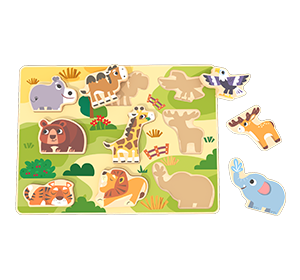
Chunky animal puzzles look like the simplest product in the wooden toy catalogue. A handful of thick pieces, a friendly elephant or a farm cow, a peg or a knob to grip. That simplicity is exactly why so many importers treat them as a catalogue commodity — and why so many first shipments disappoint. The piece that looked solid in the sample arrives with a rough edge under the knob. The lion's mane print starts lifting after two weeks on a retail shelf. The inner box opens to find pieces rattling loose because nobody specified a partition.
None of these failures come from bad intentions. They come from ordering a puzzle without specifying the three things that decide whether a chunky puzzle survives real toddlers, real shelves and real container journeys: edge finish, print wear resistance and drop-tested packing. This guide walks through each one from the buyer's side — what good looks like, what the red flags are, and what to ask a wooden puzzle manufacturer before you confirm an order.
What this guide covers
- Why chunky puzzles punish shortcuts more than any other wooden toy
- Edge finish: the check you can do with your thumb
- Print wear: why the artwork surface is a specification, not a detail
- Drop-test packing: engineering the journey, not just the product
- Side-by-side checklist you can send to any factory
- Timelines, MOQ and sample economics at KIDMERRY
- FAQ
Why chunky puzzles punish shortcuts more than any other wooden toy
A chunky puzzle concentrates every wooden toy quality risk into a small, heavily handled object. The pieces are thick — usually 15 to 18 mm board — so toddlers grip them, gum them, bang them on tray tables and carry them around the house. The tray gets flexed. The artwork is touched hundreds of times a week. And the whole set ships in a box that a distributor may stack, drop and re-stack before it reaches a shelf.
Compare that with a large dollhouse, where most stress sits on the structure and the buyer inspects it once at assembly. A chunky puzzle gets abused daily and judged at arm's length. That is why experienced buyers evaluate a puzzle manufacturer on the three wear surfaces — edge, print and packaging — before they even talk about price. Price decides your margin on the first order. Those three decide whether there is a second order.
There is also a compliance dimension. Any wooden puzzle for under-three use in the EU falls under EN 71-3 heavy metal migration requirements, and small-part geometry matters for the age grading on the box. If your supplier cannot produce test documentation per product (model/style) — not a blanket certificate for "wooden puzzles" as a category — you are importing somebody else's paperwork risk. We cover the document side in depth in our guide to which compliance documents wooden toy importers need from a manufacturer.
Edge finish: the check you can do with your thumb
Run your thumb firmly around the edge and the underside of any chunky puzzle piece. On a well-finished piece you feel a continuous, rounded surface — no ridge where the top laminate meets the side, no fibres catching skin, no sharp corner where the knob meets the body. On a rushed piece you feel it immediately. Buyers who have been burned once learn to do this test before they look at anything else, because edge quality is the single most honest indicator of how a factory runs its sanding and finishing line.
What you are actually checking is the last three steps of production. First, profiling: the piece outline should be cut and rounded in the same setup, so the radius is consistent across a batch rather than dependent on which operator was at the sander. In our own workshop, puzzle outlines are cut on CNC routers where the toolpath holds a machining accuracy of ±0.1–0.2 mm, which is what keeps the knob centred and the finger hole consistent from piece 1 to piece 5,000. Second, progressive sanding: edges need the same grit progression as faces, not a single fast pass. Third, the finish coat: a puzzle that will be wiped clean daily needs a sealed edge, because an unsealed MDF or plywood edge is where moisture enters and where lifting starts.
The red flags are specific. Fuzz or splinters along the underside — the sanding pass skipped the contour. A sharp arris at the top edge — the rounding radius is too small or the sanding head was worn. Glue squeeze-out darkening the edge line — pressing pressure or glue metering is off, and it will show worse after coating. Colour variation between pieces of the same animal in one batch — the board sourcing or batching is loose. None of these are visible in a retouched product photo, which is exactly why the physical sample matters more for chunky puzzles than for almost any other wooden toy category.
One more practical note: knobs and pegs are the highest-stress geometry on the piece. A chunky puzzle knob takes sideways torque every time a small hand pulls it out of the tray at an angle. Ask how the knob is joined — a glued dowel into a drilled hole with proper hole diameter control outlasts a surface-bonded knob every time. This is also where a factory with in-house CNC tooling separates itself from one buying pre-cut blanks, because the joint quality starts with hole accuracy.
Two details are worth putting in the specification rather than leaving to the workshop. The first is the sanding sequence: a consistent edge radius comes from a defined grit progression on the contour as well as on the face, not from one fast belt pass, and it is the reason a batch can feel uniform from the first piece to the last. The second is the seal coat on the cut edge. Ask whether the edge is sealed before or after the artwork is applied, because a seal laid over printed edges can change how the colour behaves under wiping, while a seal applied to the face only leaves the board core exposed at the sides.
Print wear: why the artwork surface is a specification, not a detail
The artwork is what sells the puzzle on the shelf and what the child touches every day, and it is the surface most likely to fail. Print wear on wooden puzzles shows up in three ways: colour lifting at the piece edges where the artwork wraps the contour, scuffing on high points that get handled most, and fading where cleaning wipes have been used repeatedly. All three are predictable, and all three can be engineered out — if the printing method is chosen to match the artwork, not the other way around.
The three common methods behave differently. Direct screen printing lays down a thick, hard-wearing ink layer and is economical for simple, flat-colour animal graphics at volume. Thermal transfer wraps full-colour artwork around edges and handles photographic detail well, with strong scratch behaviour when properly sealed. Digital UV printing offers short-run flexibility and fine detail for multi-colour sets, and its durability depends heavily on the topcoat. There is no single best method — there is a right method per design, and a manufacturer worth ordering from will tell you which one they are quoting and why, rather than defaulting to whichever machine is free that week.
| Printing method | Best for | Wear behaviour | Ask the factory |
|---|---|---|---|
| Direct screen print | Flat-colour animals, high volume, bold shapes | Thick ink film resists handling; colour count limited per design | How many colours in my design, and what is the per-colour setup cost? |
| Thermal transfer | Full-colour artwork, gradient shading, edge wrapping | Excellent edge wrap; needs a proper seal coat on top | Show me a scratch-and-wipe sample of a transfer-printed piece, sealed. |
| Digital UV | Short runs, fine detail, multi-SKU series | Detail-strong; topcoat quality decides scuff life | What topcoat system goes over UV, and has it been abrasion-checked? |
Whatever the method, the acceptance test is the same and you can do it yourself in two minutes on the pre-production sample: rub the printed surface firmly with a dry cloth for thirty seconds, then with a damp cloth, and inspect the high points and the piece edges. Ink on the cloth, or clouding at the corners, means the seal is not right. Do this before the production run, not after it, because print wear is baked in at the finishing stage and cannot be fixed by sorting finished goods.
If your program is fully custom — your own animal artwork rather than a factory standard design — print specification belongs in the artwork handover, not in an email thread after sampling. The workflow matters here: artwork goes through development into a priced prototype before bulk, and if you want to see how that works end to end, our guide on how artwork becomes a priced custom puzzle prototype walks through the stages and where the costs land.
The approval point matters as much as the test. Agree the print method and the topcoat on a sealed pre-production sample and record it in writing before bulk starts, because once the ink is cured and the sets are packed there is no sorting step that restores a weak seal. For multi-SKU animal series, ask for one approved wear sample per artwork family rather than a single "representative" piece — colour count and ink coverage differ between a flat-colour cow and a gradient-shaded forest scene, and so does scuff behaviour. Keep the approved sample with your purchase order; it is the reference both sides reach for if a later shipment looks different on the shelf.
Drop-test packing: engineering the journey, not just the product
A chunky puzzle's hardest life stage is not the playroom — it is the forty days between the finishing line and the retail shelf. Pallets get clamped, cartons get double-stacked in a container, and somewhere in every shipment a box takes a corner drop. For a heavy, dense product like thick wooden pieces, inadequate packing does not just risk cosmetic damage: pieces that shift inside a carton abrade each other, and print wear that survived the finishing line can be created by the freight itself.
Good puzzle packing is specified in three layers. The piece layer: does each piece sit in a formed tray or a partitioned inner box so nothing can move more than a few millimetres? The inner-box layer: is the stack count per inner box calculated against the compression the export carton will see, and are the puzzles separated from each other by a bag or sleeve so face-to-face printing contact cannot cause transit scuffing? The carton layer: what is the carton specification — board grade, wall construction, stacking strength — and is the pallet pattern planned so cartons are not bridging over unsupported gaps?
Then the question that separates exporters from packers: show me the drop-test logic. A manufacturer that ships wooden puzzles at volume should be able to tell you which orientations the carton was dropped from, what the piece condition was afterwards, and what changed in the packing spec as a result. You are not looking for a lab certificate for every SKU — you are looking for evidence that packing is treated as an engineering subject with a feedback loop, not a cost line to be minimized. In practice, this conversation also settles the freight details that matter to your landed cost: carton external dimensions, gross weight per carton, pieces per carton, and how the carton behaves on a EUR pallet versus a US one.
One buyer-side habit worth building: keep one packed inner box from your first order, unopened, labelled with the shipment and carton number. If a later order shows transit damage, that archive box is your reference for whether the packing spec drifted — and it turns a quality dispute into a two-minute comparison instead of a blame exchange.
Freight conditions are part of the same conversation. A container can sit in a humid port before loading and cross several climate zones afterwards, so board-based trays and paper sleeves need to hold their shape and keep printed surfaces separated for the whole journey, not just on the day they are packed. Pallet choice changes the spec too: a carton that stacks cleanly on a EUR pallet may be loaded differently on a US one, and the drop orientations should be recorded against the pattern you will actually ship. Ask the factory to state the carton external dimensions, gross weight and pieces per carton on the packing drawing — those three numbers are what your freight forwarder needs, and they are the quickest way to spot a packing spec that has not been thought through.
The side-by-side checklist you can send to any factory
The table below condenses the three check areas into the form that survives a real sourcing conversation: what to verify, what good looks like, what the red flag is, and the exact question to put to the manufacturer. Send it with your RFQ — a factory's response style to this table tells you almost as much as the answers themselves.
| Check | What good looks like | Red flag | What to ask |
|---|---|---|---|
| Edge finish | Continuous rounded edges, no fuzz, sealed contour, consistent knob joints | Sharp arris, underside splinters, glue lines visible after coating | Walk me through your sanding and edge-sealing steps for chunky pieces. |
| Print durability | Method matched to artwork, sealed topcoat, clean scratch-and-wipe sample | "We print however is available", no sample offered | Which print method for my design, and can I approve a sealed wear sample? |
| Piece fit | Pieces seat flush, lift out with a grip, no wobble in the tray | Pieces rock in the tray or need forcing | What tolerance do you hold between piece and tray recess? |
| Packing | Formed tray or partitions, pieces bagged, carton spec declared, drop orientations documented | Pieces loose in inner box, carton spec unknown | Show me the packing drawing and the drop-test orientation plan. |
| Compliance paper | EN 71-3 reports issued per product (model/style); FSC-certified board available on request within certificate scope | One blanket certificate for "all wooden toys" | Send a sample test report for a puzzle model, with the model number on it. |
| Production control | Named contact, staged updates, sample approved in writing before bulk | Only a salesperson between you and the workshop | Who owns my project after the PO, and how do I reach the workshop? |
Notice what the table does not contain: price, lead time or MOQ. Those are commercial terms, and they are easy to compare. The rows above are capability terms, and they are what make the commercial terms real. A quote that is 8% lower means nothing if the edge finish row and the packing row fail.
Put the three checks in writing before you pay for a sample. Standard-design samples take 7–10 working days and samples built from your own drawings take 15–20 working days, both excluding courier time; bulk production runs 30–45 days after sample approval, extending to 45–60 days in the Q2–Q3 peak season. Locking edge finish, print method and packing into the approved sample is far cheaper than discovering a weak seal after the cartons are sealed.
A five-line RFQ checklist you can paste into your enquiry
- Edge finish: state the required rounded radius, sealed cut edge and knob-joint method, and ask for the sanding and edge-sealing steps in writing.
- Print wear: name the artwork type, ask which print method and topcoat are quoted, and request a sealed scratch-and-wipe sample for written approval before bulk.
- Piece fit: ask for the tolerance held between each piece and its tray recess, and confirm it on a full set rather than a single piece.
- Packing: request the packing drawing, carton dimensions, gross weight, pieces per carton and the drop-test orientation plan.
- Documents: ask for test reports issued per product (model/style) covering EN 71-3 heavy metal migration and CPSC / ASTM F963, with FSC-certified board available on request within certificate scope.
How these checks map to factory capability
Everything in the checklist traces back to what the factory actually controls in-house. Edge consistency comes from cutting and sanding on the same equipment park; at KIDMERRY the puzzle outlines, finger holes and knob holes are machined on multi-spindle CNC routers with automatic tool change, holding the ±0.1–0.2 mm machining accuracy that piece-and-tray fit depends on. Print durability comes from having the three printing methods available in-house and the finishing line to seal them properly. Packing engineering comes from exporting wooden toys at volume and treating carton performance as part of the product. And the document layer — the part your customs broker and your retail customers will eventually ask about — comes from running certified systems: EN 71-3 heavy metal migration testing, CPSC / ASTM F963 for the US market, ISO 9001:2015 quality management, and social-compliance audits under BSCI and Sedex (SMETA), with FSC-certified board available on request for buyers whose programs require it — worth confirming your specific SKU falls within the FSC certificate scope, as our materials guide on what makes a wooden toy safe explains alongside the material choices themselves.
This is also the honest dividing line between a manufacturer and a trading supplier for this category. A trading company can absolutely pass your enquiry to a puzzle factory and relay your emails — and for a mixed container from multiple product categories, that can be the right tool. But the checklist above can only be answered definitively by the people standing next to the sanding line, the printing machines and the packing station. If your chunky animal puzzle program is a core line rather than a filler SKU, the distance between you and those people is worth something. We put the full comparison in our supplier-versus-factory guide, and the OEM side of the conversation — from your artwork to a running production line — is what our OEM and ODM wooden toy development page covers.
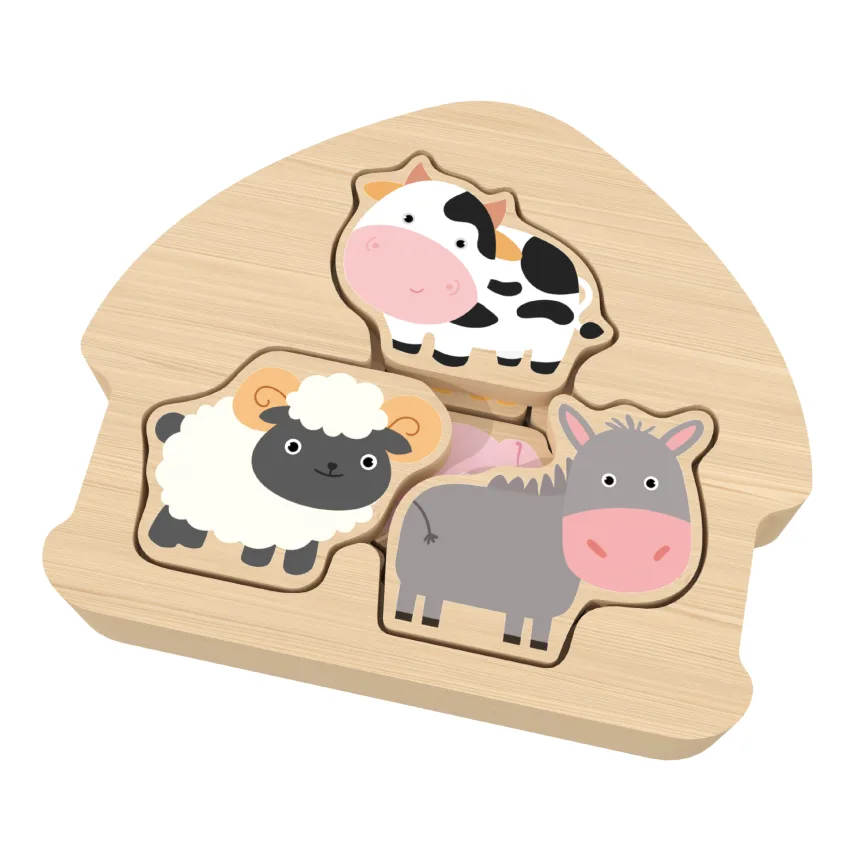
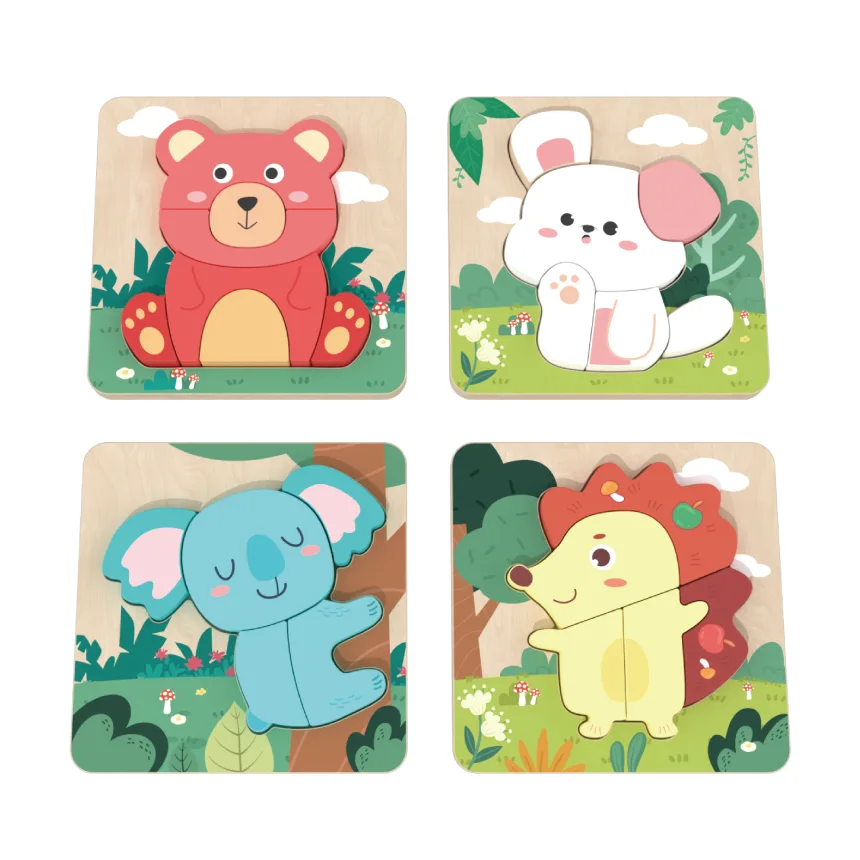
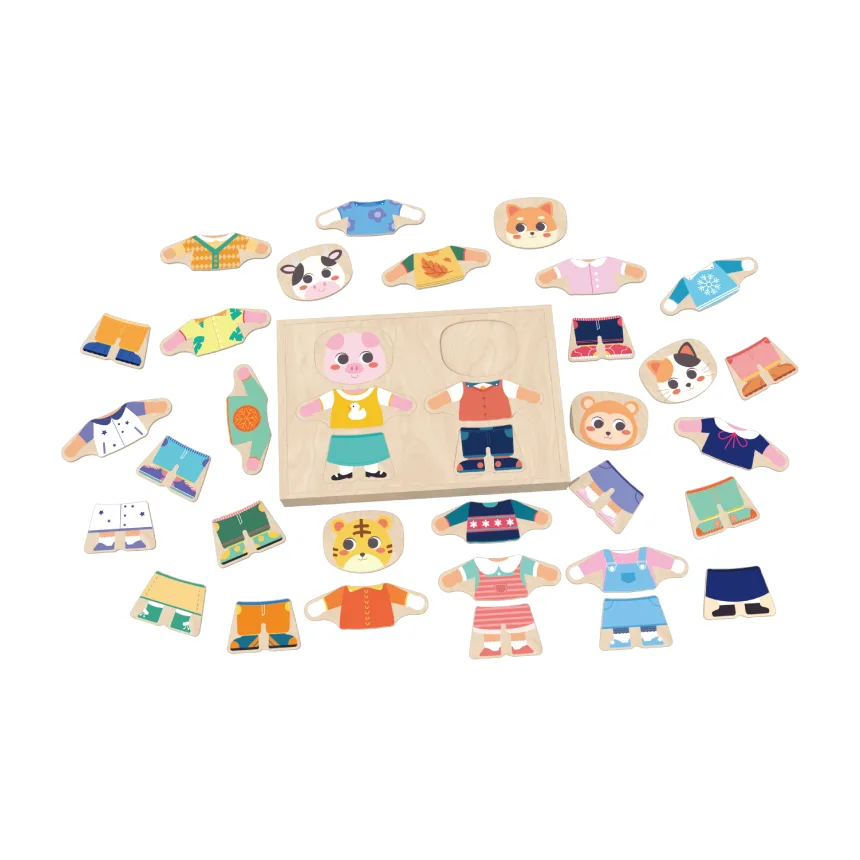
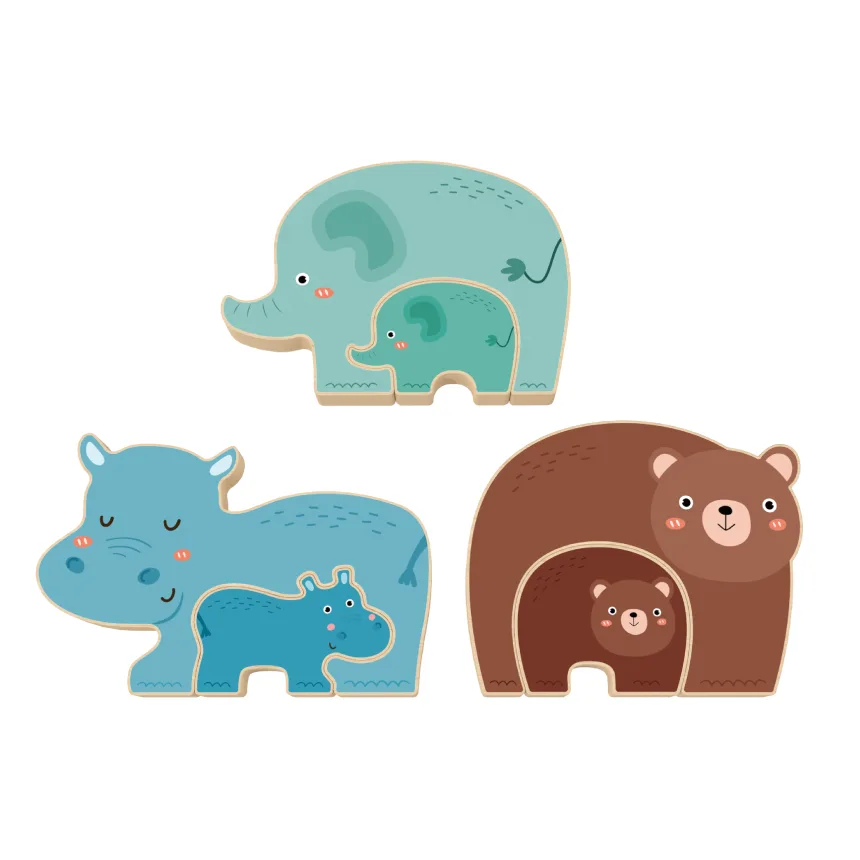
To make that concrete with the products themselves: a custom wooden animal puzzle for toddlers is the classic chunky format — thick board, grip-friendly pieces, artwork as the selling surface — and every check in this article applies to it directly. The farm animal peg puzzle adds the peg geometry, which brings the knob-joint question from the edge-finish section into play. Both formats are produced in-house from board machining through printing to packing, which is why the checklist can be answered with a workshop walk-through rather than a promise.
Timelines, MOQ and sample economics
The commercial frame at KIDMERRY, so you can benchmark any quote against it. Standard-design samples take 7–10 working days; samples built from your own drawings take 15–20 working days, both counted from confirmation and excluding courier time. Bulk production runs 30–45 days after sample approval, extending to 45–60 days in the Q2–Q3 peak season — plan ocean freight on top of that, not inside it.
On order size, wooden puzzle economics follow the same structure as the rest of the range: large structural items or all-wood designs sit at 500 pieces per style, while designs with a higher share of plastic fittings or very small pieces start at 1,000 pieces per style — and the final number is always confirmed per SKU, because a puzzle with sound electronics is not the same production animal as a plain chunky set. Sample fees typically range from USD 200–500 per sample depending on product and process complexity, with the exact fee confirmed per design; if the sample is approved in writing and mass production of the same design reaches 5,000 pieces, the basic sample fee is credited back against the bulk order or refunded. Payment runs as T/T with 30% deposit and the balance against copy of B/L, with irrevocable L/C available for established programs.
If your artwork is ready and you are working toward a launch date, the sampling window is the moment to lock the three checks from this article into the specification — not after the bulk PO. It is far cheaper to reject a pre-production sample on print wear than to discover the same issue in a sealed carton in your warehouse.
Frequently Asked Questions
What MOQ should I expect for custom chunky animal puzzles?
All-wood chunky puzzle designs start at 500 pieces per style; designs with more plastic fittings or very small pieces start at 1,000 pieces per style. The final number is confirmed per SKU before quotation, since electronics or mixed materials change the production setup.
Which printing method lasts longest on puzzle artwork?
None lasts longest in absolute terms — the right method depends on the artwork. Flat-colour animal graphics suit screen printing with its thick ink film; full-colour artwork with edge wrapping suits thermal transfer under a seal coat; short multi-SKU runs suit digital UV with a verified topcoat. The decisive test is the dry-and-damp cloth rub on a sealed pre-production sample, whichever method is quoted.
What packing information should I request before confirming an order?
Ask for the packing drawing: inner-box tray or partition layout, pieces per inner box, carton dimensions, gross weight, cartons per pallet, and the drop-test orientation plan the carton was validated against. Also request one unopened archive inner box from your first shipment as a reference for later orders.
Which documents prove the puzzles are compliant for export?
Test reports issued per product (model/style) covering EN 71-3 heavy metal migration for the EU and CPSC / ASTM F963 for the US, backed by the factory's ISO 9001:2015 system and social-compliance audit status (BSCI, Sedex SMETA). FSC-certified board is available on request — confirm your SKU falls within the FSC certificate scope before making on-pack claims.
Planning a chunky animal puzzle order?
Send us your artwork or your target specification — edge finish, print method and packing included — and we will come back with a structured quotation, a sample schedule and the document package that goes with it.