



What Does MOQ per Style Mean for a Shape Sorter Cube Trial Run?
For a brand, importer or wholesaler introducing a wooden shape sorter cube, a trial order is the cheapest way to test demand before committing to a full season. One detail trips up more first orders than any other: the minimum order quantity.
Quick Answer: For wooden shape sorter cubes, KIDMERRY's MOQ is 1,000 pcs per style — the standard threshold for small items in the wooden learning range; large structural items start at 500 pcs per style. The minimum applies to each design on its own, not to the purchase order total: four styles at 250 units is a 1,000-unit order in which no single style qualifies. Styles and colors are not combined automatically — shared-component coordination is possible only where the factory assesses it and confirms it in writing.
The arithmetic is what catches first orders. A factory quotes per style because each design gets its own setup, so a container's worth of mixed small runs can be unbuildable while the total quantity looks healthy. This guide covers what drives that number for shape sorter cubes, and how to size a trial run that actually ships.
1. What MOQ per Style Means for Shape Sorter Cubes
MOQ is the smallest quantity a manufacturer will produce under a given set of production conditions. The question that matters is the unit the MOQ is counted in.
MOQ per order. One minimum for the whole purchase order, whatever the mix of styles inside it. Simple for the buyer, and increasingly rare for wood products, because the factory still has to set up each design separately.
MOQ per style. A minimum for each individual design or model. A 3,000-unit order across six designs does not automatically clear a 1,000-unit per-style threshold — it clears it only if each design reaches 1,000 on its own.
MOQ per color. A minimum for each color configuration, applied when a color change requires separate paint preparation, separate material planning or a separate run through finishing. Whether color counts separately depends on the finishing process, so it has to be asked rather than assumed.
What KIDMERRY's standard MOQ is
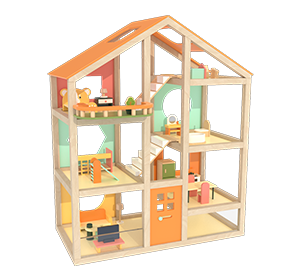
For wooden shape sorter cubes, KIDMERRY's standard MOQ is 1,000 pcs per style. That figure comes from the product class: small items in the wooden learning and education toys range are scheduled at 1,000 pcs per style, as are constructions with a high proportion of plastic components. Large structural pieces — dollhouses, play kitchens, outdoor climbing frames — start at 500 pcs per style.
The category is confirmed per design, not inferred from material alone: a small solid-wood sorter cube sits at 1,000 pcs per style, while a large solid-wood dollhouse sits at 500.
The threshold is per style, never per order — and 1,000 pcs is the floor for standard production. A quotation confirms the figure for a specific design, material and packaging combination.
The same order, three ways
Take a buyer planning 2,000 wooden shape sorter cubes. Every mix below totals the same 2,000 units; the mix decides whether the order can run:
| Mix on the purchase order | Can it be scheduled? |
|---|---|
| Two styles, 1,000 each | Yes — both styles clear the per-style threshold |
| Four styles, 500 each | No — every style sits at half the minimum |
| Ten styles, 200 each | No — the catalogue looks impressive, the order cannot run |
The lesson is structural, not commercial: the number that decides whether an order runs is the smallest per-style quantity in it, not the sum on the purchase order.
2. Why Two Similar Cubes Can Carry Different Requirements
Two shape sorter cubes can sit side by side in a catalogue, look like variations of one product, and still require separate production arrangements. The MOQ difference follows the manufacturing difference.
Product structure and components
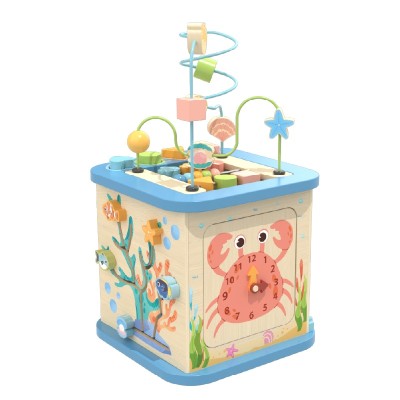
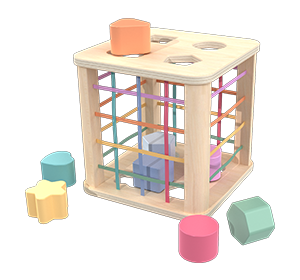
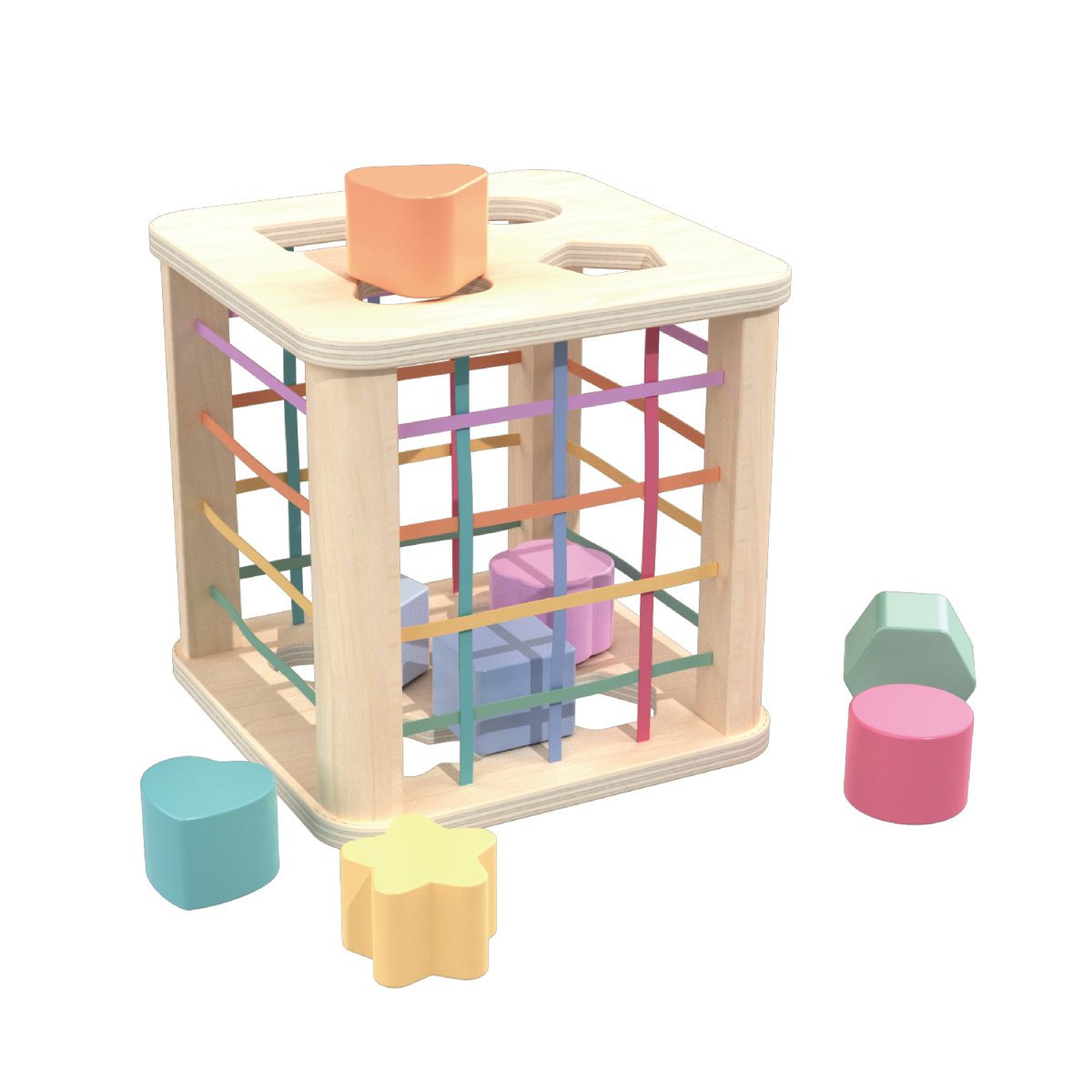
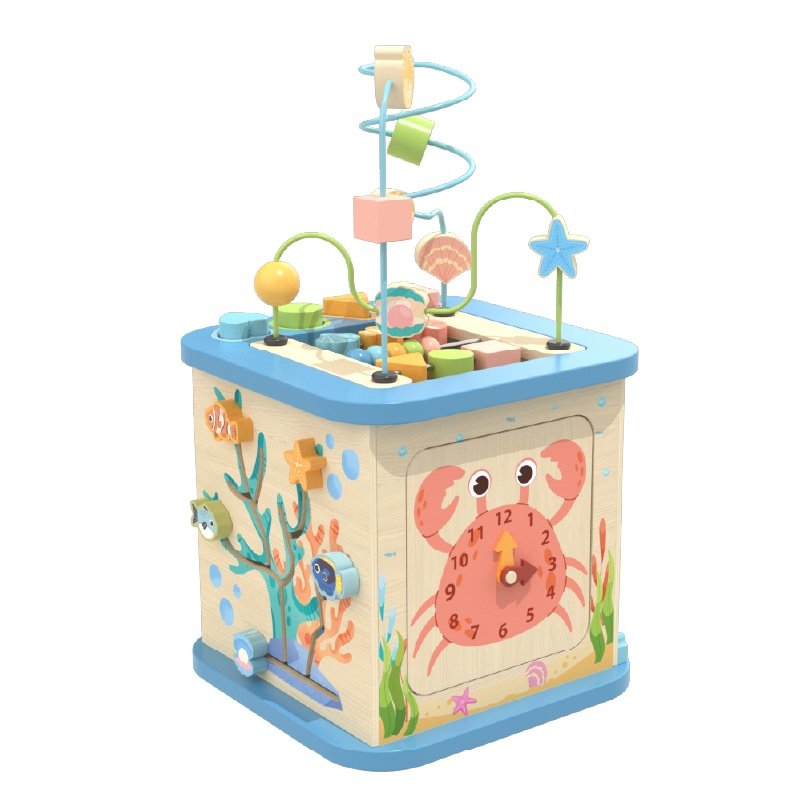
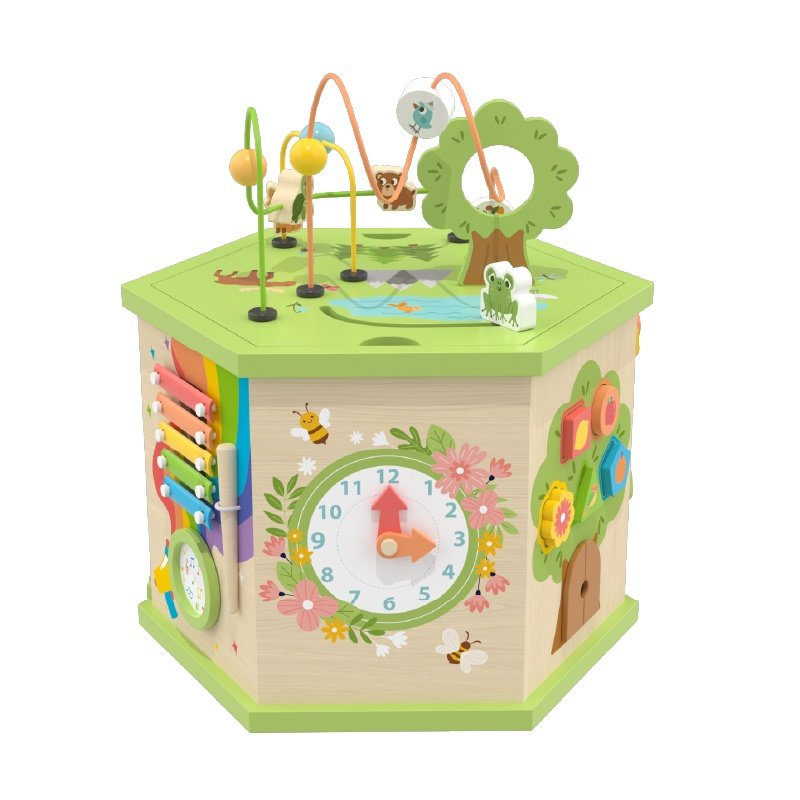
A basic cube with six shape openings and a set of blocks is a straightforward build: one body, one set of cutouts, one block set. Add sensory panels, a bead maze on top, a drawer, or a lid that opens, and the component count rises along with the operations — cutting, edge banding, assembly, inspection — that each component requires.
Even where two designs share an outline, differences in dimensions, hole positions, component specifications or assembly sequence can prevent them from running as one batch, because the fixtures and the inspection checkpoints differ.
Wood species, thickness and preparation
Species, thickness and component dimensions all feed into material planning. Two designs in the same species and thickness can often be cut from the same stock; two designs in different species, or with different board thicknesses, cannot share a cutting plan without waste that has to be paid for somewhere.
How species behave by product type — which woods hold fasteners, which weather better — is compared in our guide to choosing wood for wooden toys.
Sharing material creates coordination opportunities. It does not merge two styles into one MOQ.
Painting and color configuration
Color is where trial orders most often break. A standard colorway can run with existing paint batches. A custom palette with three new colors on small components means new paint preparation, new drying schedules and separate handling through finishing — and, depending on how the line is organized, a separate minimum for that color run.
Tooling and setup
Standard openings and standard block profiles run on existing programs. Custom shape openings, non-standard dimensions or a new exterior profile may need new tooling, fixtures or a CNC program. How that development work is structured, from buyer drawings to tooling, is set out on the custom wooden toy design and development page — and the setup cost has to be amortized over a quantity. This is the point where a design that looked like a variant becomes a new project, and where a lower MOQ stops being available at any price worth paying.
Retail packaging, quoted separately
The product is only half of the order. Printed cartons, inserts, labels, hang tags and instruction sheets carry their own minimums from the packaging supplier, and those minimums do not move when the toy MOQ changes.
A buyer can clear 1,000 pcs on the cube and still be short on the carton, because the printing supplier sets its own minimum and it can run well above the toy quantity. Product MOQ and packaging MOQ are two separate confirmations, and both belong in the quotation review. How brand-led packaging programs are structured is described on the private label programs page.
How piece counts, spare parts and retail-ready packaging are sized together for a retail range is covered in our farm block sets retail guide.
3. Combining Styles in One Trial Order
Combining designs in a single order is a reasonable way to test a range. Whether the quantities can be combined for production is a different question, and it has three practical answers.
Option A: One style, done properly
The simplest trial is one design at the per-style minimum. One specification to approve, one sample cycle, one packaging configuration, one set of test reports that matches what ships.
The trade-off is range: a single style tests a single bet. For a first order into a new market, that is often the correct amount of risk.
Option B: Styles designed to share components
If two or more cubes share body dimensions, board thickness, block profiles and finishing, it is worth asking the factory whether they can be coordinated in production. The questions to ask, in order:
- Are the main structures and component sets compatible?
- Do they use the same materials, thicknesses and machining operations?
- Are the painting and finishing requirements the same?
- Can fixtures, CNC programs or setup time be shared?
- Can the packaging be standardized across the styles?
Shared components may reduce setup cost and improve scheduling efficiency. They do not automatically make two styles eligible for one combined MOQ — the factory has to assess the actual production requirements and confirm it in writing.
Option C: Standard design first, customization second
For a buyer testing a new market, starting from an existing configuration removes variables: the structure is proven, the tooling exists, the test reports cover the shipped configuration, and the MOQ is a known number rather than a negotiation.
Custom structures, colors and retail packaging can follow once sell-through justifies them. This does not guarantee a lower MOQ — it makes the first decision legible, which is usually worth more. How custom programs are structured, and who owns which part of the design, is set out on the OEM and ODM customization page.
4. Planning a Wooden Toy Trial Order That Actually Ships
A good trial order is not the smallest order a buyer can talk a factory into. It is the smallest order that answers the question the buyer is actually asking, at a cost that makes sense.
Step 1: Define what the trial is testing
One new design? A range for a new channel? A seasonal slot? The answer sets the number of styles, and the number of styles sets the quantity — at 1,000 pcs per style, every additional design is another 1,000 units of commitment, not a rounding error.
Step 2: Choose styles for contrast, not for count
Four similar cubes with different paint schemes test nothing except the buyer's inventory discipline. Two cubes that differ in age grade, play pattern or price positioning test something real.
A common pairing: one basic sorter cube at an entry price point, one activity-led cube with additional panels for a higher tier. Two styles, 2,000 units, two clear data points.
Step 3: Confirm quantities per style and per color before fixing the PO
Ask for the MOQ of each selected style explicitly, and ask separately whether color variants count toward it. Also ask whether standard and customized versions carry the same threshold — they often do not. Get this in writing before the purchase order, not after sampling: a quantity problem discovered at PO stage costs a renegotiation; discovered at production scheduling, it costs a season.
Step 4: Compare landed cost, not unit price
A smaller order rarely produces a lower unit cost. The cost lines that move with quantity:
- Unit price at the quoted quantity break
- Sampling and development charges, if applicable
- Tooling or setup charges, if applicable
- Retail packaging and printing, with their own minimums
- Testing and inspection, quoted per product and per order
- Freight, duties and import charges, which follow carton volume
Two scenarios are worth pricing side by side: two styles at 1,000 each, and one style at 1,000 plus a second style deferred to a reorder. The second is often cheaper per unit sold, because it concentrates volume and setup on one design.
For how another category compares on these lines in practice, see our breakdown of play kitchen suppliers on MOQ, tooling and freight.
Step 5: Set the reorder criteria in advance
Decide before the first shipment what would justify a second order: sell-through rate, repeat purchase, return rate, or performance of a specific colorway. Then ask whether reorders carry the same MOQ.
Do not assume a reorder gets a lower minimum. Repeat-order quantities depend on material availability, retained components, scheduling and whether the specification changed. A color change on a reorder can reset the discussion entirely.
5. What to Confirm Before Requesting a Quotation
A precise inquiry shortens the quotation cycle and removes the ambiguity that produces wrong MOQs in the first place.
Product and style
- Which shape sorter cube designs are under consideration?
- Standard designs, or custom development?
- Are drawings, reference images or specifications available?
Quantity
- What is the MOQ per style for each design?
- Does color count separately?
- Can any styles share production arrangements?
- Is the MOQ different for reorders?
Materials and finishing
- Which wood species, board thickness and component specifications?
- Standard colorways, or custom painting?
- Does the design require new tooling or setup?
Packaging
- Standard export packaging, or custom retail packaging?
- What is the packaging supplier's minimum per component?
- Can packaging be standardized across styles?
Sampling and production
- What is the sample approval process?
- What are the sampling and bulk lead times?
- Which specifications must be signed off before mass production?
Testing and documents
- Which tests and documents does the destination market require?
- Do existing reports cover this exact configuration, material and coating?
- Are additional tests needed for customized components or packaging?
6. What a Manufacturer Should Tell You Before You Commit
A quotation that contains only a unit price and a number is incomplete. For a shape sorter cube program, the factory should also be able to explain what sits behind the number: the structure review, the shared-component analysis, the material and finishing plan, and whether two styles can realistically be coordinated.
KIDMERRY's standard terms for this product class, so that a first conversation starts from real numbers:
- MOQ: 1,000 pcs per style for wooden shape sorter cubes; 500 pcs per style for large structural items such as dollhouses, play kitchens and climbing frames. Confirmed per design, material and packaging combination.
- Sampling: 7–10 working days for an existing design; 15–20 working days for a new sample built from buyer drawings. Working days exclude courier transit.
- Bulk production: 30–45 days after sample approval; 45–60 days in the Q2–Q3 peak season. Excludes sea freight.
- Sample fee: the base sampling charge is credited against the bulk order or refunded once the same style reaches 5,000 pcs in cumulative production, with the sample approved in writing.
- Documents: EN 71-3 heavy-metal migration reports for applicable products, ASTM F963 for the US market, ISO 9001:2015 quality management, BSCI and Sedex SMETA social compliance audits, and FSC chain-of-custody certification for the wood and board grades within its scope — confirm the specific SKU sits inside that scope before relying on it. Reports are issued per product and per order, not as a blanket certificate for the range.
- Payment: T/T with 30% deposit and the balance against copy of B/L, L/C at sight, or PayPal for samples. Prices are quoted FOB.
Quotation structure, payment terms and document flow are set out in the wooden toy purchasing guide.
Conclusion: Size the Order to the Decision
MOQ per style is not a negotiating tactic — it is a description of how the factory schedules work. Each design needs its own setup, its own material plan and its own inspection standard, and the minimum quantity is what makes that setup viable.
For a shape sorter cube trial, that leaves three numbers to settle before anything else: how many styles, how many units per style, and whether color counts separately. At 1,000 pcs per style, two styles is a 2,000-unit order that can actually run; six styles at 330 units is a 2,000-unit order that cannot.
Plan the mix around the decision you need to make, price the landed cost of two realistic scenarios, and write the reorder criteria down before the first shipment lands. That is a trial order doing its job.
Planning a wooden shape sorter cube program? Share your target designs, per-style quantities and customization needs through our contact page, and the first review will confirm the MOQ, sampling schedule and production lead time for each style.
FAQs About MOQ for Wooden Shape Sorter Cubes
What is the MOQ for wooden shape sorter cubes?
At KIDMERRY, 1,000 pcs per style for this product class, and 500 pcs per style for large structural items such as dollhouses, play kitchens and climbing frames. The number is confirmed per design, material and packaging combination in the quotation.
Can I negotiate a lower MOQ for my first order?
1,000 pcs per style is the standard floor for this product class. Any exception depends on the design, materials, tooling and production scheduling, and is assessed case by case. If a concession is possible, it will be confirmed in writing before the purchase order — a first order should not be budgeted on an assumption.
Can I combine different styles or colors to meet the MOQ?
Not automatically. Each style is set up and planned separately, so quantities cannot simply be pooled across designs. Colors count separately only when the finishing process requires separate runs. Where designs genuinely share components, coordination is sometimes possible — ask for a written confirmation per style.
Why do manufacturers set a minimum order quantity?
Every design needs its own material plan, machining setup, finishing arrangements and inspection standard. The MOQ is the quantity at which that dedicated setup becomes economically viable and the per-unit cost and quality stay stable.
Can I pay for the full packaging MOQ but order fewer toys?
Possibly, subject to confirmation. Packaging minimums come from the packaging supplier and are quoted separately from the toy MOQ. Paying for a full packaging run while ordering fewer units is feasible in principle, but it raises the packaging cost per unit and must be priced into the quotation before deciding.
Is it worth paying a higher unit price for a smaller trial order?
Sometimes. If a smaller run is accepted at all, the unit price and the per-unit share of setup costs rise. The premium is worth paying when the market information from the trial outweighs the extra cost — compare the total landed cost of both scenarios rather than unit prices alone.
Can I place one MOQ order and receive the goods in multiple shipments?
Subject to factory confirmation. Production is scheduled as a single order, so split deliveries depend on finished-goods storage, scheduling and shipping arrangements, and they add freight and handling costs. Agree the delivery plan in writing before the purchase order is issued.
What should I confirm before placing a trial order?
Five things, in writing: the MOQ per style and whether color counts separately; the packaging minimums; the sampling fee and lead time; the bulk production lead time and required test documents for the destination market; and the payment terms. The quotation is where all of these become numbers.
Plan Your Shape Sorter Order with KIDMERRY
About Kidmerry: Yunhe Kidmerry Toys Co., Ltd is a wooden toy manufacturer based in Yunhe, Zhejiang, China. The factory runs in-house CNC machining, finishing and assembly, and holds ISO 9001:2015 certification, with FSC-certified board available on request. Sampling takes 7–10 working days for existing styles and 15–20 working days for custom drawings; bulk production runs 30–45 days after sample approval. Ask Kidmerry for a quotation, a sample set and third-party test reports before your next development cycle.
Request a Quotation