




Which Export Cartons Protect an Activity Table from a Wooden Toy Manufacturer?
A wooden activity table is one of the hardest products in the category to pack for export: a wide footprint, a heavy top, detachable legs and loose accessories, all moving through a supply chain that stacks, vibrates and squeezes. This guide is for importers, brand owners and product development managers weighing carton specifications against freight budgets. It follows the carton from factory to shelf and separates what testing standards say from what packaging folklore promises.
An activity table is the hardest wooden toy to pack — wide footprint, heavy top, detachable legs — and the carton decides whether it arrives as product or scrap. Specify the drop-test height, the transit testing and the stacking load in writing, design the foam layout around the detachable parts, and approve the carton on the assembled unit, not on the foam drawing; at sea, cube matters, so cartons should stack without voids and share the pallet footprint. Keep a pack-out record with the shipment documents so the carton that ships is the carton that was tested, and note that printed master cartons and shelf-ready trays are available from the standard MOQ of 1,000 pcs per style.
What This Guide Covers
A buyer who had approved a well-made round activity table came back after the first container with a complaint: the table was fine, but a share of cartons had arrived with crushed corners, and some tabletops carried scratches from parts that had shifted in transit. The product had passed its safety requirements — the failure was in the export packaging for wooden toys around it. What such a packaging plan must get right, and which decisions belong to the buyer rather than the factory, is the subject of this article.
Why Activity Tables Need More Thoughtful Export Packaging
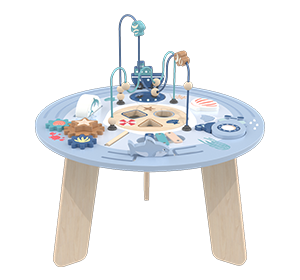
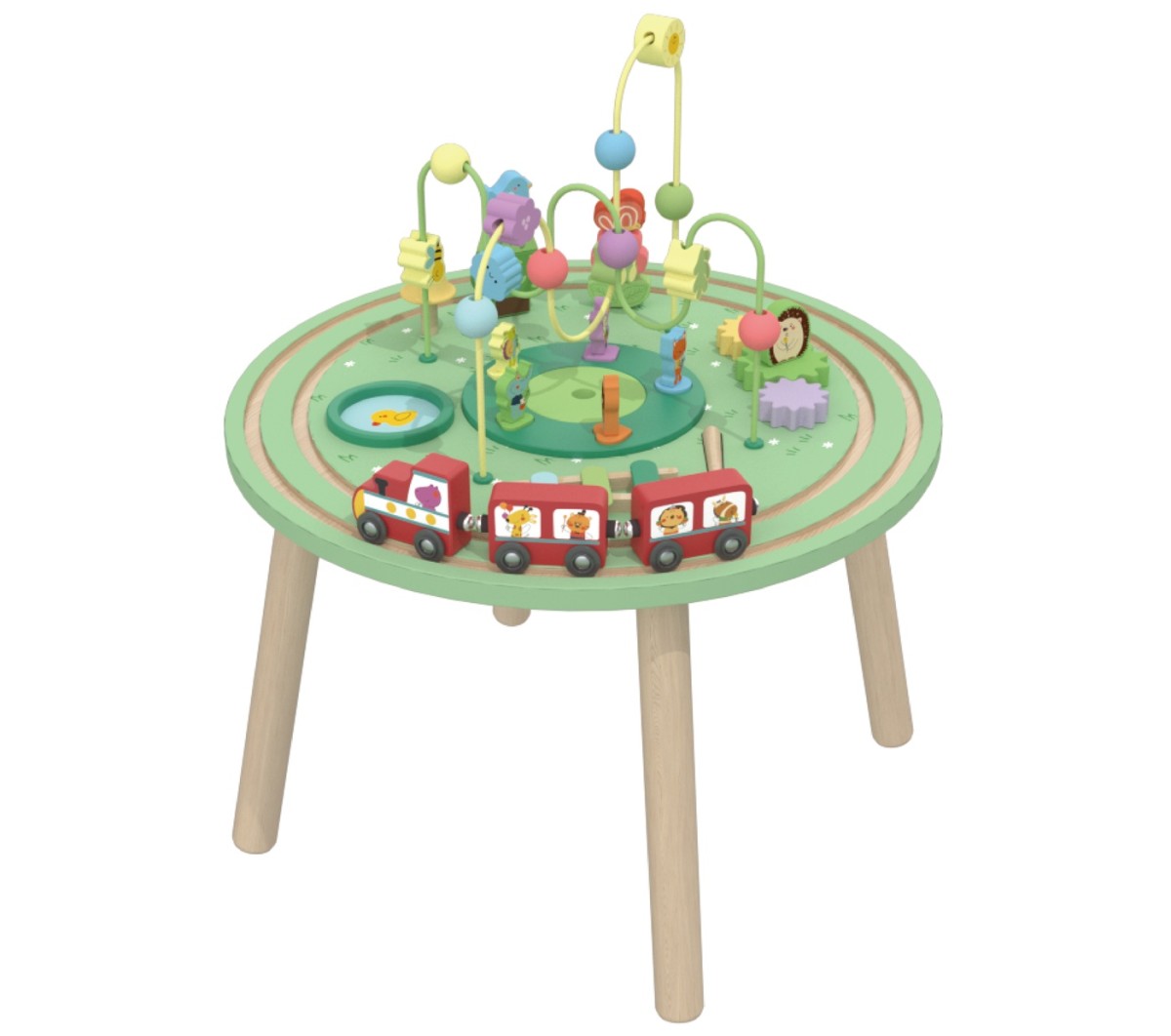
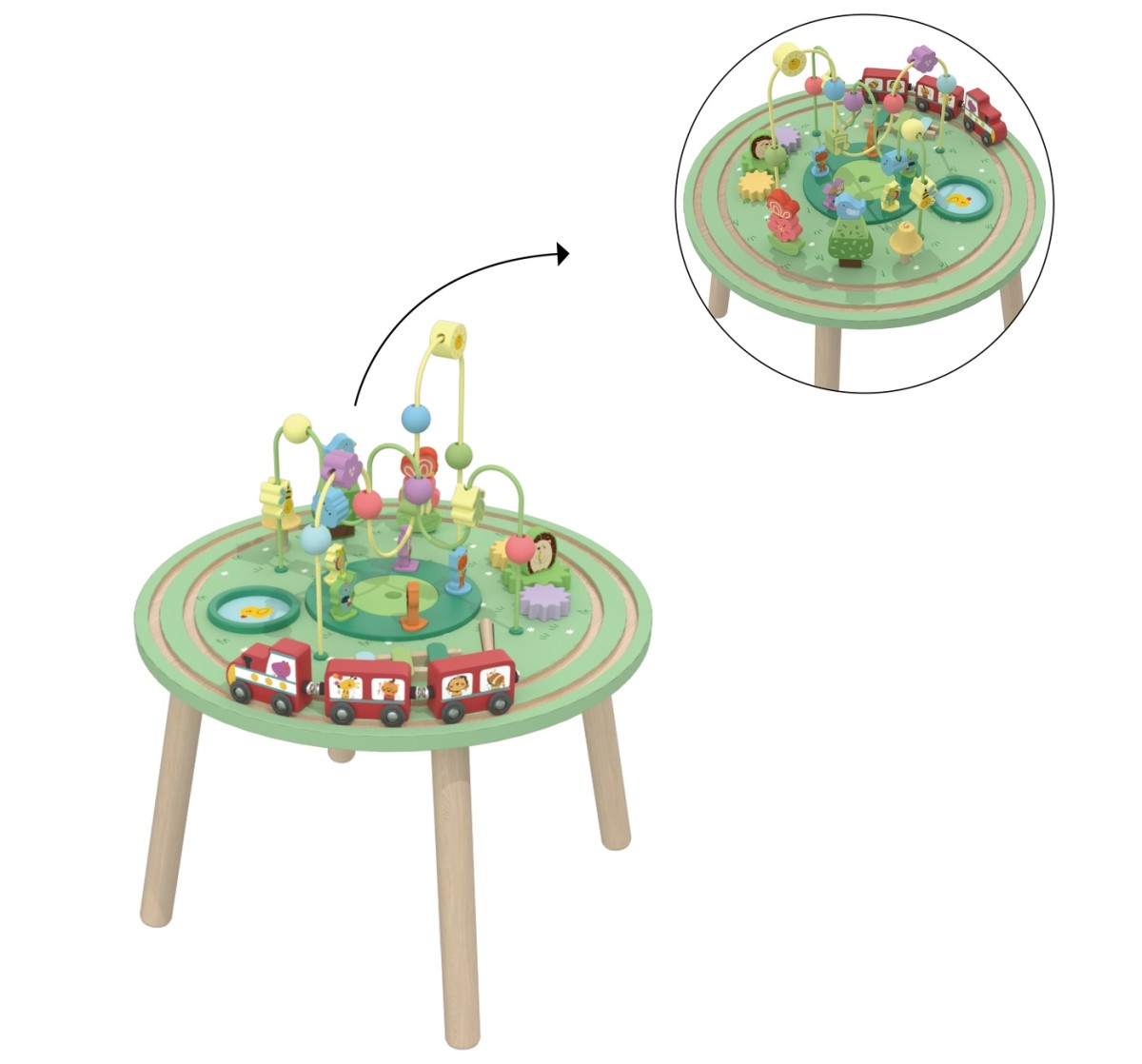
Most wooden toys are compact, light and symmetric. An activity table is none of these. Its tabletop is wide relative to its weight, so a carton sized to the top is largely air; its legs are slender components whose ends concentrate force on small areas; and its play features — bead mazes, train tracks, removable panels — sit proud of the surface. A carton that survives for a block set can fail for a table: loads, clearances and internal movement differ in scale.
Construction choices change the problem, too. Shipped assembled, the table occupies a tall carton with heavy point loads at the leg ends. Shipped flat-pack, the components are distributed differently, assembly hardware becomes loose parts that must not migrate, and the carton shape changes with them. Neither configuration is automatically safer; each defines a different set of risks, which is why carton decisions belong alongside product development, not after it.
Single-Wall or Double-Wall? Understanding Corrugated Carton Choices
Corrugated board for a wooden toy carton is a laminate: linerboard bonded to fluted paper. Single-wall board has one flute layer between two liners; double-wall adds a second flute layer and a middle liner. The industry measures how the two behave under stacking and impact with standardized tests, not adjectives.
Three measurements answer different questions. Edge crush resistance — per ISO 3037:2022, applicable to single-, double- and triple-wall board — shows how the board's edges support vertical stacking load. Bursting strength, per ISO 2759:2014, measures resistance to puncture-type pressure but says little about stacking. Box compression resistance, per ASTM D642-25 (which fulfills the requirements of ISO 12048), tests the finished filled container — the closest lab proxy for a warehouse stack. A burst value alone does not predict stacking performance; ask which was measured, on board or on the finished carton.
| Option | What it offers | Where it fits | Watch for |
|---|---|---|---|
| Single-wall carton | Lower material cost, lighter carton, easier handling | Lighter tables, short retail cycles, palletized loads with modest stack heights | Fewer stacking reserves; sensitive to humidity during long storage |
| Double wall shipping carton | Higher compression reserve, better impact tolerance | Heavier tables, mixed handling, higher warehouse stacks | More material cost and weight; still needs internal protection |
| Double-wall plus engineered inserts | Controlled positioning, load spread, fewer internal collisions | Flat-pack sets with hardware, premium finishes, parcel-mixed channels | Design effort up front; must be locked before mass production |
Swipe sideways to see the full table
One further variable is moisture. Corrugated board loses stiffness as it absorbs it, which is why ISTA procedures require pre-test conditioning at controlled temperature and humidity. A carton sampled in a dry office and tested in a damp warehouse is not the same carton.
What Happens to an Activity Table During the Export Journey?
The export cycle is a sequence of different hazards, not one big drop. At the factory, finished cartons are palletized and stretch-wrapped; the pallet is raw wood, so it falls under ISPM 15, the international standard requiring treatment and marking of wood packaging made from raw wood (plywood is exempt). And carton cube is paid for repeatedly — the Freightos Baltic Index for China/East Asia to the North American West Coast stood at USD 8,245 per FEU in the week of 10 November 2026, a weekly index.
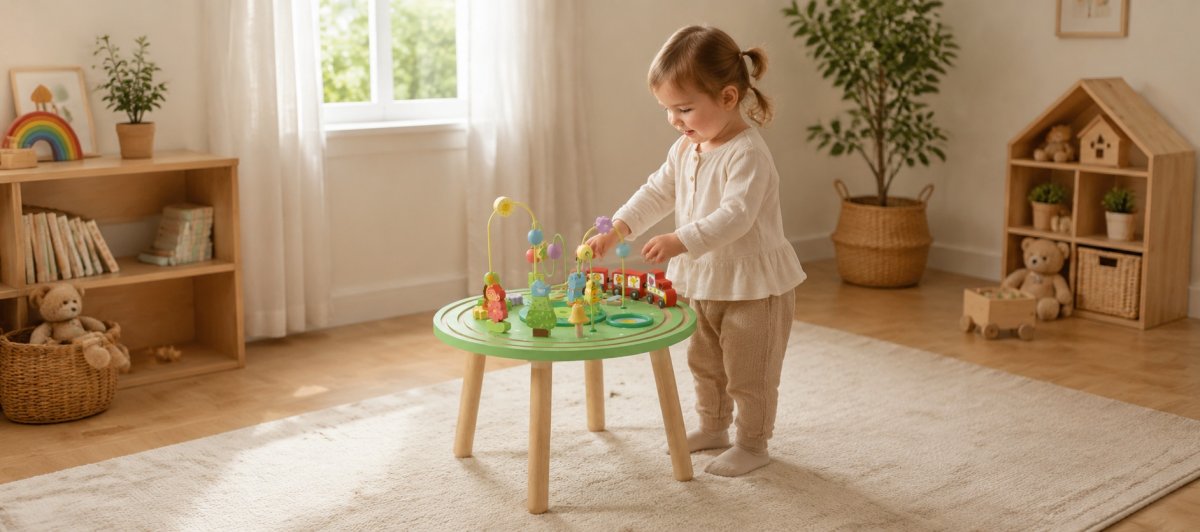
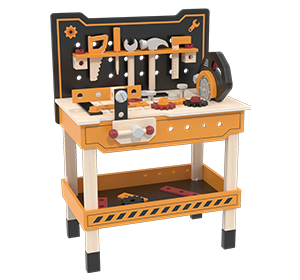
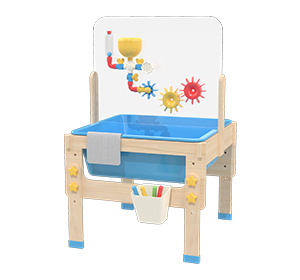
At sea, decks vibrate and humidity swings; in port, containers are lifted, shifted and occasionally dropped; in the warehouse, cartons are stacked — sometimes beyond what a pallet tier was designed for — then broken down for last-mile delivery, where a parcel channel adds its own drops. Each stage stresses a different part of the packaging system; one test cannot stand in for the whole journey. The packaging system this describes was designed around our sand and water activity table — a wide footprint, a heavy lid and detachable legs, all four of the stress patterns above in one product.
Internal Packaging Matters as Much as Carton Strength
Strong board cannot compensate for a loose interior. The practical toolkit includes die-cut corrugated inserts that lock the tabletop into position, corner protectors at the exposed points, protective sleeves around finished legs, and a sealed compartment for screws and hardware so nothing wanders across a painted surface. Paper cushioning fills irregular voids; foam earns its cost only where a fragile feature justifies it.
The logic is positioning first, cushioning second: a part that cannot move cannot scratch a neighbor. More material is not automatically better — excessive fill adds weight and cube, and often hides the real problem: two components were free to collide. When reviewing a sample, look at where each component sits at rest and where it can travel, not just at padding thickness.
How Carton Dimensions Affect Freight and Container Loading
Carton dimensions decide freight twice: as billed weight and as cube. For parcel and express channels, carriers bill on the greater of actual and dimensional weight, with a divisor of 5,000 per UPS rules. An illustrative example — assumptions stated, not a quotation: a 60 × 50 × 40 cm carton has a dimensional weight of 120,000 ÷ 5,000 = 24 kg; at an actual 21 kg, the shipment is billed at 24 kg, rounded up per the carrier's increments. The same arithmetic punishes every centimeter of unnecessary clearance.
For sea freight the logic shifts to cube. Cartons that stack without voids, share a footprint with their pallet and keep a consistent orientation load more neatly into a container, while oversized cartons waste cube. The trade-off cuts both ways: tightening dimensions saves freight but erodes protective clearance, and the correct answer depends on measured clearances — established through the testing below — not on a cost target alone. This is also where export carton dimensions must be confirmed before retail artwork is finalized, since master carton configuration can force changes on the inner boxes it contains.
How Should Buyers Evaluate Export Carton Performance?
Carton strength testing is a menu, not a ritual: the right choice depends on how the product will actually travel. For a screening benchmark early in development, ISTA Procedure 1A applies to packaged products weighing 150 lb (68 kg) or less; Procedure 2A adds partial simulation such as atmospheric conditioning and random vibration; Procedure 3A simulates a parcel delivery system for packages up to 70 kg. Individual methods isolate single hazards: ASTM D5276 for free-fall drop of manually handled containers, ASTM D4728 for random vibration, and ASTM D642 with ISO 12048 for compression and stacking. Retail programs may impose their own member protocols — Amazon's Ships-in-Own-Container program exists because that network has its own hazard profile.
The buyer's questions are specific: which procedure, on which configuration, after what conditioning, with what pass criteria — product damage, carton failure, or both. A "tested" label without those details is a sentence, not a specification. Where toy packaging testing is arranged, the distribution environment assumed in the test should match the one the goods will actually see.
Five Packaging Mistakes Buyers Should Avoid
Passing the drop test, failing the warehouse
A carton can absorb a specified drop yet bow under days of static stacking: drop performance and compression reserve are different properties. Require compression data on the finished carton, not board-level values, and know the stack height it will face.
Legs that scratch the tabletop
Loose legs and migrating hardware mark finished surfaces before the carton shows external damage. Positioning inserts and a sealed hardware compartment solve this cheaply; thicker padding alone often does not.
Buying cushioning with container cube
Adding clearance "to be safe" enlarges the carton, and the enlarged cube is paid for at every stage of the journey. Clearance should be justified by test results, not anxiety.
Approving a sample, then receiving a different carton
Substituting board grade, flute structure or insert design in bulk quietly voids what the sample demonstrated. Put the carton specification on the order documents, with sample-to-bulk consistency checked at inspection.
Designing retail packaging before the master carton
A retail box whose dimensions ignore how inner boxes combine into a master carton — and how those cartons palletize — usually gets redone at the buyer's expense. Confirm master carton configuration first, then finalize artwork. Buyers planning private label programs will find this sequencing in the wooden toy purchasing guide. For the demand side of the same calendar — when the reorder has to be placed for a Q4 peak — our guide to planning reorders around the peak season completes the picture.
What Should Buyers Confirm Before Approving Activity Table Packaging?
Before sign-off, get these in writing per product and market:
- Product dimensions and shipped configuration
- Export carton dimensions, net and gross weight
- Carton specification: wall structure, board grade, board-level or finished-carton values
- Internal packaging: inserts, corner protection, hardware compartment
- Stacking assumptions: warehouse stack height and pallet configuration
- Shipping method and channel mix
- Test basis: procedure, conditioning, pass criteria, retest costs
- ISPM 15 treatment where raw wood pallets are used
- Retail packaging compatibility with the confirmed master carton
- Sample-to-bulk verification at incoming and final inspection
A supplier who answers these without improvising is showing you how production runs; one who cannot is telling you something else. For a structured conversation, contact our team with your market and channel plan.
From Product Design to Export Delivery: Building Better Packaging Together
Packaging works best when engineered alongside the product, not appended to it. At design, the configuration — assembled versus flat-pack — is chosen with carton consequences in view; finish decisions shape the internal protection surfaces need. At sampling, carton, inserts and hardware compartments are validated together with the product, and approved packaging joins the golden sample. At mass production, incoming board, insert accuracy and final pack-out are checked against that standard, so the carton that ships is the carton that was tested. Timing: sampling runs 7–10 working days for an existing style and 15–20 working days from customer drawings; bulk takes 30–45 days after sample approval, or 45–60 in the Q2–Q3 peak season — factory-level planning figures, not industry statistics.
For buyers of wooden activity table packaging, the practical conclusion is to raise carton requirements in the first conversation with your wooden activity table manufacturer, not the last. An activity table OEM manufacturer that treats packaging as part of the product specification will quote cube, weight and protection trade-offs side by side — wooden toy packaging solutions that hold up across the whole export cycle.
From Sample Approval to Container Loading: One Linked Chain
Everything above reduces to a sequence in which each step protects the next. Run it in order and the carton that ships is the carton that was tested:
- Fix the specification in writing first — drop-test height, transit testing and stacking load named per product, so "tested" becomes a specification instead of a sentence.
- Match the test to the journey — the distribution environment assumed in the protocol should be the one the goods will actually see, with conditioning applied before testing, since a dry-office sample and a damp-warehouse carton are not the same carton.
- Require finished-carton compression values — board-level burst numbers do not predict stacking, and the warehouse stack height the carton will face should be known.
- Design positioning before cushioning — inserts, corner protection and a sealed hardware compartment decide whether protection reaches the product; clearance is justified by results, not enlarged to be safe.
- Confirm the master carton before retail artwork — how inner boxes combine into the master, and how those cartons palletize, decides whether the retail box gets redone at someone's expense.
- Put the carton specification on the order documents — board grade, flute structure and insert design locked, with sample-to-bulk consistency checked at incoming and final inspection.
- Keep the pack-out record with the shipment documents — the record travels with the goods, so any transit claim can be compared against what was actually packed.
Each line costs little at approval time; each is expensive to retrofit after a damaged container arrives. That asymmetry is the argument for treating the carton as part of the product specification from the first quotation onward.
Two practical notes when running the chain. First, conditioning is not a formality: corrugated board loses stiffness as it absorbs moisture, so the humidity and temperature the carton is tested at should match the warehouse and port climate it will face, or the compression reserve on paper is not the reserve in the container. Second, agree the retest position up front — when a board grade, insert or carton dimension changes mid-program, the question of who pays for revalidation is much cheaper to answer before the change than after it.
Frequently Asked Questions
Frequently Asked Questions
Do activity tables ship flat-packed or pre-assembled?
Almost all activity tables ship knock-down — legs and accessories detached, tabletop protected flat. Flat-pack is what keeps the carton cube inside the freight budget and the tabletop away from point loads; pre-assembled packing is possible but changes both the carton design and the freight cost materially.
Which transit tests do export cartons pass?
Cartons are validated against the transit protocol agreed in the specification — commonly referenced to ISTA-style drop sequences with defined heights, plus stacked compression for container and warehouse loads. The test unit is the packed export carton, not the bare product.
How are legs and small accessories protected in transit?
Each leg is wrapped and boxed against the tabletop with foam pads at the contact points; small accessories are bagged, counted and positioned so they cannot migrate inside the carton. Every component is a BOM line with a defined packing position, checked at the packing table.
Can cartons be customized for retail shelves?
Yes — printed master cartons and shelf-ready trays are available from the standard MOQ of 1,000 pcs per style. Printed packaging carries its own artwork and minimum from the packaging supplier, so confirm both numbers separately before fixing the order quantity.
Conclusion
Choosing an activity table export carton is a balance, not a maximization problem. Board grade sets the ceiling of protection; inserts and positioning determine whether that protection reaches the product; dimensions decide what the carton costs after the factory; and standardized testing — read with its conditioning and pass criteria — tells you which of these is true. None of these decisions is expensive during product development; all are expensive after a damaged container arrives. Specify the carton as deliberately as the toy, and the delivery looks the way the sample did.
Approve an Export-Ready Activity Table Carton
About Kidmerry: Yunhe Kidmerry Toys Co., Ltd is a wooden toy manufacturer based in Yunhe, Zhejiang, China. The factory runs in-house CNC machining, finishing and assembly, and holds ISO 9001:2015 certification, with FSC-certified board available on request. Sampling takes 7–10 working days for existing styles and 15–20 working days for custom drawings; bulk production runs 30–45 days after sample approval. Ask Kidmerry for a quotation, a sample set and third-party test reports before your next development cycle.
Request a Quotation