Wooden Sensory Toys: A Buyer's Guide to Sensory Play, Materials and Safety
Sensory play is one of the strongest stories in early-childhood retail and one of the easiest to get wrong in sourcing. The claim is developmental; the product is mechanical. This guide separates the two, so that a category manager can write a specification for wooden sensory toys that survives both a safety review and a school year.
What this guide covers
- Why sensory play sells, and where the claim meets the factory
- The three sensory channels a wooden toy can actually engineer
- Materials and surface: the safe-touch requirement
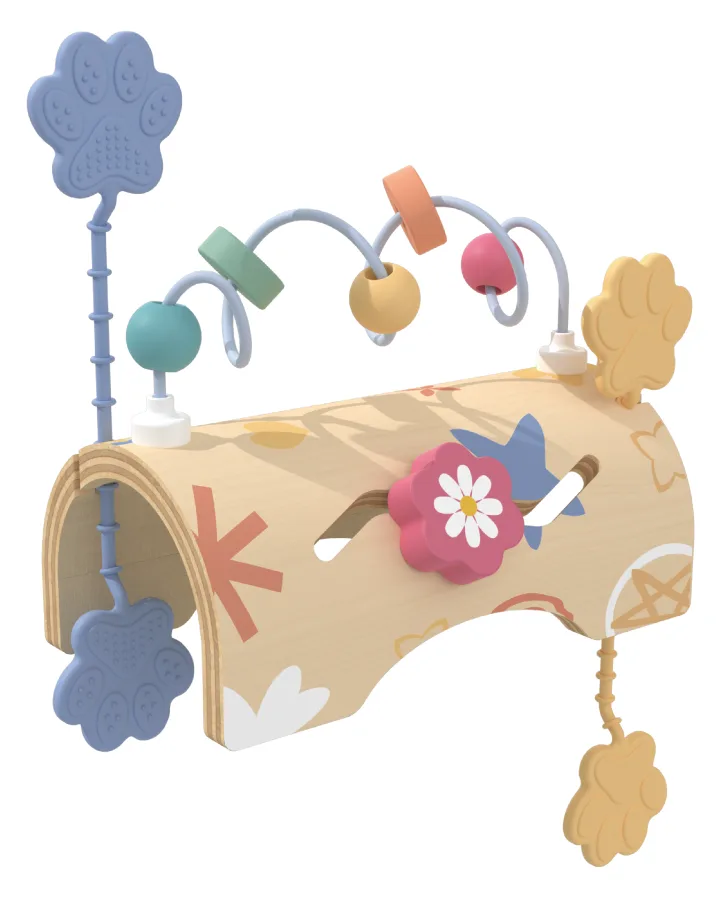
- Mechanics of sensory elements: beads, wires, knobs and gears
- Colour, contrast and graphic decisions
- Age grading, hygiene and care instructions
- MOQ, sampling, QC, certification and export
- Frequently asked questions
Why sensory play sells, and where the claim meets the factory
Early childhood is a period of unusually fast brain development. The Harvard Center on the Developing Child, for example, describes the first years as a time when more than one million new neural connections form every second — a framing widely used in early-years communication rather than a laboratory measurement, but useful because it explains why touch, sight, sound and movement dominate product design for under-fives.
What that means commercially is that a sensory toy has to deliver repeated, varied, physical feedback. It is not enough for a product to be made of wood and described as sensory. The feedback has to be engineered: resistance in a knob, travel in a bead, weight difference between two pieces, an audible click where a click is intended. Those properties are all manufacturing variables, and each of them can be specified, sampled and inspected.
For buyers, the practical shift is to stop asking whether a toy is “sensory” and start asking which channel it stimulates, how strongly, and how that property is held constant across ten thousand units. Suppliers who can answer in those terms are worth shortlisting; suppliers who answer with adjectives are not.
The three sensory channels a wooden toy can actually engineer
Tactile: grain, weight, temperature and resistance
Wood delivers tactile information that plastic does not: it is warmer to the touch, it varies in density by species, and its surface changes with finish. A tactile specification should name four things. The species, because beech and pine feel different in the hand at the same dimension. The sanding sequence, because a 180-grit finish and a 320-grit finish are different products to a toddler’s fingertips. The edge radius, because a sharp arris is the most common tactile complaint on wooden goods. And the finish build, because a thick lacquer can neutralise the very grain the design is relying on.
Visual and auditory: contrast, motion and controlled sound
Visual stimulation in wooden toys usually comes from contrast rather than from colour count: light wood against saturated accent, moving element against static frame. Ask how the accent colour is applied and whether it survives abrasion, because a worn accent on a high-contact part makes a premium product look cheap within weeks. Auditory feedback — a wooden click, a bell, a rattle chamber — should be intentional. If a sound is incidental, treat it as a potential complaint and a potential noise-limit issue rather than as a feature.
Proprioceptive and vestibular: resistance, weight and balance
The heaviest sensory load in this category is proprioceptive: pushing, pulling, twisting and lifting against real resistance. Knobs, toggles, gears and lacing elements all work because they resist. The engineering requirement is repeatability — the fifth knob on the fifth unit must turn with the same force as the first. That is a torque specification, and it is rarely written down. Ask for it on any element your marketing describes as “resistance building” or “strength training”.
Materials and surface: the safe-touch requirement
Sensory toys are handled, mouthed, dropped and wiped far more than display toys. Three material decisions follow from that.
Species for high-contact parts
Beech is the usual choice for parts that are gripped, twisted or mouthed, because it is hard, fine-grained and resists denting. Birch plywood is the usual choice for the panels and cases that carry the mechanism, because it is stable and takes a clean, pale finish. Pine appears in frames and value lines where weight and cost lead. Maple and basswood are used where the profile is fine — basswood particularly for carved or routed detail. These are general characteristics of the species, not a statement about any single product: confirm the actual species on the data sheet, especially where a set mixes species, because mixed assemblies can finish to visibly different tones under the same coating.
Finishes and what to test
Water-based coatings are the default expectation in most export markets, driven by odour, yellowing and volatile organic compound limits as much as by toy-safety limits. For sensory items, the property that matters most is resistance to saliva and sweat, because that is the exposure the product actually sees. State the standard you want the coating tested against and require the report, rather than accepting a “non-toxic” adjective.
KIDMERRY uses water-based paints and controlled finishing processes, and holds EN 71-3 (migration of certain elements) on its certificate list. EN 71-3 is the migration part of the European toy standard, and it is the part that addresses this exposure; testing to other parts, and to other market standards, is arranged per product and per order. If your market requires a specific part or a specific national standard, name it in the enquiry.
Discuss your custom wood and finish. Tell us the species, the coating system and the market, and we will come back with a construction proposal, a finish schedule and the test evidence available for that configuration.
Discuss Your Custom Wood / FinishMechanics of sensory elements: beads, wires, knobs and gears
Moving parts are where sensory toys fail. The failure modes are predictable, and all of them are preventable at the specification stage.
| Element | What it must do | Common failure | What to specify |
|---|---|---|---|
| Bead maze wire | Hold path shape through repeated flexing | Wire bends out of alignment; bead jams | Wire gauge and material, end termination method, cycle test count |
| Beads and rings | Travel freely, stay captive | Split at the moulding line; sharp edge after coating | Secure enclosure or proven retention, edge radius, coating adhesion test |
| Knobs and toggles | Consistent turning resistance | Torque varies unit to unit; knob loosens | Torque range, fixing method (screw and thread locker vs. glue), pull test |
| Gears and cams | Mesh without binding through humidity change | Swell in damp conditions, then bind | Species stability, clearance at tolerance extremes, humidity conditioning before assembly |
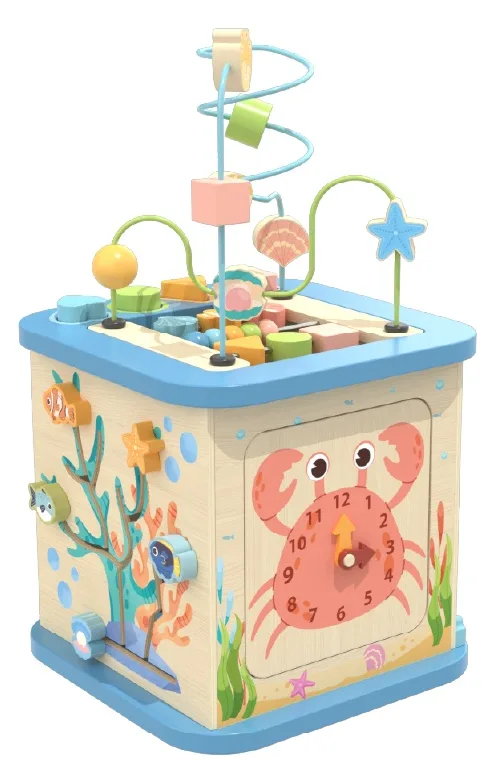
Two points deserve emphasis. First, captive elements must be proven captive: if a bead is enclosed, the enclosure has to survive the abuse test, not just assembly. Second, humidity matters more than buyers expect. Wood moves with moisture content, and a mechanism with tight clearances assembled at 14% moisture can bind at 8%. Ask what moisture content the factory conditions to before assembly, and whether the clearance was validated at the tolerance extremes.
Colour, contrast and graphic decisions
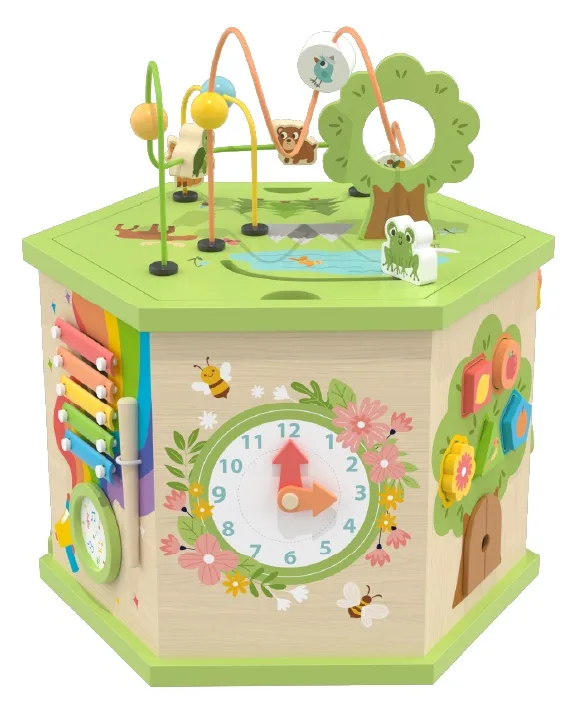
Sensory lines carry more colour than Montessori lines, and that has production consequences. Specify colours as physical references rather than screen values, because wood substrate shifts the perceived tone in a way that a Pantone swatch on paper will not predict. Keep fine text above the size the printing method can hold. Approve on the actual substrate in the actual coating. And decide early whether the accent colour has to match across wood, plastic fittings and carton — cross-substrate matching is a separate approval loop.
For brand owners, sensory lines are often where the brand colour system meets its hardest substrate. A custom wooden toy programme for brand owners typically begins with a colour-approval round on the real material, precisely because screen-matched artwork and production-matched artwork are rarely the same result.
Age grading, hygiene and care instructions
Age grading drives part size, warning text, drop-test height and the claims you can make, so it should be fixed before design freeze. Sensory products for the youngest age band carry the strictest small-part and mouth-exposure requirements, which trace back into bead size, wire end treatment and coating test choice.
Hygiene is a growing buyer question, and the honest answer is that wooden toys are wipe-clean, not dishwasher-safe and not steriliser-safe. Care instructions should say that plainly on the packaging, because an over-claim about washability becomes a warranty problem in a school or nursery channel. Where a programme supplies nurseries, ask for the cleaning method the coating is validated against and put that method in the instructions.
MOQ, sampling, QC, certification and export
MOQ
Minimum order quantity is driven by changeover time, board yield and component sourcing. At KIDMERRY the structure is 500 pieces per style for large structural products such as doll houses, play kitchens and outdoor climbing frames, and for all-wood designs; 1,000 pieces per style where the plastic component share is high, and for small-item designs. Final MOQ is confirmed per project. Note the unit: per style, not per order — a multi-style sensory programme multiplies the requirement accordingly.
Sampling
Existing-style samples take about 7–10 working days. New items built from your drawings take about 15–20 working days, because tool paths, fixtures and first-article inspection have to be created. Both are factory working days and exclude courier time. For sensory items, approve on a production-route sample: hand-finished prototypes hide exactly the problems that matter here, which are torque consistency, coating adhesion and joint strength.
Quality control
Ask for the incoming, in-process and outgoing checks in writing: moisture content and board grade on incoming, first-article and interval dimension checks plus joint and cure checks in process, and an outgoing inspection basis with an AQL level and defect classification. KIDMERRY operates under ISO 9001:2015 and holds BSCI and Sedex (SMETA) registrations. Certificates cover a legal entity and a defined scope; the test report that matters for a shipment is the one issued for that product and that order.
Certification
For the EU, the applicable framework is still the Toy Safety Directive 2009/48/EC. A new Regulation, (EU) 2025/2509, was published in the Official Journal on 12 December 2025, enters into force on 1 January 2026 and applies from 1 August 2030, introducing a digital product passport among other changes. Plan current shipments against the directive and track the transition; do not claim conformity to rules that are not yet applicable.
For the US, ASTM F963-23 is mandatory under 16 CFR 1250 from 20 April 2024, with certain flammability provisions excluded by 16 CFR 1250.2(b), and applicability determined by date of manufacture rather than date of import. CPSIA limits buyers should know: 100 ppm total lead in substrate, 90 ppm lead in coatings under 16 CFR 1303, 0.1% for certain phthalates under 16 CFR 1307, plus tracking labels. The Children’s Product Certificate is issued by the importer or a US domestic manufacturer, not by the overseas factory — resolve that early if a supplier offers to “supply the CPC”.
Export coordination
After sample approval, mass production runs about 30–45 days, extending to 45–60 days in the second and third quarter peak. The window starts at approval and excludes sea transit. Agree early who issues the invoice, packing list, certificate of origin and test-report pack, and whether any solid-wood packaging needs ISPM 15 treatment — plywood and MDF panels are normally exempt, solid-wood crates and pallets are not. Payment terms: T/T with a 30% deposit, L/C at sight, and PayPal for samples.
Frequently asked questions
Which wood species is best for a sensory toy that will be mouthed?
Beech is the usual answer for high-contact parts because it is hard and fine-grained, with birch plywood for the panels and cases that carry the mechanism. Confirm the actual species per item on the product data sheet, and specify the sanding sequence, edge radius and coating system separately — those matter as much as the species.
What finish should I specify for a sensory line?
Water-based is the market default, and the property that matters most is resistance to saliva and sweat, because that is the real exposure. State the standard you want the coating tested against and require the report. KIDMERRY uses water-based paints and holds EN 71-3 on its certificate list; testing to other parts or standards is arranged per product and per order.
How do I stop bead mazes from failing in the field?
Specify the wire gauge and material, the end termination method, a cycle-test count, and a coating adhesion test. Require the approval sample to come off the production route rather than being hand-finished, and ask what moisture content the factory conditions to before assembly.
Can wooden sensory toys be dishwasher cleaned?
No. Wooden toys are wipe-clean. Care instructions should say so plainly, because over-claiming washability becomes a warranty problem in nursery and school channels. Ask for the cleaning method the coating is validated against and put that method in the instructions.
What is the MOQ for a sensory toy programme?
Plan per style. All-wood designs and large structural products start at 500 pieces per style; designs with a high plastic-component share and small-item designs start at 1,000 pieces per style. Final MOQ is confirmed per project, and packaging print minimums may exceed the product MOQ.
Who issues the Children’s Product Certificate?
The importer or a US domestic manufacturer. The overseas factory supplies the test reports and product information the certificate relies on, but it cannot issue the certificate itself.
Ask about MOQ and packaging. Send the age grade, the sensory channels you want the product to cover and the target market. We will propose a construction, quote MOQ and sampling time, and set out packaging options.
Ask About MOQ and PackagingBuilding a sensory-play wooden toy line?
Sensory products succeed or fail on repeatability: the tenth unit has to feel like the first. That is why we treat torque, coating adhesion and joint strength as specification items rather than as finishing details. If you are developing a sensory range, send the age grade, the channels you want to cover, the species and finish preference, and the quantity per style.
We will come back with a construction proposal, a sampling plan, MOQ and packaging options, and a production window — plus the questions we still need answered before quoting. For the wider commercial frame, our wooden toy purchasing guide covers materials, certification scope and packaging in sequence, and our OEM and ODM customisation service outlines how a concept moves into tooling and production.
Request a sensory toy sample
Tell us the product, the age grade, the market and the quantity per style. We will come back with a sample plan, MOQ and lead times — and the documents we can supply for that market.
Request a Wooden Toy Sample