



What Is Changing in the U.S. Toy Market? How Wooden Toy Brands Can Win New Opportunities
The American toy market is in the middle of a structural change that favours smaller, more intentional product lines: retail channels are fragmenting, discovery is moving away from pure search, and a generation of brands is finding that design and story convert better than price. For wooden toy makers this is a genuine opening. This analysis sets out where the opening is, what US buyers actually require, and how to plan a programme that survives contact with the compliance and logistics reality.
What is changing in the US market is enforcement maturity, not a ban — wooden toy brands win by planning backwards from the shelf date through ocean transit to production, because the Q2–Q3 production peak falls directly across the autumn selling season. Sample in the quiet months: a new design takes 15–20 working days, a window far easier to secure in Q1 than in Q3, and mass production runs 30–45 days after sample approval, 45–60 in the peak. On paperwork, the Children's Product Certificate must identify the product, cite the applicable rules, give the manufacturer with date and place of manufacture and identify the third-party laboratory. Minimums stay at 500 pieces per style for large structural and all-wood products, 1,000 for small items or high-plastic designs.
- Channel Structure: Where Wooden Toys Actually Sell
- Why Story-Led Brands Outperform Price-Led Ones in Specialty Channels
- What US Buyers Require Before They List a Product
- Categories With Room to Grow
- Compliance: ASTM F963, CPSIA and the Children's Product Certificate
- Cost, Minimum Quantity and Lead-Time Planning for US Programmes
- Building Your US Wooden Toy Programme
What This Guide Covers
- Channel Structure: Where Wooden Toys Actually Sell
- Why Story-Led Brands Outperform Price-Led Ones in Specialty Channels
- What US Buyers Require Before They List a Product
- Categories With Room to Grow
- Compliance: ASTM F963, CPSIA and the Children's Product Certificate
- Cost, Minimum Quantity and Lead-Time Planning for US Programmes
- Building Your US Wooden Toy Programme
Channel Structure: Where Wooden Toys Actually Sell
The most useful change in the US market is not that any single channel has grown; it is that the number of viable channels has increased, and the ones that have grown reward exactly the attributes wooden products have.
Large marketplaces
Marketplaces remain enormous and remain the default discovery mechanism for many categories. Their economics, however, punish undifferentiated goods: listing fees, advertising costs and price competition compress margin, and a product that cannot be distinguished in a thumbnail competes on price alone. Wooden toys can sell here, but they rarely build a brand here, and the channel rewards the supplier who has already won somewhere else.
Direct-to-consumer websites
Brand-owned e-commerce has matured to the point where it is a credible primary channel rather than a supplement. For wooden products, this matters because photography and copy can convey material quality reasonably well, and because the brand controls the entire presentation. The cost is customer acquisition, which is why DTC works best in combination with at least one channel that generates discovery.
Specialty boutiques and curated marketplaces
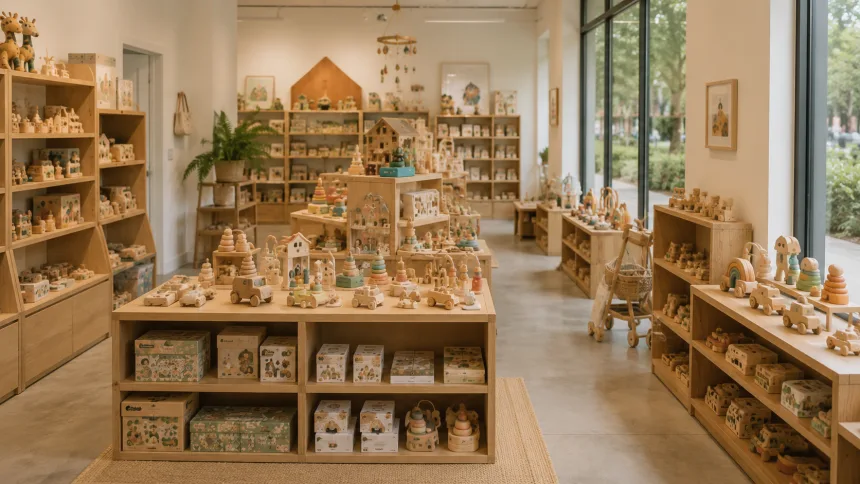
This is the structural advantage. Independent toy stores, museum shops, bookstore gift sections and curated online marketplaces select on design, story and craftsmanship rather than on price-per-unit. Wooden toys perform well here because the value is tactile: a customer picks the item up and understands it in two seconds. Boutique buyers also order in quantities that suit wooden manufacturing economics better than national chains do.
One structural point underlies all three channels and is worth stating explicitly, because it is the reason smaller brands can compete at all: discovery has moved away from a single search result toward social recommendation, editorial placement and in-store curation. A wooden product with a distinctive silhouette and a photographable finish is advantaged in all three of those mechanisms and disadvantaged in none. That is a change in the economics of launching, not just in the economics of selling.
Why Story-Led Brands Outperform Price-Led Ones in Specialty Channels
Three mechanisms explain why story outperforms price in this channel, and each has a practical implication for how a range should be presented.
Justification of price. A premium wooden product needs a reason to exist at its price, and the reason has to be deliverable in one sentence by a shop assistant. Material origin, craftsmanship, safety documentation and design intent are all usable; "better quality" is not, because it is a claim without content.
Gifting logic. A large share of specialty toy retail is gift purchase. Gifts are bought on sentiment, and sentiment attaches to a story far more readily than to a specification. This is why packaging copy written for a gift buyer outperforms packaging copy written for a parent comparing features.
Repeat and recommendation. A customer who knows the story of a product recommends it with the story attached, which is word-of-mouth with the marketing built in. Specialty retail depends on exactly that mechanism, which is why boutique buyers favour brands that give them something to say.
What US Buyers Require Before They List a Product
This is the part of the market that surprises first-time exporters. US buyers, including small boutiques, operate a documentation gate, and the gate is not optional.
| Requirement | What it means | Who provides it |
|---|---|---|
| ASTM F963 compliance | Mandatory toy safety standard, enforced through 16 CFR Part 1250; version depends on date of manufacture | Third-party testing, arranged by factory; evidence held by importer |
| CPSIA limits | Lead and certain phthalate limits for children's products | Third-party laboratory testing |
| Children's Product Certificate | A certification document citing the applicable rules and the testing laboratory | The importer, not the factory |
| Age grading with rationale | Stated age range supported by reference to CPSC age determination guidance | Brand or importer, recorded before artwork is printed |
| Tracking label | Permanent information identifying manufacturer, location and date of production, and batch or run | Factory, to the brand's specification |
| Warnings and language | Warning statements in English for the US market | Brand, in the artwork |
| Barcode and retail packaging | Scannable identification and shelf-ready carton presentation | Brand, with factory carton specification |
Two of these are worth emphasising because they are regularly missed. The Children's Product Certificate is issued by the importer, so it is your document even when every test behind it was arranged by the factory. And the age grading has to be decided before the artwork is printed, because it appears on the box and it determines which small-parts and other requirements apply to the design.
One further requirement is commercial rather than regulatory, and it is the one that most often delays a listing: retail-ready packaging. Boutique and chain buyers alike expect a carton that can be put on a shelf without repacking, with a scannable barcode in a predictable position and a presentation face that reads at a metre. This is not a compliance item, but it is a listing gate, and it belongs in the same workstream as the carton artwork rather than being discovered at the buyer's onboarding stage.
Categories With Room to Grow
Not every wooden category benefits equally from the current channel structure. The categories that do tend to share three properties: they photograph well, they are tactile in-store, and they have a clear developmental or design story that can be stated without making a claim.
- Open-ended construction. Blocks, planks and simple building systems. Photograph well, restock reliably, and work across a wide age band.
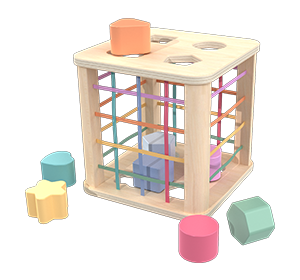
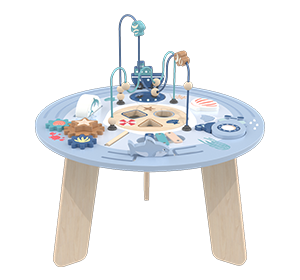
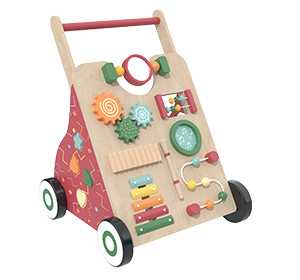
- Graders, stackers and sorters. The core of the early-years segment, bought by parents and by gift buyers, and easy to explain in one line.
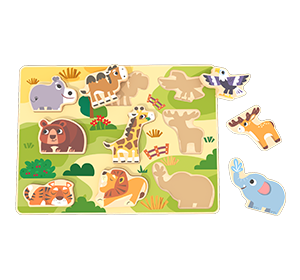
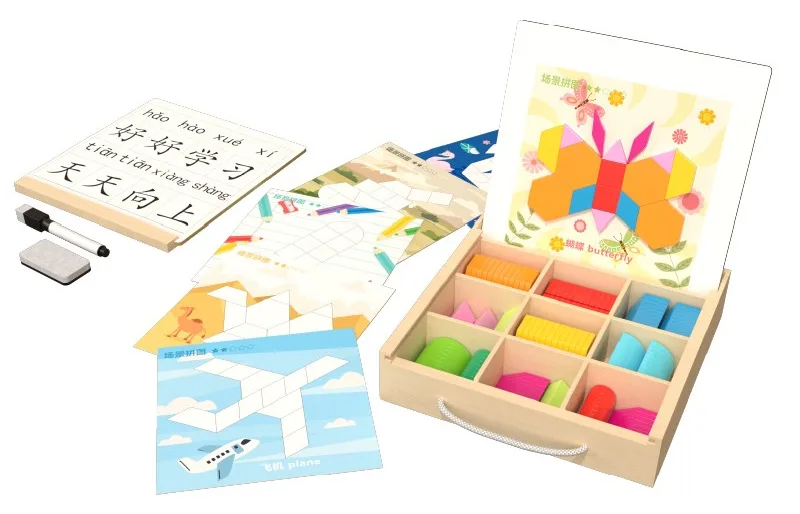
- Magnetic and mechanical puzzles. Tangram and maze formats travel well, have a clear skill story and a compact carton, which helps both freight and shelf economics.
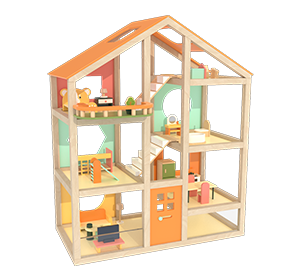
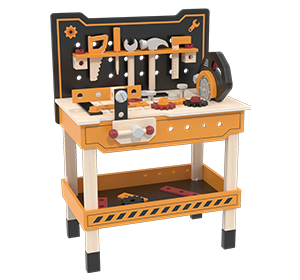
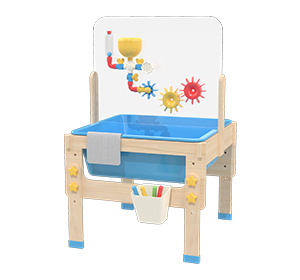
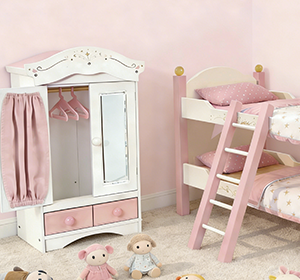
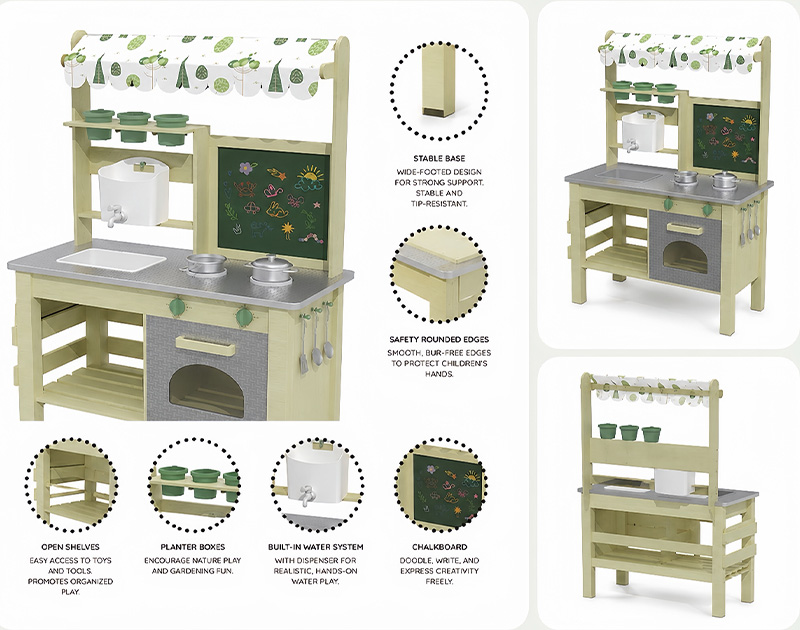
- Role-play and small-world play. Kitchens, shops, medical sets and doll houses. These carry higher ticket values and justify the shelf space that specialty retailers have.
- Large motor structures. Climbing and activity structures sit at the top of the price ladder and perform better in specialty and direct channels than in price-competitive ones.
The categories that struggle are the ones where wood's disadvantages dominate: fine character detail, complex mechanisms, and anything whose value proposition is lowest unit price.
A caution on range architecture. The temptation in a growing market is to launch wide, and for wooden ranges that is usually a mistake. Wooden products carry a higher unit value and a higher working-capital requirement per style than the plastic equivalents they sit beside, so a wide first range ties up capital in SKUs that have not yet earned their place. A tighter range of four to six items, each with a clear price tier, produces better sell-through data and a cleaner second season than twelve items launched together.
Compliance: ASTM F963, CPSIA and the Children's Product Certificate
The US compliance picture is narrower than the EU one in some respects and stricter in others, and the version question is the one that costs people money.
Version depends on date of manufacture
ASTM F963 is a mandatory consumer product safety standard for toys, enforced by the Consumer Product Safety Commission through 16 CFR Part 1250. The applicable version is tied to the date of manufacture, not to the date you placed the order or the date the standard was published. Confirming the version with your laboratory before testing, and recording the production date on the certificate, avoids a mismatch that is expensive to correct after shipment.
A test report has a scope, not an expiry date
Test reports describe a specific sample with a specific material and coating set, and there is no universal validity period. If the product remains unchanged, the report can generally still be used; if materials, coatings or the applicable standard change, further testing may be required. This is why the finish must be locked before the test submission, and why the bill of materials belongs in the compliance file alongside the report.
The certificate is yours
The Children's Product Certificate must identify the product, cite the rules the product is certified against, name the certifying party, give the date and place of manufacture, and identify the third-party laboratory. Build it into your own import procedure rather than waiting for it to arrive with the goods.
Cost, Minimum Quantity and Lead-Time Planning for US Programmes
US programmes have a planning characteristic that differs from European ones: distance. Ocean transit plus domestic distribution means the order-by date is further from the shelf date, and the Q2 to Q3 production peak falls directly across the autumn selling season.
Our standard minimum is 500 pieces per style for large structural items and all-wood products, and 1,000 pieces per style for small items and designs with a high proportion of plastic components, applied per style rather than per order. Sampling a new custom design takes 15 to 20 working days, and mass production runs 30 to 45 days after sample approval, extending to 45 to 60 days during the Q2 to Q3 peak.
Three planning consequences follow. First, work backwards from the shelf date through production, transit and domestic distribution, and treat the resulting order-by date as the real deadline. Second, prioritise carton density: for bulky wooden products, freight can exceed the difference between two supplier quotations, and pack efficiency is often the largest available saving. Third, place the certification workstream first, because it has an external dependency you do not control.
A fourth consequence is easy to overlook because it is administrative: the tracking label. US rules require permanent tracking information on the product and packaging identifying the manufacturer, location and date of production, and batch or run number. This has to be designed into the product and the carton, not added at pack-out. On small wooden items the available surface is limited, so decide the method — laser engraving, a printed area, or a carton-only solution where permitted — while the design is still editable.
Entering or expanding in the US market? Tell us your categories, channel mix and target price points, and we will map the compliance and production timeline for your programme.
Discuss Your US Programme Industry DevelopmentBuilding Your US Wooden Toy Programme
Four recommendations, in the order they should be executed.
Budget for the first order honestly. A first US programme carries costs that do not repeat: sampling, testing, tooling where required, and the freight on a partial container. Spread across a small first run, these can exceed the unit cost itself. Knowing that number before you commit to a launch price is the difference between a first season that funds the second and one that does not.
Choose the channel before the range. A range designed for marketplace price competition and a range designed for boutique selection are different ranges. Deciding first prevents the most common failure: a good product aimed at the wrong buyer.
Lock the compliance file before the artwork. Age grading, warnings, tracking label content and the certificate all end up on the box or in the import file. Changing any of them after printing is expensive and slow.
Design the carton for freight, not only for shelf. For bulky wooden items, landed cost is dominated by volume. A carton that is ten percent smaller can be worth more than a two percent unit-cost saving, and it is usually easier to achieve.
Plan the second order before the first ships. The lead-time structure means the reorder decision for a season is made while the first shipment is still on the water. Knowing your reorder trigger in advance is what turns a good first season into a second one.
One last practical note on timing. Because the Q2 to Q3 production peak falls directly across the autumn selling season, the programmes that ship on time are the ones that were sampled in the quiet months before it. Sampling a new design takes 15 to 20 working days, and that window is far easier to secure in Q1 than in Q3.
Commercial terms are set out in the KIDMERRY wooden toy purchasing guide, and how exclusive programmes work is covered on the custom for brand owners page. To discuss a specific US programme, contact us with your categories and target dates.
Which ASTM F963 version applies to my order?
Who issues the Children's Product Certificate?
The factory side is supplying the test reports the certificate relies on — against limits of 100 ppm total lead in substrate, 90 ppm in coatings and 0.1% for certain phthalates — with reports issued per product and per order.
What is the minimum order for a US programme?
How far ahead should I order for an autumn season?
Which categories suit the US specialty channel best?
Plan the channel calendar around them: sampling a new design takes 15–20 working days and bulk production 30–45 days after approval, extending to 45–60 days in the Q2–Q3 peak that overlaps the autumn selling season.
Do small boutiques really require compliance documentation?
The obligation scales with the product, not the account: 1 Children’s Product Certificate per product, citing the applicable rules and the third-party laboratory, regardless of order size.
Position Your Wooden Toy Range for the US Market
About Kidmerry: Yunhe Kidmerry Toys Co., Ltd is a wooden toy manufacturer based in Yunhe, Zhejiang, China. The factory runs in-house CNC machining, finishing and assembly, and holds ISO 9001:2015 certification, with FSC-certified board available on request. Sampling takes 7–10 working days for existing styles and 15–20 working days for custom drawings; bulk production runs 30–45 days after sample approval. Ask Kidmerry for a quotation, a sample set and third-party test reports before your next development cycle.
Request a Quotation