Outdoor Wooden Toys: A Buyer's Guide to Weather Resistance, Safety and Freight
Outdoor wooden toys are the hardest category to quote correctly and the easiest to get wrong in the field. Sun, water, temperature cycles and a much higher abuse load change almost every material and structural decision. This guide is for buyers sourcing sand and water tables, climbers, ride-ons and push toys, and it focuses on weather resistance, structural safety, freight economics and the certification questions that are specific to outdoor use.
What this guide covers
- Why outdoor changes every material decision
- What drives demand for outdoor wooden play
- Weather resistance: species, coatings and hardware
- Structural safety for water play, climbing and ride-on
- Dimensions, weight and freight economics
- Assembly, instructions and spare parts
- Age grading, MOQ, QC, certification and seasonality
- Frequently asked questions
Why outdoor changes every material decision
An indoor toy meets a controlled environment. An outdoor toy meets ultraviolet light, standing water, freeze-thaw cycles, fungal growth and a child who treats it as equipment rather than as a toy. Each of those attacks a different part of the product: ultraviolet light degrades coatings and surface colour, water drives dimensional change and joint failure, and temperature cycling opens up clearance problems that never appear in a showroom.
The commercial consequence is that the specification has to be written for the environment, not for the photograph. Buyers who specify outdoor items using indoor criteria produce products that look right on day one and fail in the first season, and the resulting claims cost more than the material upgrade would have.
What drives demand for outdoor wooden play
The demand case rests on physical activity rather than on novelty. The World Health Organization’s 2019 guidelines on physical activity, sedentary behaviour and sleep for children under five recommend at least 180 minutes of physical activity a day for one- and two-year-olds, and at least 180 minutes for three- and four-year-olds including 60 minutes of moderate-to-vigorous activity, with sedentary screen time limited to no more than one hour for two- to four-year-olds and none recommended under two. Those recommendations are a useful framing for category planning, and they are also the reason school and nursery channels buy outdoor equipment rather than more indoor product.
Two buyer implications follow. First, the channel matters: nursery, school and community buyers ask for durability documentation and maintenance instructions that a retail buyer never asks for, so prepare a different information pack per channel. Second, seasonality is real: outdoor programmes should be planned against a Q2–Q3 production peak, which is exactly when factory capacity is tightest and lead times extend. We track how that demand shows up across the category on our wooden toy industry development page.
Weather resistance: species, coatings and hardware
Species selection
Outdoor items usually combine a stable panel material with solid wood at load points. Birch plywood is common for panels and tabletops because it resists warping better than solid stock at that width. Solid wood appears at legs, frames, rails and handles, where strength and joint integrity matter. Species choice at those points is a balance: harder species resist denting and hold fasteners better, softer species are lighter and cheaper but mark and can split at fasteners. Confirm the species per part on the data sheet, and ask what moisture content the factory conditions to before assembly — for outdoor product this is the single most important process number.
Coatings and water management
For outdoor use, the coating system and the design’s water management matter more than the species. Ask three questions. What is the coating system, and is it validated for exterior exposure or only for indoor use? How does the design shed water — are there horizontal surfaces where water can stand, are end grains sealed, are there drainage paths? And what happens at the fasteners, because a coated panel with an unsealed screw hole will fail at the hole first.
KIDMERRY uses water-based paints and controlled finishing processes, and applies FSC-certified material where the project calls for it. FSC at our end is a chain-of-custody certificate with a defined product scope rather than a statement about every item, so confirm the SKU against the certificate scope before printing an FSC claim. Where a programme needs exterior-grade performance, say so explicitly in the enquiry — the finish schedule for a garden product is not the same as the schedule for a playroom product, and the difference has to be engineered in rather than added later.
Hardware
Corrosion is the fastest visible failure on outdoor wooden product. Specify fastener material and coating, ask for corrosion resistance evidence appropriate to the market, and avoid designs where a fastener sits in a water trap. Where a part is intended to be removed for storage — a liner, a lid, a leg set — specify the cycle life of that interface, because it will be used far more often than an assembly joint.
Discuss your custom wood and finish. Tell us where the product will live, the market and the finish expectation, and we will come back with a construction proposal, an exterior finish schedule and the evidence available for that configuration.
Discuss Your Custom Wood / FinishStructural safety for water play, climbing and ride-on
Water and sand play
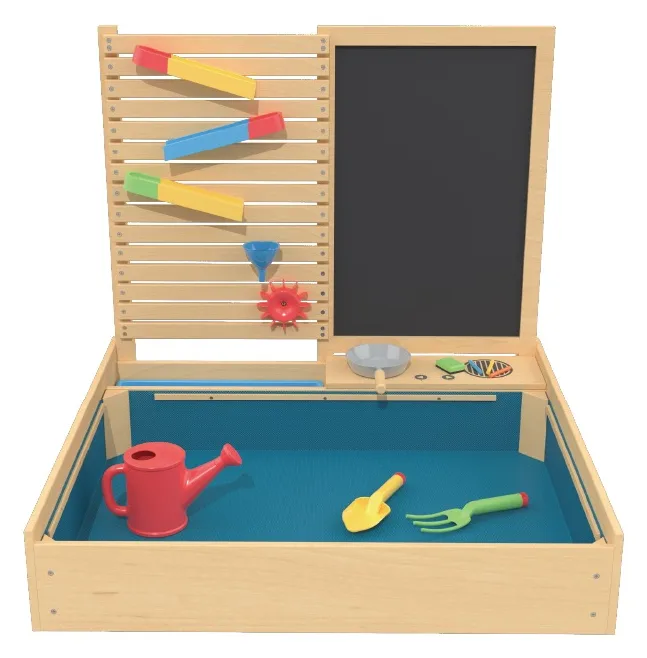
The exposure here is standing water and wet sand, both of which are heavier and more persistent than a spill. Design questions to put in writing: is the liner removable and how is it sealed, is the liner material captured in the compliance test, what is the drainage path, and what is the cleaning method. Lids that double as surfaces need their own load and pinch-point assessment, because a lid is where fingers get caught.
Climbing and balancing
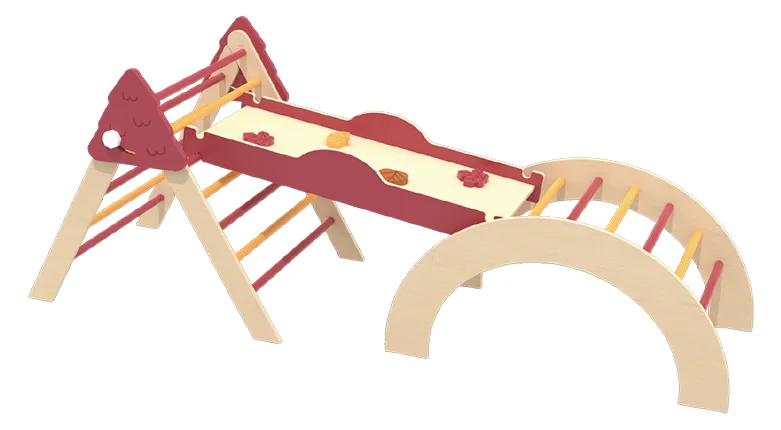
Climbing structures introduce stability, entrapment and fall-height considerations that do not apply to floor toys. Ask what stability or tip-over test the factory applies and at what load, how openings are assessed against head and limb entrapment, and what the intended fall surface is — because the correct answer for a climber’s safety depends partly on what it stands on, which the instructions must state.
Ride-on, push and pull toys
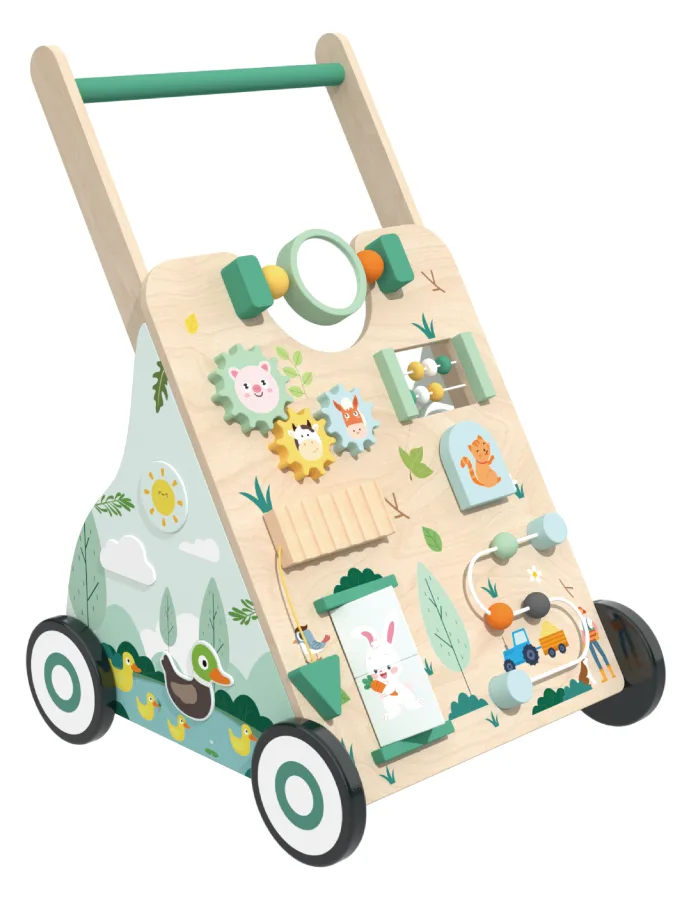
These products see continuous dynamic load. The failure points are wheel and axle retention, handle fixing, and the frame’s resistance to racking when a child pushes at an angle. Specify the axle retention method and a pull or push test, and require the sample to be tested rather than inspected.
Dimensions, weight and freight economics
Outdoor product is bulky, and freight is often the deciding variable in the landed cost. Ask for packed carton dimensions and the units-per-container figure before you commit to a design, because a small dimensional change can move the container count by a meaningful margin. Where a design can nest, fold or ship as a sub-assembly, price both configurations — the saving on freight sometimes exceeds the added assembly cost.
Weight matters for a second reason: channel. A product that is heavy to move is harder to sell into a home-garden channel and easier to sell into institutional channels that install once. Decide the channel before the structure is frozen.
Assembly, instructions and spare parts
Outdoor product is usually assembled by an adult, often once, often outdoors, and often with the box already open for an hour. That is an instruction-design problem. Require: an unambiguous parts list with a visual, a fastener schedule that matches the bag, torque guidance where a joint is structural, and a maintenance note covering re-coating intervals and winter storage.
Spare parts are a small decision with a large service impact. If a liner, a wheel or a bolt can fail, decide whether you will hold spares and make that part identifiable in the instructions. Institutional buyers ask this question, and having an answer shortens the tender process.
Age grading, MOQ, QC, certification and seasonality
Age grading and classification
Age grading drives small-part limits, warning text and the applicable test set. Outdoor product adds a classification question: depending on how an item is classified, additional parts of a standard can apply — in the EU, activity toys intended for domestic use are addressed by EN 71-8, for example. Rather than assuming, ask how the specific product is classified for your market and which parts of the standard are therefore in scope.
MOQ and seasonality
MOQ follows changeover time, board yield and component sourcing. At KIDMERRY, large structural products such as doll houses, play kitchens and outdoor climbing frames, and all-wood designs, start at 500 pieces per style; where the plastic component share is high, and for small-item designs, the starting point is 1,000 pieces per style. Final MOQ is confirmed per project, and it is quoted per style, not per order. Plan outdoor orders early: mass production runs about 30–45 days after sample approval, extending to 45–60 days in the second and third quarter peak, which is precisely the window when outdoor product is wanted on shelf.
QC, certification and export
Ask for incoming, in-process and outgoing checks in writing, including moisture content and board grade on incoming, first-article and interval dimension checks in process, and an outgoing inspection basis with an AQL level and defect classification. KIDMERRY operates under ISO 9001:2015 and holds BSCI and Sedex (SMETA) registrations, with EN 71-3 and CPSC / ASTM F963 on the certificate list; testing to other parts and standards is arranged per product and per order.
For the EU, current shipments are assessed under the Toy Safety Directive 2009/48/EC. A new Regulation, (EU) 2025/2509, published in the Official Journal on 12 December 2025, enters into force on 1 January 2026 and applies from 1 August 2030, introducing a digital product passport and wider chemical restrictions. Plan against the directive and track the transition. For the US, ASTM F963-23 is mandatory under 16 CFR 1250 from 20 April 2024, determined by date of manufacture and not date of import, with certain flammability provisions excluded by 16 CFR 1250.2(b). CPSIA limits to know: 100 ppm total lead in substrate, 90 ppm in coatings under 16 CFR 1303, and 0.1% for certain phthalates under 16 CFR 1307, plus tracking labels. The Children’s Product Certificate is issued by the importer or a US domestic manufacturer, not by the overseas factory.
On shipping, confirm whether solid-wood crating or pallets need ISPM 15 treatment — plywood and MDF panels are normally exempt, solid wood is not. Payment terms: T/T with a 30% deposit, L/C at sight, PayPal for samples.
Frequently asked questions
What finish should I specify for an outdoor wooden toy?
Ask for a coating system validated for exterior exposure rather than an indoor schedule, and address water management in the design: sealed end grain, drainage paths, no standing-water traps. Confirm the hardware specification too, because corrosion is the fastest visible failure outdoors.
How do I plan around seasonality?
Production runs about 30–45 days after sample approval, extending to 45–60 days in the Q2–Q3 peak, which is the same window when outdoor product is wanted on shelf. Book the slot early, and freeze artwork and component lists before the peak rather than during it.
Which certification applies to a climbing frame or activity toy?
It depends on how the product is classified for your market. In the EU, activity toys intended for domestic use are addressed by EN 71-8, so ask how the specific item is classified and which parts of the standard are in scope rather than assuming the general toy assessment covers it.
What is the MOQ for outdoor wooden toys?
Large structural products and all-wood designs start at 500 pieces per style; designs with a high plastic-component share and small-item designs start at 1,000 pieces per style. Final MOQ is confirmed per project, quoted per style rather than per order.
Should I hold spare parts?
If a liner, wheel or fastener can fail, decide before launch whether you will hold spares, and make the part identifiable in the instructions. Institutional buyers ask this during tendering, and an answer shortens the process.
How is freight handled for bulky outdoor items?
Ask for packed carton dimensions and units per container before design freeze. Price nested, folded or sub-assembled configurations against the assembled version — the freight saving can exceed the added assembly cost.
Ask about MOQ and packaging. Send the product type, the age band, the market and the quantity per style. We will propose a construction, quote MOQ and sampling time, and set out carton and container options.
Ask About MOQ and PackagingPlanning an outdoor wooden toy range?
Outdoor programmes reward the buyer who decides the environment, the channel and the season before the structure is frozen. If you are developing one, send the product type, the age band, the intended surface and market, and the quantity per style.
We will come back with a construction proposal, an exterior finish schedule, a sampling plan, MOQ and packaging options, and a production window — plus the questions we still need before quoting. The materials and certification sequence is also set out in our wooden toy purchasing guide, and the build route is described on our OEM and ODM customisation page.
Request an outdoor toy sample
Tell us the product, the market, the age grade and the quantity per style. We will come back with a sample plan, MOQ and lead times — and the documents we can supply for that market.
Request a Wooden Toy Sample