New Pretend Play and Outdoor Wooden Toy Collection: A Buyer's Review
A sushi set, a foldable gnome house and an 80 cm sand-and-water table look like three unrelated products. Buyers should read them as one programme: a single age spine from eighteen months to eight years, spanning indoor narrative play and outdoor construction play. This article reviews each item in specification terms and then looks at what combining them does to packaging, container planning and compliance scope.
What this guide covers
- Why these three items belong in one programme
- Item-by-item specification review
- Materials, corners and finishes
- Mechanisms: hook-and-loop food, folding houses and water tables
- Packaging and container planning across mixed sizes
- Age spine, MOQ, QC, certification and export
- Adapting the collection to your market
- Frequently asked questions
Why these three items belong in one programme
Retail and distribution buyers rarely buy a single role play item; they buy a story arc that keeps a child in a brand from toddlerhood to early school age. This collection is built for that arc. The food set works from about eighteen months, when the play is slicing and posting. The foldable house carries narrative play through the preschool years. The activity table takes over when the same child wants construction, water and gravity.
For a buyer, the value of reading the three as one programme is commercial rather than educational. A shared age spine means one brand voice across the packaging. A shared material and finish specification means one colour-approval loop instead of three. And a shared compliance scope means one test plan rather than three separate ones — provided the plan is written to cover the accessories and the mixed materials, which is where these programmes usually go wrong.
Item-by-item specification review
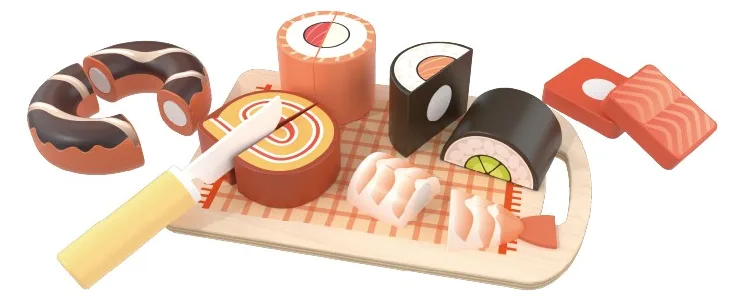
Wooden Japanese Sushi Velcro Cutting Play Set
A pretend sushi kitchen in a box: a solid wood chopping board, a round-tip wooden knife, and seven hook-and-loop layered food pieces covering sushi rolls, tamago, shrimp, salmon and a chocolate donut. The developmental claim is fine motor control alongside food vocabulary, counting and restaurant role play.
The specification items are the joining method and its cycle life, the piece size against the lowest age in the range, and the capture of the hook-and-loop material and any coating in the tested scope. Hook-and-loop joins are excellent for play value and demanding on production: the bond has to survive repeated separation without the layers peeling, and the join has to feel consistent across pieces.
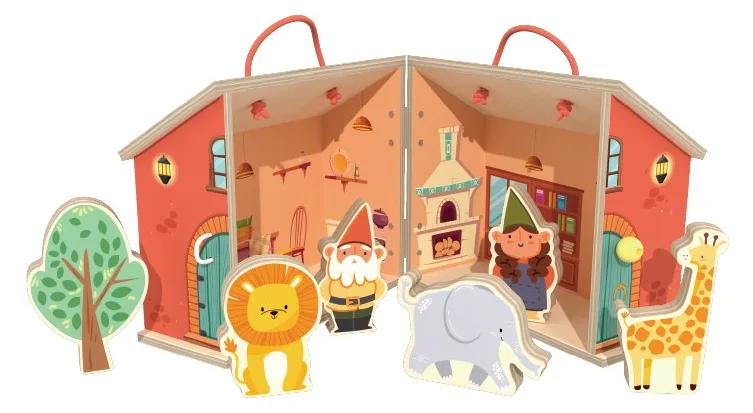
Foldable Forest Gnome Doll House with Animal Figures
A 15 x 13 x 13 cm storybook house that opens into two rooms with hand-drawn kitchen and dining scenes, supplied with two gnome dolls, lion, elephant and giraffe cutouts and a small tree, with a fabric handle for carrying. The claim is portable narrative play.
This is the item where folding tolerance matters most. A folding house has to close flat, open square and survive many cycles, so the specification should cover hinge hardware, the fabric handle’s attachment strength, and the panel alignment tolerance through the fold. Ask for a sample that has been cycled the number of times you expect in the product’s life, not one that has been opened twice.
Wooden Sand and Water Activity Table with Ball Track
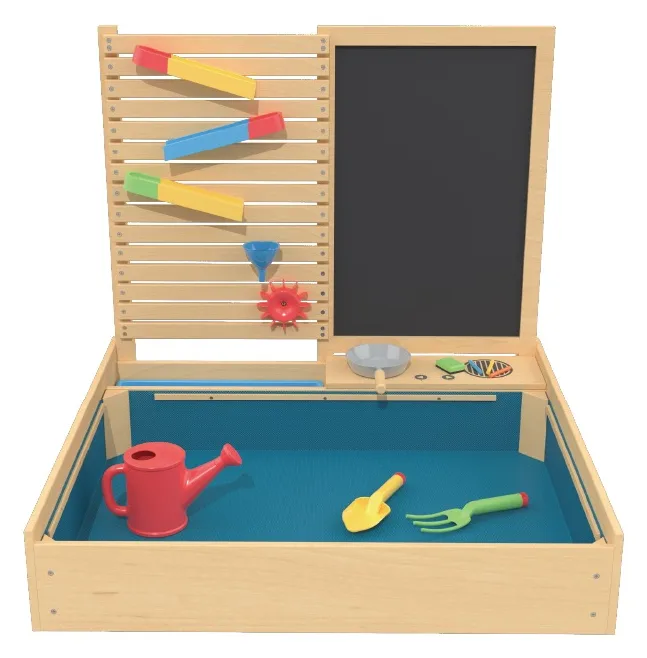
An 80 x 73 x 73 cm all-weather table with a removable waterproof liner for sand or water play, a marble-run style louvered ball track with funnel and gears, and a double-sided dust-free chalkboard lid that converts the unit into a clean tabletop when closed. The claim is sensory awareness and early physics intuition.
The specification items are the liner and its sealing method, whether the liner material is captured in the compliance test, the drainage path, the load and pinch-point assessment on the lid, and the exterior performance of the coating. At this size, packed carton dimensions and units per container also become a first-order commercial question rather than a shipping detail.
Materials, corners and finishes
The collection is built from solid birch and pine plywood with rounded corners and water-based finishes. Three points are worth translating into specification language.
Rounded corners are a process requirement, not a description: state the minimum edge radius and how it is verified, because an arris that survives a moulded prototype often survives badly in production. Water-based finishes should be specified by property — abrasion resistance for surfaces dragged across a floor, saliva and sweat resistance for pieces a younger child will mouth — and by the standard you want tested, not by the adjective “non-toxic”.
On certification, KIDMERRY holds EN 71-3 (migration of certain elements) and CPSC / ASTM F963 on its certificate list, operates under ISO 9001:2015 and holds BSCI and Sedex (SMETA) registrations. Testing to other parts of a standard, or to standards outside that list, is arranged per product and per order. FSC is a chain-of-custody certificate with a defined product scope rather than a statement about every item; we apply FSC-certified material where a project calls for it, and an FSC claim on packaging should be checked against the certificate scope for the specific SKU before artwork goes to print.
Discuss your custom wood and finish. Tell us which items you want to adapt, where they will be used and the market, and we will come back with a construction proposal, a materials schedule and the evidence available for that configuration.
Discuss Your Custom Wood / FinishMechanisms: hook-and-loop food, folding houses and water tables
| Mechanism | What it must do | What to specify | Typical failure |
|---|---|---|---|
| Hook-and-loop food pieces | Separate cleanly, rejoin reliably, many cycles | Joining method, bond strength, cycle count, inclusion in the tested scope | Layers peel after repeated separation |
| Folding house panels | Close flat, open square, survive travel | Hinge hardware, handle attachment strength, fold alignment tolerance, cycle test | Panels drift and the house will not close flat |
| Removable water liner | Seal reliably, drain, clean easily | Liner material, sealing method, drainage path, cleaning method, compliance capture | Seepage at the liner seam and standing water |
| Chalkboard lid | Carry load, no pinch points, erase cleanly | Load assessment, pinch-point review, surface cycle test | Pinched fingers and ghosting after a few uses |
KIDMERRY runs a dedicated CNC cell with multi-spindle routing and automatic tool change, working to a machining accuracy of roughly ±0.1–0.2 mm on routed parts. That is a machining capability, not a finished-part tolerance promise; what can be held on a specific part depends on its geometry, the species and the finish build. Put the agreed tolerance on the drawing, and require the approval sample to come off the production route rather than being hand-finished.
Packaging and container planning across mixed sizes
This collection spans a 15 cm carry-along and an 80 cm table, which is exactly the mix that makes container planning interesting. Two approaches work. The first is to ship each item in its own retail carton and accept the volume. The second is to design the small items so they nest into the large item’s carton void, which is only possible if the carton is engineered for it from the start.
Either way, ask the factory for packed carton dimensions and the units-per-container figure for each configuration before design freeze. Also specify carton grade and internal protection for the actual pack, and require drop and vibration evidence on the packed unit rather than on the bare product. Print minimums on packaging frequently exceed the product MOQ, so ask for both numbers separately before setting the order quantity.
Age spine, MOQ, QC, certification and export
Age spine
Age grading should be fixed before design freeze, because it drives small-part limits for accessories, warning text, stability requirements and the claims you can make. Because this collection spans eighteen months to eight years, the constraint that applies to the youngest band applies to the whole set unless the items are clearly separated in packaging and marking. Practically, that means the food set’s piece sizes and the house’s small figures set the floor for the programme.
MOQ
MOQ follows changeover time, board yield and component sourcing. At KIDMERRY, large structural products such as doll houses, play kitchens and outdoor climbing frames, and all-wood designs, start at 500 pieces per style; where the plastic component share is high, and for small-item designs, the starting point is 1,000 pieces per style. Final MOQ is confirmed per project. Note the unit: per style, not per order — taking all three items is three MOQ commitments, not one.
Sampling, QC and certification
Existing-style samples take about 7–10 working days; new items from your drawings take about 15–20 working days, because tool paths, fixtures and first-article inspection must be created. Both are factory working days and exclude courier time. After approval, mass production runs about 30–45 days, extending to 45–60 days in the second and third quarter peak, starting at approval and excluding sea transit.
Ask for incoming, in-process and outgoing checks in writing, including moisture content and board grade on incoming, first-article and interval dimension checks plus mechanism checks in process, and an outgoing inspection basis with an AQL level and defect classification. For multi-component sets, add a component-completeness check on the packing line, because a missing accessory is the most common complaint in this category and the most expensive to fix after shipment.
For the EU, shipments are currently assessed under the Toy Safety Directive 2009/48/EC; a new Regulation, (EU) 2025/2509, published in the Official Journal on 12 December 2025, enters into force on 1 January 2026 and applies from 1 August 2030, introducing a digital product passport and wider chemical restrictions. Plan against the directive and track the transition. For the US, ASTM F963-23 is mandatory under 16 CFR 1250 from 20 April 2024, determined by date of manufacture rather than date of import, with certain flammability provisions excluded by 16 CFR 1250.2(b). CPSIA limits to know: 100 ppm total lead in substrate, 90 ppm in coatings under 16 CFR 1303, and 0.1% for certain phthalates under 16 CFR 1307, plus tracking labels. The Children’s Product Certificate is issued by the importer or a US domestic manufacturer, not by the overseas factory. Payment terms: T/T with a 30% deposit, L/C at sight, PayPal for samples.
Adapting the collection to your market
The realistic adaptation levers are food and story content, artwork and character selection, colourway, packaging format and language. Artwork is the longest-lead item and should start first; colourway is more expensive than buyers expect, because matching across wood, print and carton is a separate approval loop.
A custom wooden toy manufacturer can run artwork, dielines and sample development in parallel, but only if the artwork is frozen early — artwork approval is the most common cause of a slipped launch in this category. For brand owners with an existing visual identity, approvals should be done on the real substrate rather than against a screen, because wood shifts perceived tone in ways paper swatches do not predict.
Frequently asked questions
Can I take the three items as one order?
Yes, but MOQ is quoted per style, so all three items means three MOQ commitments. All-wood designs and large structural products start at 500 pieces per style; designs with a high plastic-component share and small-item designs start at 1,000 pieces per style. Final MOQ is confirmed per project.
How is the water liner specified?
Name the liner material, the sealing method, the drainage path and the cleaning method, and confirm the liner is captured in the compliance test for your market. Lids that double as surfaces also need a load and pinch-point assessment.
Will the foldable house survive travel use?
It should, provided the hinge hardware, handle attachment and fold alignment are specified and cycle-tested. Ask for a sample that has been folded and unfolded a realistic number of times rather than one opened twice.
What is the lowest age the collection can be graded to?
The programme spans roughly eighteen months to eight years, and the constraint that applies to the youngest band applies to the whole set unless items are clearly separated in packaging and marking. The food set’s piece sizes and the house’s small figures set the floor.
How do I plan the container mix?
Ask for packed carton dimensions and units per container for each configuration before design freeze, and consider whether the small items can nest into the large item’s carton void. That has to be engineered into the carton from the start.
Can I print an FSC claim on the packaging?
Only where the specific product falls within the chain-of-custody certificate scope and your own arrangements support the claim. FSC at KIDMERRY is a chain-of-custody certificate with a defined product scope, so check the SKU before committing artwork to print.
Ask about MOQ and packaging. Send the items you want, the age spine, the market and the quantity per style. We will propose a construction, quote MOQ and sampling time, and set out carton and container options.
Ask About MOQ and PackagingLooking for a wooden toy manufacturing partner for this kind of range?
Collections that span indoor and outdoor play are where a factory’s process discipline shows: the same finish system has to work on a 15 cm carry-along and an 80 cm outdoor table, and the same compliance scope has to cover accessories, liners and hardware. If you are planning a range like this, send the age spine, the target market, the items you want to lead with and the quantity per style.
We will come back with a construction proposal, a sampling plan, MOQ and packaging options, and a production window — plus the questions we still need answered before we can quote. The materials and certification sequence is also set out in our wooden toy purchasing guide, and private label artwork routes are described on our private label customisation page.
Request a sample of this collection
Tell us the items, the market, the age grade and the quantity per style. We will come back with a sample plan, MOQ and lead times — and the documents we can supply for that market.
Request a Wooden Toy Sample