New Educational and STEM Wooden Toy Series: A Buyer's Specification Review
Three new items — a two-in-one magnetic maze and pixel board, a magnetic tangram and drawing case, and a forest animal balance stacking set — share one design brief: portable, screen-free, and mechanically honest. This article is written for buyers rather than for parents. It sets out what each item actually is in specification terms, where the manufacturing risks sit, and what a private label or OEM adaptation of the series involves.
What this guide covers
- The design brief behind the series
- Item-by-item specification review
- Materials, finish and the safety case
- Manufacturing notes: magnets, tolerances and printing
- Packaging, merchandising and retail readiness
- MOQ, sampling, QC, certification and launch timing
- Adapting the series for your market
- Frequently asked questions
The design brief behind the series
The brief was narrow on purpose. Three constraints shaped every item: it must work without a screen, it must fit in a travel bag, and it must be mechanically self-evident — a child should be able to see whether they succeeded without an adult explaining it. Those constraints produce a specific kind of product, and they also produce a specific kind of sourcing conversation.
Portability drives the format: cases that close, boards that store their own pieces, and components that cannot be scattered across a car floor. Screen-free drives the mechanism: magnetic guidance, gravity, balance and geometry rather than electronics. Self-evidence drives tolerance, because the feedback the child reads is the fit of parts. For a buyer, the useful question is not whether the series is attractive but which of these three constraints matter most in your channel, because that determines which item to lead with and how to adapt it.
Item-by-item specification review
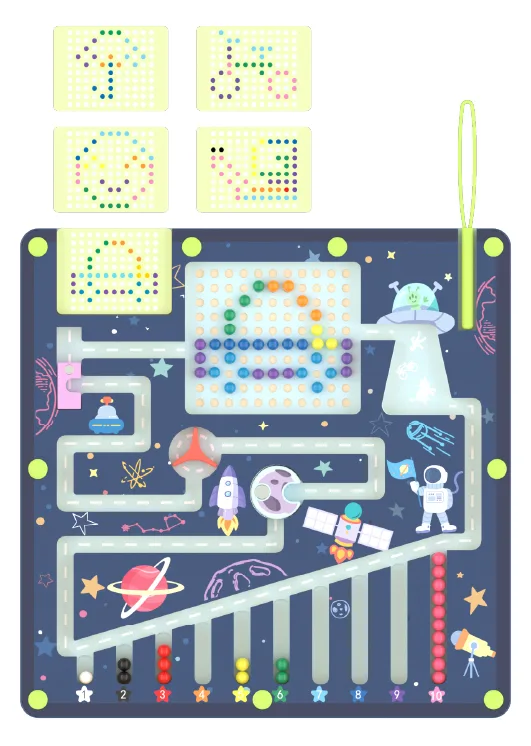
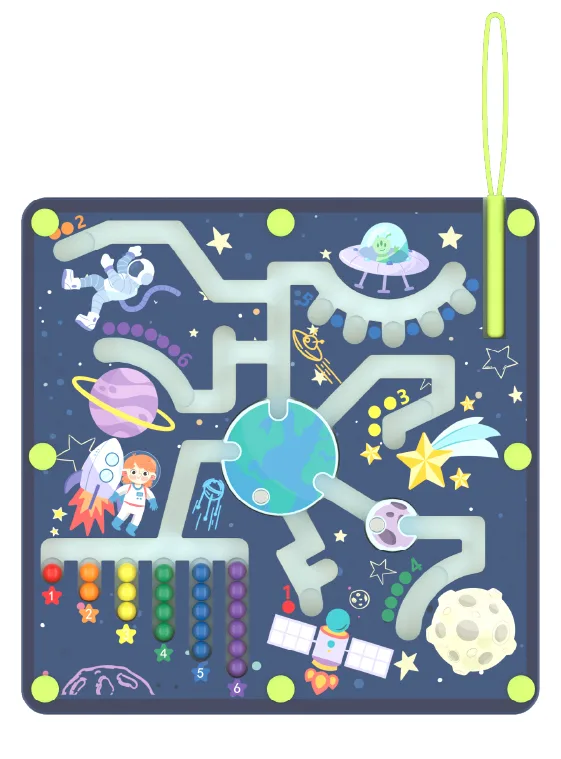
Space Magnetic 2-in-1 Maze and Pixel Art Board
A 30 x 30 cm board with a classic bead maze on one face and a dot-matrix pixel board on the other, supplied with four pattern cards for rockets, planets and astronauts. The developmental claim is wrist control, hand-eye coordination and early pattern maths. The manufacturing questions are more specific: how the beads are sealed, how the magnetic pen is retained, how the pixel board’s dot grid is registered to the pattern cards, and how the two faces are joined so the board does not rack.
From a sourcing standpoint, this is the item where the safety case is most visible. Enclosed beads remove the small-part risk only if the enclosure survives abuse, so the specification should name the panel construction, the sealing method and the test that proves it. The magnetic pen must also be retained — a captive stylus is a design decision, not an accessory.
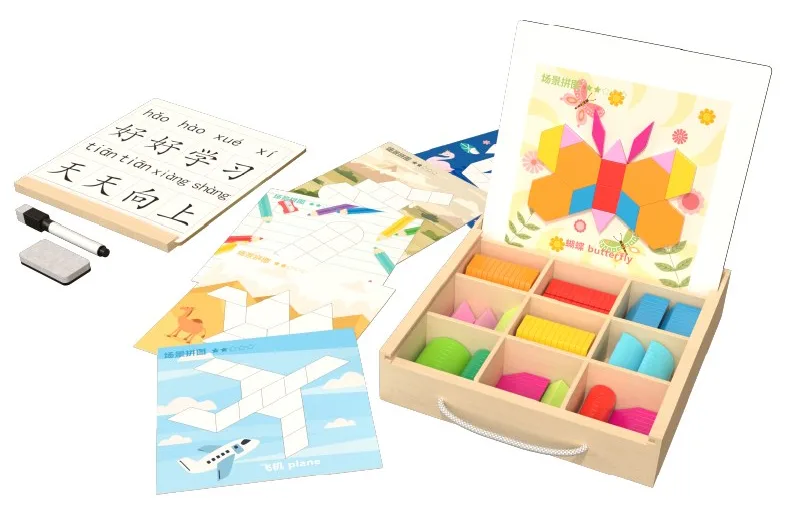
Wooden Magnetic Tangram Puzzle and Drawing Board
A 22 x 22 cm flip-top case that stores geometric blocks in eight compartments, doubling as a magnetic puzzle board and a dry-erase whiteboard, with bilingual picture cards covering butterfly, plane and swan patterns and their English names. The developmental claim is geometry, creativity and early language.
Two specification points dominate. The first is template accuracy: if the seven pieces are not consistent, the figures never close and the product teaches the wrong lesson. The second is the whiteboard surface: it has to erase cleanly through a realistic number of cycles, which is a coating property worth testing rather than assuming. The bilingual cards also make this the item most likely to need a language adaptation for your market — decide that before artwork freeze, not after.
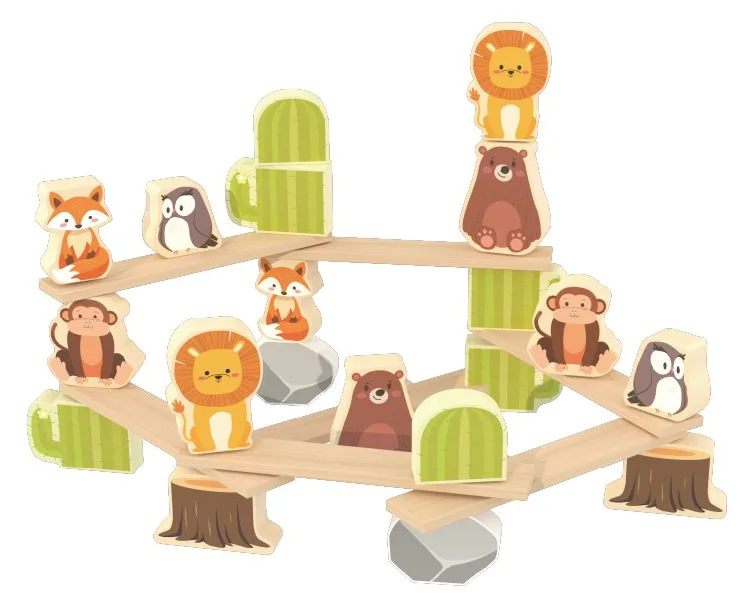
Forest Animal Balance Stacking Blocks
Five animal characters — lion, brown bear, monkey, fox and owl — with balance planks and scenery pieces for a toppling-tower game. The developmental claim is prediction of centre of gravity, controlled force, focus and resilience, in a two-player format.
The engineering question here is weight distribution and repeatability. A balance game is only fair if the pieces behave consistently, so the specification should cover piece weight and its tolerance, the flatness of the contact faces, and the stability of the base. Two-player formats also sell better when the rule set fits on the box, so plan the artwork around a rule panel.
Materials, finish and the safety case
All three items use natural wood with rounded edges and water-based finishes. Two buyer-facing points are worth stating precisely, because they are the two most common sources of a reprint or a rejected listing.
First, the safety case is market-specific and product-specific. KIDMERRY holds EN 71-3 (migration of certain elements) and CPSC / ASTM F963 on its certificate list, operates under ISO 9001:2015, and holds BSCI and Sedex (SMETA) registrations. Testing to other parts of a standard, or to standards not on that list, is arranged per product and per order. If your market needs a specific part, name it in the enquiry rather than discovering the gap when you book the shipment.
Second, FSC is a chain-of-custody certificate with a defined product scope, not a statement that every item is FSC-certified. KIDMERRY applies FSC-certified material where the project calls for it. If your programme needs to print an FSC claim, confirm the specific SKU against the certificate scope before artwork goes to print — this single check prevents the most expensive reprint in the category.
Discuss your custom wood and finish. Tell us which item you want to adapt, the market and the finish expectation, and we will come back with a construction proposal and the evidence available for that configuration.
Discuss Your Custom Wood / FinishManufacturing notes: magnets, tolerances and printing
| Element | Why it matters to a buyer | What to specify |
|---|---|---|
| Magnets and magnetic pens | Retention and ingestion risk are the two issues that stop a listing | Enclosure method, magnet retention test, stylus tethering, inclusion in the tested scope |
| Enclosed beads | A sealed panel removes small-part risk only if it survives abuse | Panel construction, sealing method, abuse test and acceptance criteria |
| Template accuracy | Geometric tasks only work if pieces are consistent | Template tolerance, first-article check, production-route approval sample |
| Dry-erase surface | Poor erase performance generates returns | Coating system, erase cycle count, ghosting acceptance |
| Pattern cards | Registration errors make the task unsolvable | Print method, registration tolerance, language version control |
KIDMERRY runs a dedicated CNC cell with multi-spindle routing and automatic tool change, working to a machining accuracy of roughly ±0.1–0.2 mm on routed parts. That figure is a machining capability, not a finished-part tolerance promise; what can be held on a specific part depends on its geometry, the species and the finish build. Put the agreed tolerance on the drawing rather than in an email, and require the approval sample to come off the production route — a hand-finished prototype hides exactly the consistency problems these products depend on.
Packaging, merchandising and retail readiness
Small educational items are usually bought on a shelf or a listing page, and in both cases the packaging does the explaining. Four things belong in the brief. A rule or task panel, because a product that needs a paragraph of explanation loses the shelf comparison. A clear age and skill statement, because that is what a parent or a buyer filters on. A language plan, since bilingual cards and multi-market artwork are a separate approval loop. And a carton specification with drop and vibration evidence for the packed configuration.
Print minimums on packaging frequently exceed the product MOQ, so ask for both numbers separately before setting the order quantity. For e-commerce channels, also decide whether the item ships in its retail carton or needs an over-pack — that decision changes the carton grade requirement.
MOQ, sampling, QC, certification and launch timing
MOQ
MOQ is driven by changeover time, board yield and component sourcing. At KIDMERRY the structure is 500 pieces per style for large structural products such as doll houses, play kitchens and outdoor climbing frames, and for all-wood designs; 1,000 pieces per style where the plastic component share is high, and for small-item designs. Final MOQ is confirmed per project. Note the unit: per style, not per order — taking all three items in a series is three MOQ commitments, not one.
Sampling and timing
Existing-style samples take about 7–10 working days. New items built from your drawings take about 15–20 working days, because tool paths, fixtures and first-article inspection must be created. Both are factory working days and exclude courier time. After approval, mass production runs about 30–45 days, extending to 45–60 days in the second and third quarter peak, starting at approval and excluding sea transit. For a back-to-school or gifting launch, work backwards from the on-shelf date and leave room for artwork approval, which is the step most likely to slip.
QC and certification
Ask for incoming, in-process and outgoing checks in writing: moisture content and board grade on incoming, first-article and interval dimension checks plus magnet retention and coating checks in process, and an outgoing inspection basis with an AQL level and defect classification. For the EU, shipments are currently assessed under the Toy Safety Directive 2009/48/EC; a new Regulation, (EU) 2025/2509, published in the Official Journal on 12 December 2025, enters into force on 1 January 2026 and applies from 1 August 2030, introducing a digital product passport. Plan against the directive and track the transition rather than claiming conformity to obligations that are not yet applicable.
For the US, ASTM F963-23 is mandatory under 16 CFR 1250 from 20 April 2024, determined by date of manufacture rather than date of import, with certain flammability provisions excluded by 16 CFR 1250.2(b). CPSIA limits to know: 100 ppm total lead in substrate, 90 ppm lead in coatings under 16 CFR 1303, and 0.1% for certain phthalates under 16 CFR 1307, plus tracking labels. The Children’s Product Certificate is issued by the importer or a US domestic manufacturer, not by the overseas factory. Payment terms: T/T with a 30% deposit, L/C at sight, PayPal for samples.
Adapting the series for your market
This is where the series becomes a programme rather than a purchase. The realistic adaptation levers are: language on the pattern cards, artwork and character selection, colourway, packaging format, and the accessory set. Artwork is the longest-lead lever, so it should start first. Colourway is surprisingly expensive to change well, because matching across wood, print and carton is a separate approval loop.
A private label wooden toy manufacturer can run artwork and dielines in parallel with sample development, but only if the artwork is frozen early. For brand owners working an existing visual identity, the custom wooden toy programme for brand owners typically begins with a colour-approval round on the real substrate, because screen-matched artwork and production-matched artwork are rarely the same result on wood.
Frequently asked questions
Can the three items be taken as a single programme?
Yes, but MOQ is quoted per style, so a three-item programme carries three MOQ commitments. Where the plastic component share is high, and for small-item designs, the starting point is 1,000 pieces per style; all-wood designs and large structural products start at 500 pieces per style. Final MOQ is confirmed per project.
How are the beads kept safe inside the maze board?
They are enclosed within the panel. The specification should name the panel construction, the sealing method and the abuse test that proves the enclosure survives, and the stylus should be retained as part of the design rather than treated as an accessory.
Can the pattern cards and artwork be localised?
Yes. Language versions, artwork and character selection, colourway and packaging format can all be adapted. Start artwork first because it has the longest lead time, and freeze it before sample approval if the launch date is fixed.
What certification applies to these items?
It depends on the market and on how the product is classified. KIDMERRY holds EN 71-3 and CPSC / ASTM F963 on its certificate list, operates under ISO 9001:2015 and holds BSCI and Sedex (SMETA) registrations. Testing to other parts or standards is arranged per product and per order, so name the requirement in the enquiry.
How long does a private label version take?
Budget 15–20 working days for a custom sample from your drawings, then 30–45 days for bulk production after approval, extending to 45–60 days in the Q2–Q3 peak. Existing-style samples are faster at about 7–10 working days. Artwork approval runs in parallel and is the most likely cause of a slipped date.
Can I print an FSC claim on the packaging?
Only where the specific product falls within the chain-of-custody certificate scope and your own arrangements support the claim. FSC at KIDMERRY is a chain-of-custody certificate with a defined product scope, not a blanket statement, so check the SKU before committing artwork to print.
Request a wooden toy sample. Tell us which item you want to see, the age grade and the market. We will propose a construction, quote MOQ and sampling time, and set out packaging options.
Request a Wooden Toy SamplePlanning a new educational wooden toy range?
The three items in this series — guided maze and pixel work, geometry and language, balance and prediction — cover the skills that educational buyers ask for most often, and each of them can be adapted in artwork, language and colourway. If you are building a range, send the age grade, the target market, the items you want to lead with and the quantity per style.
We will come back with a construction proposal, a sampling plan, MOQ and packaging options, and a production window — plus the questions we still need answered before we can quote. The wider commercial sequence, from materials to certification scope, is set out in our OEM and ODM customisation service.
Ask about MOQ, packaging and a production window
Tell us the items, the market, the age grade and the quantity per style. We will come back with MOQ, a sampling schedule, packaging options and a production slot — and the documents we can supply for that market.
Contact KIDMERRY for Wholesale Supply