

How Do You Speed Up Toy Sampling and Shorten Development Cycles?
Every week a new wooden toy spends in sampling is a week a competitor can take your shelf space. In our experience, most wooden toy development cycles are inflated by avoidable serial waiting: approvals that could run in parallel, specifications that arrive late, and material or finish decisions taken before anyone has checked whether they are actually manufacturable. This guide is written for buyers and brand owners who need to compress a sampling cycle without compressing the quality of the result.
Sampling speed is won before the sample starts: the programmes that ship fastest lock the specification first, because late changes reopen tool paths, fixtures and first-article inspection. Ask for a manufacturability review at drawing stage — here it is returned within 24 hours of a usable drawing and typically saves a sampling round — then run certification and packaging in parallel with production instead of after it. The unchangeable arithmetic: an existing design samples in 7–10 working days, a custom design in 15–20, mass production runs 30–45 days after sample approval and 45–60 in the Q2–Q3 peak, with ocean transit on top. Work backwards from the launch date and decide which of those stages can overlap — that decision is the whole schedule.
- Why Sampling Time Is a Commercial Risk, Not Just an Engineering Metric
- Where Toy Development Cycles Actually Lose Weeks
- A Parallel Sampling Workflow: What Runs at the Same Time
- The Specification Package: What to Send Before Day One
- Material, Finish and Structure Decisions That Change the Timeline
- Testing, Certification and Packaging Run in Parallel
- How to Read a Sampling Quote and What to Ask
Why Sampling Time Is a Commercial Risk, Not Just an Engineering Metric
Sampling is usually discussed as an engineering step. In a commercial programme it is a scheduling risk that sits directly on the critical path to a selling season. A wooden toy range that misses its launch window does not simply arrive late; it arrives into a different competitive set, often with retail shelf space already allocated and marketing calendars already committed.
The arithmetic is unglamorous but decisive. If a custom wooden toy takes 15 to 20 working days to sample, a further 30 to 45 days for mass production after sample approval, and then ocean transit, the order-by date moves back by roughly three months from the shelf date. Compress the sampling stage by ten days and you buy ten days of optionality: a second colourway, a repackaged gift set, or simply the buffer to absorb a freight delay.
There is a second, less visible cost. Long sampling cycles consume design attention. When a buyer waits six weeks for a first sample, the feedback loop slows, the team moves on to other projects, and the accumulated decisions arrive in one large batch rather than as several small, cheap corrections. Speed in sampling is not about rushing the factory; it is about keeping the decision loop short enough that mistakes are caught while they are still cheap.
Where Toy Development Cycles Actually Lose Weeks
Most delays are not caused by slow machines. They are caused by work waiting on other work. Four patterns account for the majority of the lost time we see in custom wooden toy projects.
Serial approvals
The classic sequence runs design, then wood sample, then paint approval, then packaging, then testing. Each stage waits for the previous one to finish. In practice, paint colour selection, carton artwork and certification documentation do not physically depend on the finished wooden sample. They depend on decisions that can be made in week one. Running them in sequence typically adds two to four weeks to a programme of any complexity.
Specifications that arrive late or incomplete
A 2D drawing without wall thickness, corner radius, or joinery detail forces the factory to ask questions. Each question is a round trip. If the drawing arrives as a concept sketch with a note that details will follow, the clock does not start until the last missing dimension is supplied.
Material choices made without a feasibility check
A specification calling for a wood species, board thickness, or finish system that the factory does not routinely run will add sourcing time before any cutting starts. This is especially common with unusual panel sizes, very thin sections, and finishes that require a longer cure cycle. A design for manufacturability review before cutting is far cheaper than a redesign after the first sample fails.
Testing started after approval
Safety testing is the single most common cause of a programme that looks finished but cannot ship. If EN71 or ASTM F963 testing is commissioned only after the sample is approved, and the result requires a change to paint, coating, or a small part, the whole cycle restarts. Testing should be commissioned against the production formula, in parallel with the final sample revisions.
A Parallel Sampling Workflow: What Runs at the Same Time
A parallel workflow does not mean doing everything at once. It means identifying which activities genuinely depend on each other and starting everything else on day one. The following is the sequence we run for custom programmes.
Stage one: DFM review before any cutting
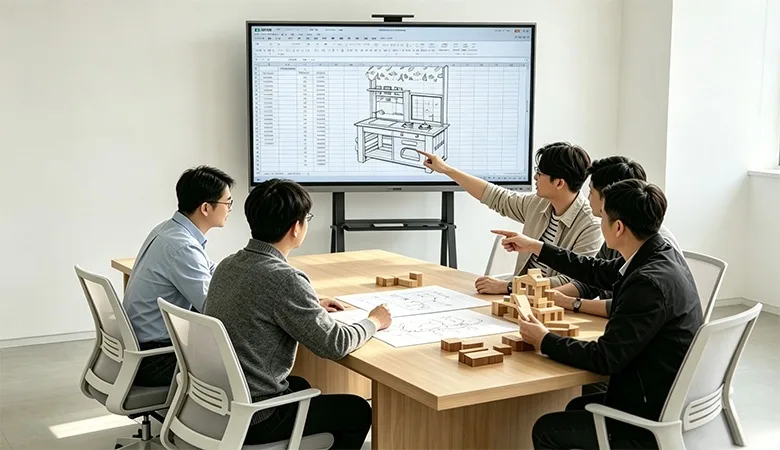
A manufacturability review checks wall thickness, corner radius, joinery method, tooling feasibility and material availability against your drawing. It is the cheapest possible moment to catch a problem, because nothing has been cut, painted, or assembled yet. In our workflow this review is returned within 24 hours of receiving a usable drawing, and it typically produces a small number of suggested changes: a radius increased to avoid a fragile corner, a section thickened to survive drop testing, a joint changed to a form that runs on standard tooling.
Our in-house CNC capability covers profile cutting, slots and tenons, relief carving, and safety radiusing in one setup, with machining accuracy in the range of plus or minus 0.1 to 0.2 millimetres. That accuracy figure describes machining capability, not a finished-part tolerance guarantee, and the practical benefit is that design features can be cut directly from your DXF or STL file without a tooling detour.
Stage two: 3D modelling and rendering
Within two to three days, the design is modelled and rendered. You approve proportions, panel layout, colour placement and print position on screen. This step exists to remove the most expensive kind of sample: the one that is technically correct but visually wrong.
Stage three: physical prototype
CNC prototyping in real beech or birch takes five to seven days for most items. The point of this sample is tactile: weight, balance, sanding quality, edge feel, and how a finish reads under real light. Photographs cannot convey any of these.
Stage four: parallel approval tracks
While the physical sample is being produced and shipped, three tracks run in parallel: paint and finish confirmation against the target standard, carton and insert artwork, and certification documentation for the target market. None of these requires the finished wooden sample. All of them gate production.
The Specification Package: What to Send Before Day One
The single highest-leverage thing a buyer can do to shorten a sampling cycle is to send a complete package first time. The following list is what we ask for, and each item exists because its absence reliably causes a delay.
| Item | Why it matters | What happens if it is missing |
|---|---|---|
| Drawing with dimensions | Defines the part before cutting | Factory raises queries; clock pauses |
| Target wood species and board type | Determines sourcing and machining route | Sample built in a substitute wood; results not comparable |
| Finish system and colour reference | Gates both appearance and chemical testing | Paint approval runs after sample; testing cannot start |
| Target market and age grade | Determines which standard applies | Testing commissioned against the wrong standard |
| Quantity per style and per order | Sets MOQ discussion and process route | Quote based on assumptions that do not hold |
| Packaging format and carton quantity | Artwork and structural design can run in parallel | Packaging becomes the critical path after approval |
| Reference photo or competitive sample | Resolves ambiguity faster than text | First model misses the intent; second iteration needed |
Material, Finish and Structure Decisions That Change the Timeline
Material selection is where a wooden toy programme is really decided, because the choice propagates into cost, compliance, durability, and perceived quality. Three decisions matter most.
Species and board type
Solid beech and birch are dense, fine-grained, and machine cleanly, which is why they are the default for puzzles, blocks and activity items where edges and engraving quality are visible. Pine costs less and is workable, but it dents more easily and absorbs paint unevenly, which matters when a large flat panel has to look uniform. Plywood and MDF appear in larger structures where dimensional stability and panel size matter more than surface hardness. Each of these routes has a different sourcing lead time, and switching species mid-programme resets the finish approval.
Finish system
Water-based coatings are the default for children's products in most export markets, and the specific system has to be validated against the chemical migration requirements of your target standard. This is why the finish should be locked at sample stage: the test report is only meaningful if it covers the exact coating and colour set used in production. Changing a colour after testing usually means re-testing.
Structure and joinery
The structural decisions that most often cause rework are thin walls, sharp internal corners, and joints that require a fixture the factory does not hold. A DFM review surfaces all three. If your design includes a feature that only a bespoke mould or jig can produce, decide early whether the unit volume justifies it, because bespoke tooling is both a cost and a calendar item.
Send your drawing and we will return a manufacturability review within 24 hours, with a day-by-day sampling schedule for your specific design and target market.
Request a Sampling Timeline See OEM / ODM CapabilityTesting, Certification and Packaging Run in Parallel
Certification is frequently treated as a final gate. Treated as a parallel track, it stops being a source of surprise. The key is to understand what each document actually is, because several are routinely confused.
The European set
Toys placed on the EU market are covered by the Toy Safety Directive 2009/48/EC, with the EN71 series of standards providing the technical test methods. EN71-1 covers mechanical and physical properties, EN71-2 flammability, and EN71-3 migration of certain elements, which is the part most relevant to paints and coatings. CE marking is the manufacturer's declaration that the product meets the applicable requirements, supported by test evidence and a technical file. A newer Regulation, (EU) 2025/2509, replaces the current directive on a transition timetable that runs to 1 August 2030; buyers planning long programmes should confirm which regime applies at the time of placing on the market.
The United States set
For the US market, ASTM F963 is a mandatory consumer product safety standard for toys, enforced through 16 CFR Part 1250, and the applicable version depends on the date of manufacture. CPSIA sets limits for lead and certain phthalates and requires a Children's Product Certificate supported by third-party testing. The certificate is issued by the importer, not the factory, which means the documentation flow is your responsibility as much as the test itself.
Chain-of-custody documentation
FSC certification in a toy supply chain is a chain-of-custody claim, not a product safety certification, and it only covers the product categories listed on the certificate. If your packaging or carton artwork carries an FSC claim, confirm that the specific SKU and component fall within the certified scope before printing.
How to Read a Sampling Quote and What to Ask
A sampling quote tells you more about a supplier than a capability brochure. Four questions separate a realistic schedule from an optimistic one.
- What exactly is included in the sampling fee? Ask whether it covers tooling or fixture preparation, the physical sample, shipping, and any iterations. A low fee that excludes tooling is not comparable to a higher fee that includes it.
- Which stage is the bottleneck? A supplier quoting a long lead time without explanation is often quoting a queue position rather than a process. Asking which step is limiting is a fair question and a revealing one.
- Will the sample be made in the production material and by the production process? A sample cut by a different method or from a substitute species will not predict the production result.
- What happens if the first sample fails testing? Establish in advance who bears the cost of re-testing and how quickly a reformulation can be turned around.
Minimum order quantities should be discussed at the same time, because they interact with the process route. Our standard position is 500 pieces per style for large structural items and all-wood products, and 1,000 pieces per style for small items and for designs with a high proportion of plastic components. The unit is per style, not per order, and this is the single most common source of misunderstanding in first enquiries.
From approved sample to stable mass production
An approved sample is not the end of the development cycle; it is the point at which the production process has to be shown to repeat it. Three controls matter.
First, a golden sample: a physically retained, signed reference that production can be measured against. Second, a defined inspection plan covering incoming material, in-process checks, and pre-shipment inspection, with agreed acceptance quality limits. Third, a packaging specification, because carton strength, insert fit and print registration are where most post-approval surprises occur.
Mass production lead time after sample approval is 30 to 45 days in normal conditions, extending to 45 to 60 days during the Q2 to Q3 peak. If your shelf date is fixed, work backwards through these numbers and add ocean transit, and treat the resulting order-by date as the real deadline rather than the sample approval date.
A realistic benchmark to hold suppliers to
For a custom wooden toy built to your drawings, 15 to 20 working days to a physical sample is achievable when the specification package is complete at the start and the approval tracks run in parallel. For a modification of an existing design, 7 to 10 working days is realistic. If a quotation is materially longer, the useful question is not "can you go faster" but "which step is the bottleneck, and can I remove it by supplying something earlier".
Planning a New Wooden-Toy Range?
If you are working to a fixed launch date, the fastest path is to send a drawing, a target market, and a target quantity per style before you finalise the artwork. A manufacturability review costs you a day and can remove weeks from the schedule, because it resolves the questions that otherwise surface after the first sample is in your hands.
You can read more about how we structure custom programmes on our OEM and ODM customisation page, and the broader commercial terms are set out in the KIDMERRY wooden toy purchasing guide. If you would like a day-by-day schedule for your specific design, send us your drawing and we will reply within 24 hours.
How long does a custom wooden toy sample take?
What does "per style" mean for minimum order quantity?
Can testing start before the final sample is approved?
In our workflow that overlap is standard: testing commissioned at coating-lock runs alongside the 15–20 working days a custom sample takes, instead of adding weeks after it.
Which wood species should I specify?
Species choice also interacts with lead time: once the species and coating are locked, sampling runs 7–10 working days for existing designs and 15–20 for custom drawings.
What causes the biggest delay in wooden toy development?
The published figures already assume parallel work — 7–10 working days to re-sample an existing style, 15–20 for custom drawings, 30–45 days of bulk after approval — and serial approvals push programmes toward the 45–60 day peak-window figure.
Do you need a 3D file, or is a sketch enough?
From a usable drawing the manufacturability review comes back within 24 hours, and sampling for the finished design then runs 15–20 working days.
Speed Up Your Sampling with KIDMERRY
About Kidmerry: Yunhe Kidmerry Toys Co., Ltd is a wooden toy manufacturer based in Yunhe, Zhejiang, China. The factory runs in-house CNC machining, finishing and assembly, and holds ISO 9001:2015 certification, with FSC-certified board available on request. Sampling takes 7–10 working days for existing styles and 15–20 working days for custom drawings; bulk production runs 30–45 days after sample approval. Ask Kidmerry for a quotation, a sample set and third-party test reports before your next development cycle.
Request a Quotation