



How Do Custom Educational Blocks Go from Design to Mass Production? A US Case Study
A US educational publisher wanted a differentiated classroom product: FSC-certified beech-wood alphabet blocks with laser-engraved letters, custom colours, and a retail-ready box. Ten thousand sets, first batch, delivered before the school season. This is how the project ran from a concept sketch to shipped containers in 75 days, and — more usefully for anyone planning a similar programme — which decisions created the time, and which would have consumed it.
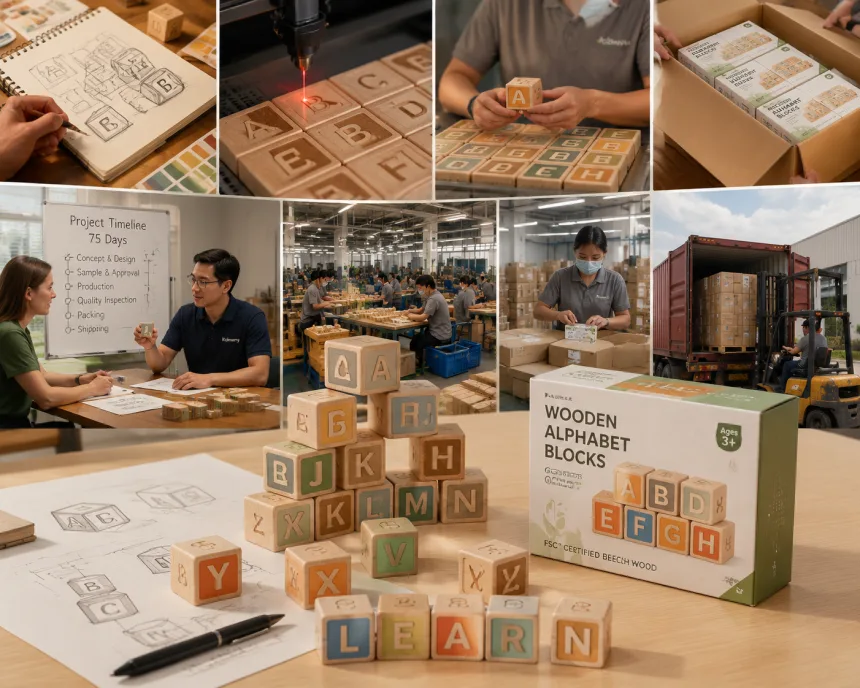
The 75-day programme from concept sketch to shipped containers worked because stages overlapped, not because each step was fast: EN 71 and ASTM F963 testing ran alongside artwork finalisation in days 18–45, and mass production with QC and shipping filled days 46–75. The specification was frozen early and designed around standard processes, which avoided tooling surprises entirely; the result was 10,000 sets delivered with zero major defects at pre-shipment inspection, with per-batch paint testing through the run. The repeatable lesson: send the concept, target date and quantity per style first, get a stage-by-stage timeline back within 24 hours, and run sampling, testing and packaging in parallel — serial steps are what turn 75 days into 120.
- The Brief: What Was Defined and What Was Not
- Locking the Specification Before Any Wood Was Cut
- Material and Decoration Decisions: Beech, Laser Engraving, Water-Based Colour
- The 75-Day Programme, Stage by Stage
- Certification and Packaging Run in Parallel
- Cost Structure and Unit Economics of a First Custom Run
- Quality Control Before Shipment
What This Guide Covers
- The Brief: What Was Defined and What Was Not
- Locking the Specification Before Any Wood Was Cut
- Material and Decoration Decisions: Beech, Laser Engraving, Water-Based Colour
- The 75-Day Programme, Stage by Stage
- Certification and Packaging Run in Parallel
- Cost Structure and Unit Economics of a First Custom Run
- Quality Control Before Shipment
- What This Means for Your Own First Custom Run
The Brief: What Was Defined and What Was Not
The client had three strong assets and one significant gap. The assets were a recognised brand in educational publishing, a clear retail channel, and a fixed launch date tied to the school season. The gap was manufacturing experience: no factory contacts, no internal engineering resource, and a specification that existed as a concept sketch plus a target retail price.
The requirements themselves were demanding. The product had to satisfy EN71 for a European sister listing and ASTM F963 for the US market simultaneously, use FSC-certified beech, carry custom brand colours, and land at a unit cost that worked at their retail price point after the distributor margin. In our experience this combination — dual-market compliance plus a hard retail price — is the most common source of late-stage redesign in educational wooden toys, because compliance choices and cost choices are made by different people at different times.
The first thing we did was separate what was genuinely decided from what was assumed. Block count per set, letter set, engraving depth and box size were negotiable. Launch date, price ceiling and the dual-market requirement were not. Writing that distinction into the brief at the start is what allowed the rest of the programme to run in parallel.
Locking the Specification Before Any Wood Was Cut
The three-day requirements workshop at the start of the programme was the highest-return activity in the entire project. It produced four locked numbers: the number of blocks per set, the letter set and typeface, the engraving depth, and the carton dimensions. Each of these is a decision that, if left open, generates a question later; each question costs a round trip.
Why block count is a specification, not a detail
Block count drives everything downstream. It sets the bill of materials, the carton size, the set weight, the pack-out labour, and the per-unit cost. It also interacts with compliance: more small parts means more items to assess for small-part and edge requirements, and more units to decorate. In this programme the count was set early and never reopened, which is unusual and valuable.
Engraving depth as a manufacturing variable
Laser engraving depth is a good example of a decision that looks cosmetic and is structural. Too shallow and the letter disappears under a coat of clear finish or wears off in a classroom; too deep and it takes longer to engrave, weakens the section, and creates a recess that is harder to keep clean. We set the depth during the design-for-manufacturability review and verified it on the physical sample, then froze it.
Typeface, spacing and the small-part question
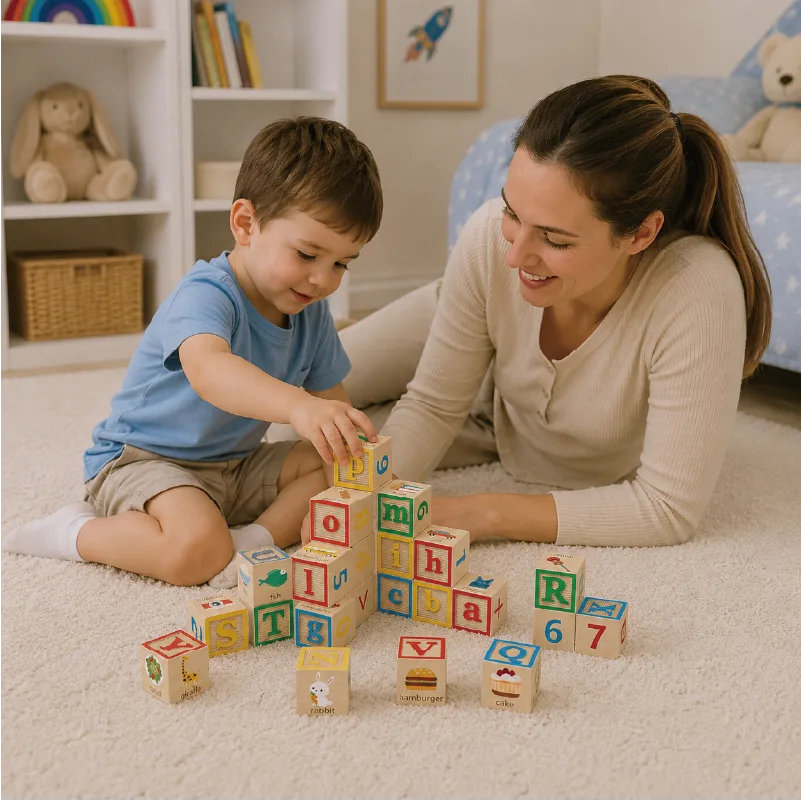
Educational products carry a specific obligation: the letter or number must be unambiguously legible to an adult teaching a child. That is a design constraint as much as a marketing one. We resolved typeface weight, stroke contrast and letter spacing during the 3D rendering stage, before any wood was cut, and the client approved the render rather than guessing from a flat sketch.
Material and Decoration Decisions: Beech, Laser Engraving, Water-Based Colour
Why beech
Beech was chosen for three reasons that are worth stating explicitly because they generalise. It is dense and fine-grained, so an engraved edge stays crisp instead of crumbling. It takes water-based colour evenly, which matters when a set contains blocks in multiple colours that must read as a family. And it is available with chain-of-custody documentation within a defined product scope, which the client needed for the listing.
The alternative was birch, which is also fine-grained and slightly lighter in tone, or pine, which costs less but dents more readily and shows more grain variation under colour. For a classroom product that will be handled daily and dropped regularly, density was worth the cost difference.
Laser engraving instead of pad printing
The original concept assumed printed letters. We proposed laser engraving, and this turned out to be the single decision that saved the most time. Printing requires a printing station, a drying cycle, and a registration check for every block face. Engraving removes all three. It also removes a layer of printed ink from the compliance surface, which simplifies the chemical migration picture, and it is more durable under classroom wear.
The trade-off is real and worth stating: engraving cannot reproduce a full-colour graphic, and it costs more per unit at very high volumes than a well-set-up print line. For letter and number decoration on a mid-volume educational product, it was clearly the better route.
Colour locked at sample stage
The client's custom colours were approved on the physical sample and then used for the test submission. This is the sequence that matters. Had the colours been changed after testing, the chemical migration test would have had to be repeated against the new formulation, which would have added weeks and put the school-season date at risk.
The 75-Day Programme, Stage by Stage
The programme ran as six overlapping stages. What made it fit into 75 days was not that each stage was fast; it was that several ran at the same time.
| Stage | Days | What was produced | Running in parallel |
|---|---|---|---|
| Requirements workshop | 1–3 | Locked block count, letter set, engraving depth, box size | Material sourcing enquiry |
| 3D design and rendering | 4–8 | Full visual approval before cutting | Carton structural design |
| DFM review | 9 | Engraving depth and edge radius optimised for CNC yield | Test laboratory booking |
| CNC sample | 10–17 | Physical samples shipped for hand-feel approval | Colour standard submission |
| Certification and packaging | 18–45 | EN71 and ASTM F963 testing, box artwork finalised | Production planning |
| Mass production, QC and shipping | 46–75 | 10,000 sets with per-batch paint testing and pre-shipment inspection | Export documentation |
Two observations for anyone planning a similar programme. First, the DFM review on day nine was a single day that prevented a redesign after the sample. Second, the certification window of roughly four weeks was only possible because the coating and colour set were already fixed by day 17; the laboratory was booked before the sample shipped.
Certification and Packaging Run in Parallel
Dual-market compliance was the largest single risk in this programme, and it was managed by treating documentation as a parallel track rather than a final gate.
The European side
For the European listing, the product was assessed against the EN71 series under Directive 2009/48/EC, with the technical file and declaration of conformity prepared alongside the test reports. Buyers should note that the EU has adopted Regulation (EU) 2025/2509, which replaces the directive on a transition timetable running to 1 August 2030; programmes with long repeat lives should plan against the regime that applies at the time of placing on the market.
The United States side
For the US market, testing was carried out to ASTM F963, which is mandatory through 16 CFR Part 1250, with the applicable version determined by the date of manufacture. The lead and phthalate limits under CPSIA were included, and the Children's Product Certificate was issued by the client as importer, citing the third-party laboratory that performed the testing. That division of responsibility was agreed in writing at the start, which is why it did not become a problem at the end.
FSC documentation
FSC-certified beech was supplied with chain-of-custody documentation. Because chain-of-custody is a traceability claim with a defined product scope, the scope was checked against the product before the carton artwork was finalised. This is a step that is easy to leave until the artwork is already at the printer, at which point it becomes expensive.
Packaging artwork approved in parallel
The carton artwork was developed while the wooden sample was still in transit and finalised while testing ran. The practical result was that packaging was ready on the day the last block was finished, and the pack-out line was not waiting on print.
Cost Structure and Unit Economics of a First Custom Run
A first custom run carries costs that a repeat order does not, and buyers who see only the unit price are usually surprised by three of them.
- Sampling and design. Modelling, rendering, DFM review and physical samples are front-loaded. On a 10,000-set order they amortise to a small per-unit figure; on a 1,000-set order they are significant.
- Testing. Safety testing is commissioned for a defined product and material set, and the cost is largely fixed regardless of run size. This is why very small first runs carry a disproportionate compliance burden per unit.
- Tooling and fixtures. Where a bespoke jig or fixture is genuinely required, it is a one-off cost. In this programme, designing to standard processes avoided it entirely.
On minimum quantities, our standard position is 500 pieces per style for large structural items and all-wood products, and 1,000 pieces per style for small items and designs with a high proportion of plastic components, with the minimum applied per style rather than per order. A 10,000-set first order sat comfortably above that threshold, which is part of why the unit economics worked.
Three decisions that saved roughly three weeks
Laser engraving instead of pad printing removed a print station and a drying cycle and improved durability. Colours locked at sample stage meant testing ran against the production formula, so no re-test followed approval. Box artwork approved in parallel meant packaging was ready the day the last block was made. None of these three saved time by working faster; each removed a queue.
Quality Control Before Shipment
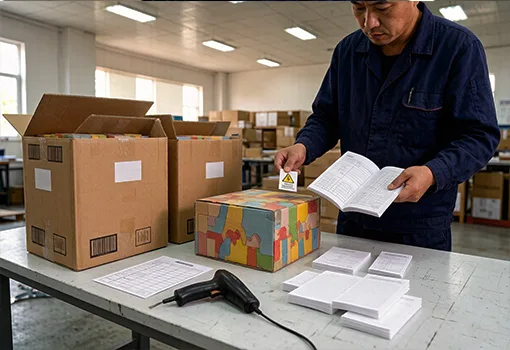
Ten thousand sets is large enough that inspection has to be planned rather than improvised. Three controls were applied.
First, per-batch paint testing, so that a coating variation between batches would be caught before it reached the assembly line rather than after. Second, an in-process check on engraving consistency, because a laser that drifts out of focus produces a batch of blocks with progressively lighter letters — a defect that is invisible in a single sample and obvious in a carton. Third, a pre-shipment inspection against an agreed sampling plan with defined acceptance limits, using the approved golden sample as the reference.
The result was 10,000 sets delivered with zero major defects at pre-shipment inspection, full documentation shipped with the goods, and a repeat order placed before the first container cleared port.
One administrative control deserves as much attention as the physical ones. The document set was agreed as a named list in the order confirmation — test reports, declaration of conformity, chain-of-custody documentation and the inspection report — so that nothing had to be requested after the container left. In practice, the most common cause of a delay at destination is not a failed product but a missing piece of paper, and the cheapest moment to fix that is before shipment rather than after arrival.
Planning a custom educational wooden toy programme? Send us the concept, the target date and the target quantity per style, and we will return a stage-by-stage timeline within 24 hours.
Start Your Programme OEM / ODM CapabilityWhat This Means for Your Own First Custom Run
Custom production is not inherently slow. It is slow when steps run serially and when requirements arrive late. In this programme the total elapsed time was 75 days from sketch to ocean shipment, and the three biggest contributors to that number were all decisions made in the first ten days, not the speed of any machine.
If you are planning something similar, the useful question to ask a potential partner is not "how fast can you sample" but "which of my decisions do you need in week one, and what can we start before the sample is approved". A supplier who can answer that specifically is a supplier who has run a parallel programme before.
Commercial terms and lead times for custom work are set out in the KIDMERRY wooden toy purchasing guide, and the brand owner customisation page covers how exclusivity and design rights are handled. To discuss a specific project, send us your brief.
How long does a first custom wooden toy run take?
Is laser engraving better than printing for letter blocks?
In this programme the engraved elements also removed a drying cycle from the schedule — one of the overlaps that helped keep the whole run inside 75 days.
Can one product be certified for both the EU and the US?
What is the minimum order for a custom educational set?
Who issues the Children's Product Certificate?
Testing behind that certificate was booked before the sample shipped here, with EN 71 and ASTM F963 running inside days 18–45 of the 75-day schedule.
What caused the biggest risk in this programme?
Both were locked early as a result: laboratory capacity was booked before the sample shipped, and testing completed inside days 18–45 of the 75-day programme.
Develop Custom Educational Blocks with KIDMERRY
About Kidmerry: Yunhe Kidmerry Toys Co., Ltd is a wooden toy manufacturer based in Yunhe, Zhejiang, China. The factory runs in-house CNC machining, finishing and assembly, and holds ISO 9001:2015 certification, with FSC-certified board available on request. Sampling takes 7–10 working days for existing styles and 15–20 working days for custom drawings; bulk production runs 30–45 days after sample approval. Ask Kidmerry for a quotation, a sample set and third-party test reports before your next development cycle.
Request a Quotation