Fold-Away Dollhouses: From a Sketch to a Production Sample
A fold-away dollhouse is a flat-pack problem wearing a toy's clothes: panels that must close into a carry case, open into a room, survive play and still fit a sensible carton. This guide follows one house from sketch to approved sample — what to settle before anyone draws a line, and what the sample has to prove.
What This Guide Covers
- Why a folding house breaks the usual sampling order
- Six decisions to settle before the first drawing
- From hand sketch to cut file
- Board grade, paint and the parts that move
- What the first sample has to prove
- Compliance that starts at the drawing board
- Per-style minimums, timing and the carton
- Frequently asked questions
In the development enquiries we receive, three questions arrive with the first file: which processes stay in-house, whether a paid prototype is possible before any commitment to production, and whether drawings can be shared under NDA. Price tends to arrive in the second message, not the first.
A folding house makes that route harder than most wooden toys. A fixed kitchen is one volume; a folding house is two panels doing three jobs — wall, lid and hinge leaf — and the drawing only ever shows one of those states. What follows is the sequence as it runs at a custom wooden dollhouse manufacturer, in the order the decisions have to be made.
Why a folding house breaks the usual sampling order
The sample is the first time anyone sees the product closed. Drawings and reference photos show a house open, furnished, in play. What ships is the closed case: flat, handled, sitting in a retail box on a pallet. Half the commercial risk here lives in a state no drawing shows.
The hinge is structural, not a detail. In a book-fold house the spine carries both panels, the handle and every open-close cycle the product will see. Choose the hinge late and you re-cut the panels that receive it.
Finish and structure pull against each other. A paint film that looks right on a rigid panel behaves differently on one that flexes at every fold — the fold line fails first, because it moves and a hand grips it.
The consequence is a reordering. On a fixed toy you sample the shape and solve packaging later. Here the closed footprint sets the board size, the board size sets the nesting, and the closed case sets the carton freight is quoted on. For a custom pretend play toy manufacturer, that is the difference between quoting a shape and quoting a shippable product.
Six decisions to settle before the first drawing
Most rework traces back to one of six items left open. None needs a factory visit; all need an answer before a toolpath exists.
One: market and age grade. The market decides which standard the sample is eventually assessed against; the age grade decides how hard it is pushed in abuse testing. An under-three house and a three-plus house can share a shape and still need different edge, small-part and fixing decisions.
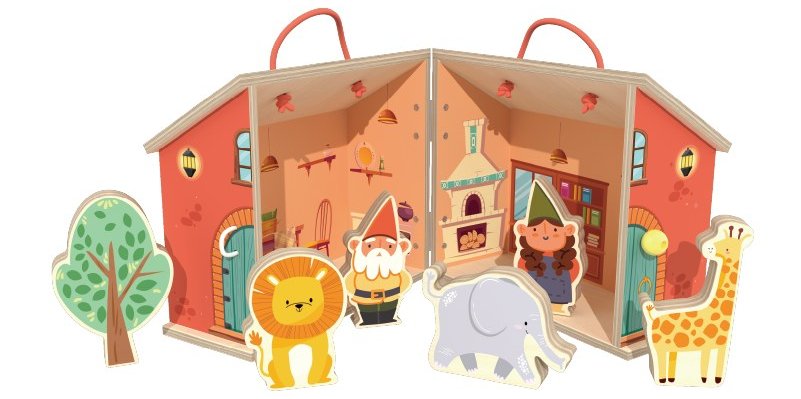
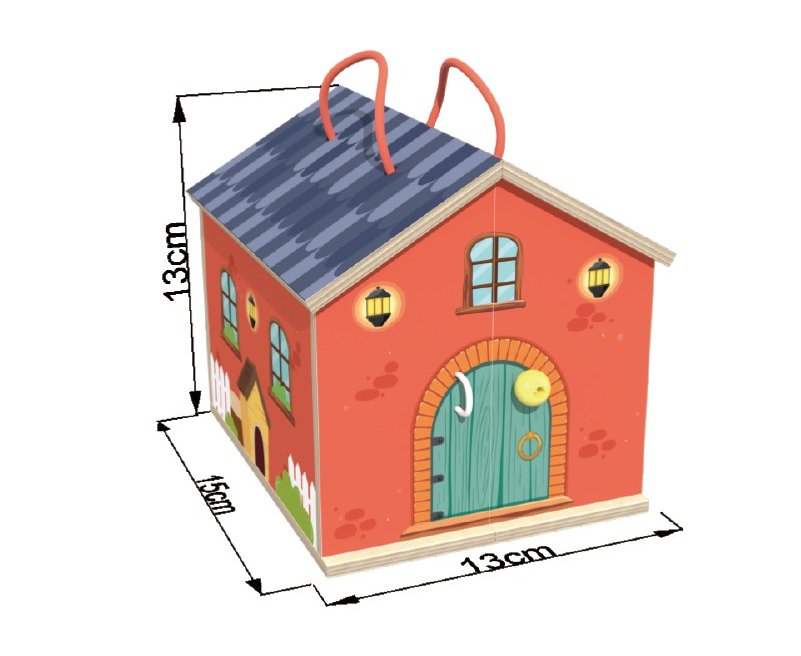
Two: open and closed footprint. Two numbers, both required. Closed is what a child carries and a box contains; open is what a retailer photographs and a table has to hold. One house in our range closes to 15 × 13 × 13 cm — small enough for a handle.
Three: panel count and hinge type. A two-panel book fold, a three-panel with floor and a four-panel with side wings are three products with three assembly sequences. The hinge follows the panel count.
Four: how it is carried. A handle cut into the spine, a webbing handle, or none. It looks like styling and behaves like structure: the handle loads the same panel as the hinge.
Five: board and finish. Needed now, because board thickness changes every slot, tenon and nesting layout downstream.
Six: retail packaging. A self-carry case, a printed retail box or a mailer — each changes the closed dimensions you can tolerate.
Where a brand owns the concept and the factory engineers and produces it, that is OEM work; where the concept is still open and the factory proposes structure, mechanism and range logic, it is ODM. Any wooden dollhouse OEM manufacturer should say which side of that line each choice sits on — our OEM and ODM wooden toy development scope sets out where we draw it.
From hand sketch to cut file
Everything before the cut file is translation; everything after it is arithmetic on board sheets. It is the stage where a wooden toy OEM manufacturer earns its keep, because the choices made here cannot be corrected in finishing.
Inputs. A dimensioned DXF or STL is the fastest start, because geometry arrives defined. A hand sketch works too — our CNC workshop models sketches into toolpaths, and many projects begin that way. A reference product or a marked-up photograph is usable, provided the changes are stated rather than implied. What cannot be used is a sketch with no dimensions and no stated intent: at that point the factory is being asked to invent the product — a legitimate request, but a different brief.
Panel breakdown. The geometry becomes flat parts — front, back, roof, floor, side wings, furniture — each a 2D outline with its joints. Slot-and-tenon joints, snap-fits and interlocking folds are machined rather than glued, which is what lets a flat-pack house assemble without a manual.
Tolerance. In our workshop, machining holds plus or minus 0.1 to 0.2 mm across panel cutting, profiling, slotting, engraving and safety radii, milled in a single pass on multi-head routing centres. That is a tolerance on the cut part, not on the assembled product, which also depends on board stability, hardware and packing.
What slows it down, in order of frequency: a hinge sourced rather than taken from stock, artwork that is not print-ready, and a footprint that changes after the panel breakdown. The first adds procurement, the second proofing rounds, the third restarts the geometry — which is why custom wooden toy product development is mostly a matter of closing those three first.
Board grade, paint and the parts that move
Plywood is usually right for a folding panel, and it is not a compromise. Solid wood moves with humidity, and the wider the panel the more it moves; on a house front that must stay square enough to close, that shows up as a warp, a sticking edge or a gap at the fold. Multi-ply plywood is dimensionally stable in the plane that matters.
What we run. Beech, maple, birch, basswood, pine, multi-ply plywood and MDF, with FSC-certified boards available on request. For a custom wooden toy manufacturer the choice per part is a decision, not a default: a visible panel, an internal shelf and a small figure do not need the same board. MDF machines cleanly and takes paint well, but it is heavier — in a product meant to be carried, weight is a design property — and it needs sealed or banded edges, one more step at the fold.
Paint on a panel that folds. We finish with water-based paint. On a sample, check adhesion at the hinge edge and colour consistency across separately painted panels: a match that holds on one panel can drift between a lid and a front. Ask for the closed case in daylight.
Board emissions. The European limit sits on the finished article, not the board. Regulation (EU) 2023/1464 introduced entry 77 in Annex XVII of REACH: from 6 August 2026, articles on the EU market must meet 0.062 mg/m³ for furniture and wood-based articles or 0.080 mg/m³ for other articles, measured on the finished item under the chamber conditions of Annex 14, and recital 36 brings children's toys of all ages within the restriction. Which limit applies to a given dollhouse is a classification question we will not settle for a buyer — ask which limit the test was run against, and whether the sample tested was the assembled article or the raw board. "E0" or "E1" describes a board class, not the article-level result the restriction is written around.
Artwork is part of the structure. Printed walls, engraved floors and painted figures each carry a placement tolerance against the panel edge, and a print running to the fold line shows all of it. Leave a margin at the spine and the fold forgives you.
What the first sample has to prove
A sample review is not a look, it is a list — and the list should exist before the sample arrives, or the review becomes a conversation about impressions. Open and close it twenty times, then work through the items below.
| Check | What to look for | Why it matters |
|---|---|---|
| Fold cycle | Twenty open-close cycles, no slackening, no screw taking load | The hinge is the weakest structural line |
| Gap and edges | Nothing catches a fingertip, edges parallel, radii consistent, no splinters | A safety question, and the first thing to drift with tooling wear |
| Fixings | Screws and inserts hold in plywood edge grain, no cracking | Edge-grain fixing is the classic failure in folding furniture |
| Stability | Pushed from the side, tipped forward when open | A house that tips during play is a design fault, not a usage fault |
| Loose parts | Figures and furniture dimensioned against the declared age grade | Small-part decisions follow the age grade, not the reverse |
| Finish | Adhesion at the hinge edge, colour match across panels | The fold edge is where the film is stressed |
| Assembly | Parts fit without force and stay fitted after a cycle | A slot needing a mallet on day one is loose by month six |
| Handle | Load at the spine without flex in the roof panel | The handle loads the same panel as the hinge |
| Closed case | Closes square, holds shut, no gap along the spine | The state that ships, and the one no drawing shows |
| Carton fit | House and accessories fit the box with intended void fill | The carton is what freight is quoted on |
Two more questions while the sample is on the table: has the carton been through a recognised distribution test series, or only an internal drop check? And does this sample match the production process, or was it hand-finished to look right? A first article off the same tooling tells you more than a beautiful one-off — which is why wooden toy sample development is judged on process, not appearance.
Compliance that starts at the drawing board
Compliance is usually discussed as end-of-line paperwork. In this category most of it is settled at the drawing board, because the checks concern geometry and materials rather than documents.
European Union. Toys placed on the EU market are assessed against the applicable parts of EN 71 — mechanical and physical requirements under EN 71-1, flammability under EN 71-2, migration of certain elements under EN 71-3. Insist on "applicable parts": the series is not one test, and a supplier who says the product "passes EN 71" without naming the parts has told you nothing you can file. The manufacturer issues the EU declaration of conformity and applies CE marking. That arrangement has a horizon: Regulation (EU) 2025/2509 replaces Directive 2009/48/EC from 1 August 2030 and moves conformity information into a digital product passport. A house developed now will still be selling then, so start with a file that carries across.
United States. ASTM F963-23 is the mandatory toy standard, incorporated through 16 CFR part 1250 and effective since 20 April 2024. Its scope is harm in normal use or reasonably foreseeable abuse, for products intended for children under 14, with age-labelling guidance in Annex A1 — which is why the age grade set in the first brief decides how the sample gets pushed. The children's product certificate is issued by the US importer, not the factory, and the tracking-label duty under 15 U.S.C. 2063(a)(5)(A) sits with the importer of record. A factory can supply test reports and production records; it cannot issue a certificate for the importer.
What travels with the order. Our documentation covers EN 71-3, ASTM F963 and CPSC requirements for the US market, ISO 9001:2015 quality management, BSCI and Sedex (SMETA) social compliance audits, and FSC chain-of-custody for wood. Test reports are issued per product and per order — the report you receive is the one for your item, not a generic certificate.
FSC, specifically. The question is not whether the factory holds a chain-of-custody certificate but whether your SKU sits inside its scope. Our scope covers wooden children's toys, building blocks, educational aids, wooden crafts, packaging boxes, and the processing and sale of matching paper gift packaging boxes. Ask for the scope document and match your product description against it before the claim goes on the box.
Ask per model, in writing. One of the more professional enquiries we have received asked for compliance confirmed per model and per market — EU, US and UK separately — with the standard named and the report attached, rejecting a blanket statement for the range. A folding house with a fabric spine, a hinge and small figures is not one compliance object: hinge, small parts and painted panel each raise their own question.
Per-style minimums, timing and the carton
Three numbers decide whether the project is viable, and they are usually asked in the wrong order.
Minimum order quantity is per style, not per order. Standard minimum is 500 pieces per style for large structural products (doll houses, play kitchens, outdoor climbing frames) and for all-wood designs; products with a high share of plastic components, and small-item designs, start at 1,000 pieces per style. Final minimums are confirmed per project. For a range the distinction decides the plan: three houses is three minimums, not one, and a hero house plus two accessories is a different commitment from four houses at once.
Sampling is in working days and depends on where the design comes from. Samples of existing designs are typically ready in 7 to 10 working days; samples developed from your drawings or specifications take 15 to 20 working days. Both exclude shipping time, and neither is a commitment until the drawing set is complete — a sketch without dimensions adds a design round first. This is the part of wooden dollhouse prototype development buyers underestimate most often.
Mass production starts after sample approval, not after the order. Standard orders are produced in about 30 to 45 days following sample approval; in peak season, generally Q2 to Q3, allow 45 to 60 days. These are factory-level planning figures from our own scheduling, not industry statistics, and exclude sea or air transit. On CFR or CIF terms, add the sailing time before promising a retail window.
The carton is a design decision with a cost attached. A closed folding house is a flat case, which gives better cube utilisation than a fixed house of the same open size. Either the retail box is the carry case, saving packaging but exposing it to play wear, or the house ships in a sleeve. For e-commerce a mailer-ready carton avoids a second overbox; for retail a shelf-ready box usually wins. Decide the channel before approving the sample: the closed dimensions may need to change to suit it.
Export paperwork follows the same logic. What travels with an order is the commercial invoice, packing list, the test reports for the models in that shipment, and FSC documentation where the claim appears on the listing. Where the importer bears a certification or labelling duty, it stays with the importer. Our wooden toy purchasing guide covers materials, packaging and inspection in more detail; the point for a dollhouse project is that the document set is per model — something an OEM wooden dollhouse supplier should state before the first order.
FAQ
Is a fold-away dollhouse harder to develop than a fixed one?
Can you work from a hand sketch without CAD files?
Do we have to commit to production to get a prototype?
What minimum applies to three dollhouse styles?
What documentation comes with a sample?
Planning a fold-away dollhouse for the next buying season? Send the sketch, reference product or STL with the four numbers that decide the project — open footprint, closed footprint, target age grade and market — through our contact page. We will answer with the panel breakdown, hinge options, sample timing and per-style minimum in writing, not a unit price that assumes all four. If the structure is still open, say so in the first message: the range logic comes before the single house.