Farm Block Sets: Piece Count, Spare Parts and Retail-Ready Packaging
Two quotations for the same wooden farm block set can sit 18 percent apart and both be honest. One is priced on a headline count of 60 pieces; the other on a component list of blocks, animals, fence sections, a storage tray, a printed insert and a retail box. One includes four sets per carton; the other quotes the carton separately. One has a spare parts allowance buried in the unit price; the other charges for it when the first replacement request arrives in month nine.
By the second round, the gap is rarely the factory's labor rate. It is the specification. A farm set is not a product with a piece count attached — it is a stack of purchasing decisions, and every one of them has a cost line behind it. Which components. Which material and finish. Which spare parts, if any. Which packaging level, for which retail channel. Which inspection plan, and which edition of the standard it is written to. Where those decisions are left open, the supplier prices the risk and the buyer discovers it at the packing table.
This guide is written for the people who have to close them: brand owners specifying a first farm set, importers comparing three factories, sourcing managers rebuilding a BOM after a missing-piece complaint, product developers who need to know which design choices the factory can actually manufacture. It covers the four documents that make a farm set orderable — a component-level BOM, a spare parts arrangement, a packaging specification, and a pack-out check — plus the sampling standard that decides whether a shipment is accepted, and the RFQ fields that stop a quotation from being re-quoted.
One rule applies throughout. Product figures come from our own product page, and where a number is not published, the article does not supply one. Everything else describes how the trade usually handles a question — an inspection basis, a spare parts allowance, a packaging service, the documents issued after an order. Those passages explain a convention and an option, not a standing commitment. A commitment exists only when it is written into the order specification; until then, treat every number in this article as something to agree rather than something to assume.
Quick Answer: What Makes a Wooden Farm Block Set Retail-Ready?
A farm block set is retail-ready when four things are fixed in writing: a BOM that reconciles the headline piece count component by component; a spare parts arrangement that names the parts, the quantity and who pays for them; packaging specified for the retail channel, not only for the shipping carton; and a pack-out check that counts every set against the approved BOM. A quotation that does not answer all four is a price, not a specification.
- Piece count — reconciled under three conventions: headline count, component list, packed contents.
- BOM — one line per distinct component, carrying quantity, material, finish, dimension and packing position.
- Spares — named parts, defined quantity basis, defined cost responsibility, defined lead time.
- Packaging — retail unit, shelf-ready case and master carton are three different jobs with three different duties.
- Verification — a pack-out count for completeness, separate from sampling inspection for workmanship.
1. Why Piece Count Must Start with a Component List
A piece count is a claim, and the same claim gets made under three different conventions without anyone saying which one is meant. The number printed on the front of a retail box, the number of lines in a quotation, and the number of objects a customer tips out of the tray are not the same quantity. The gap between them is where disputes live.
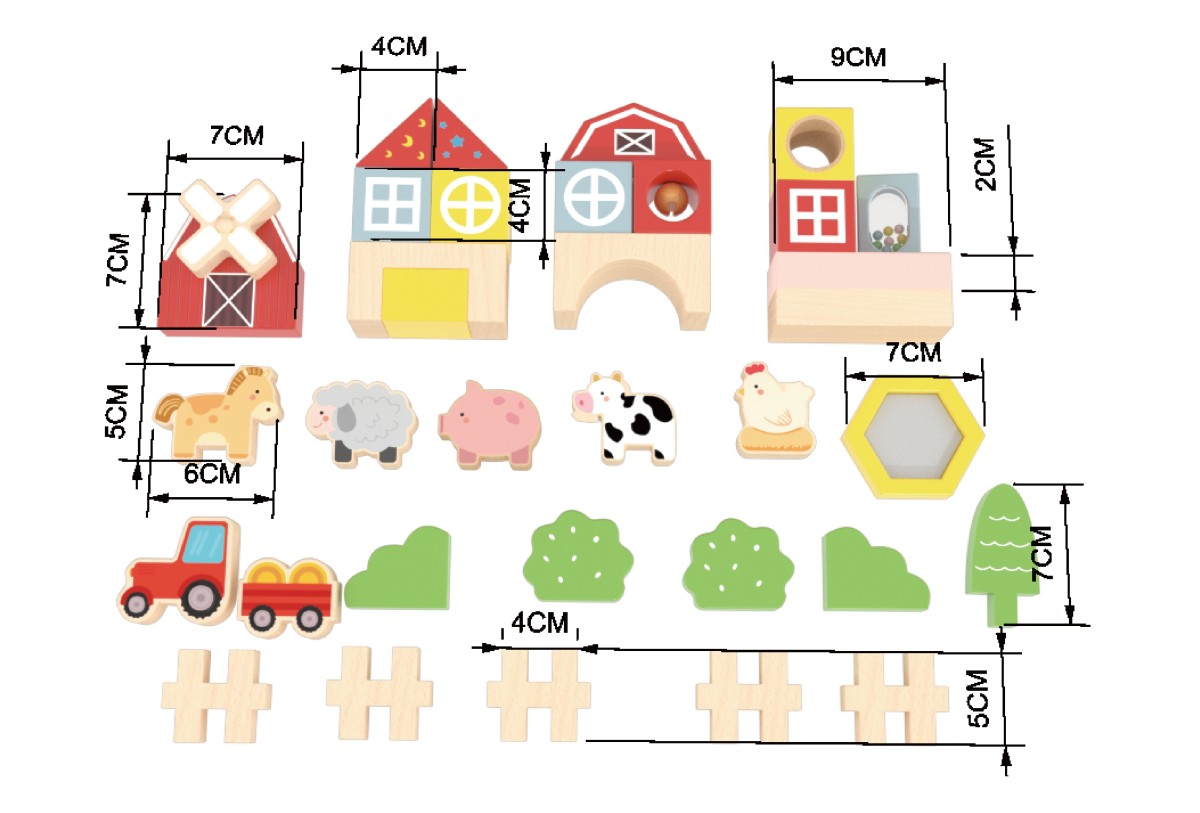
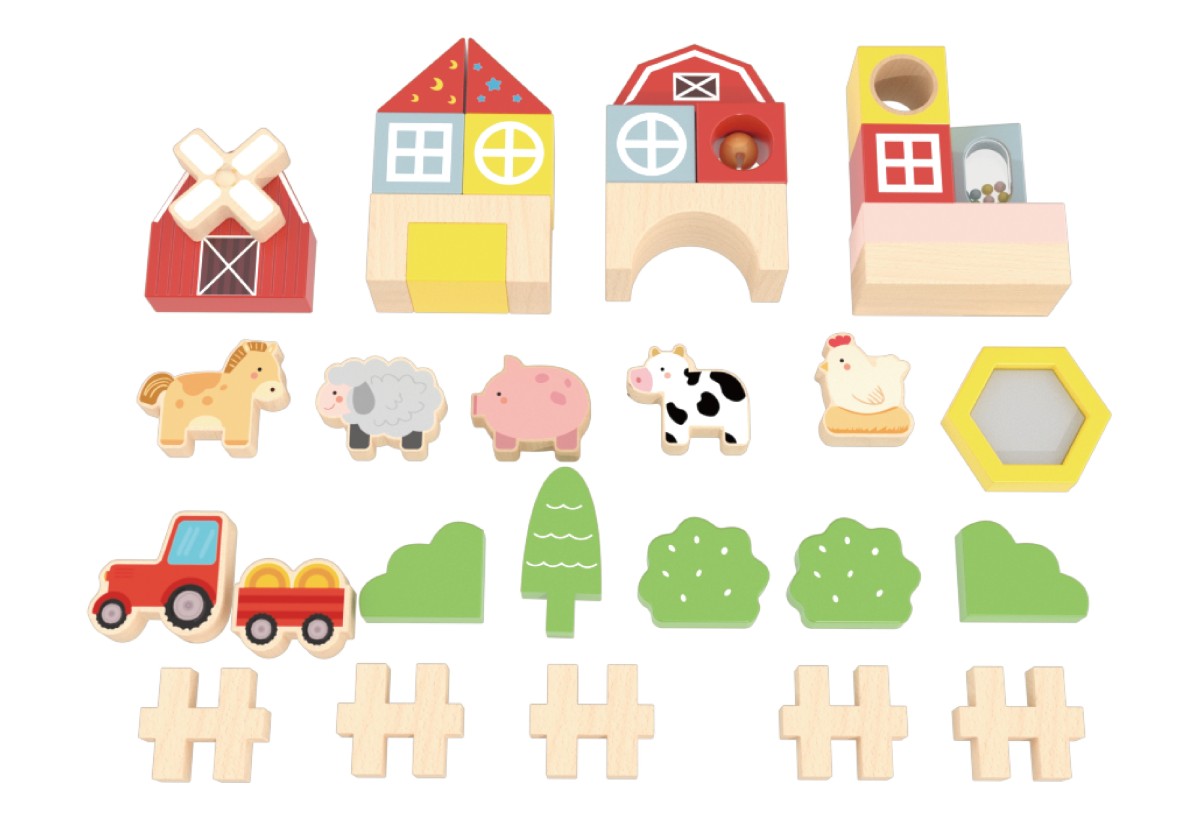
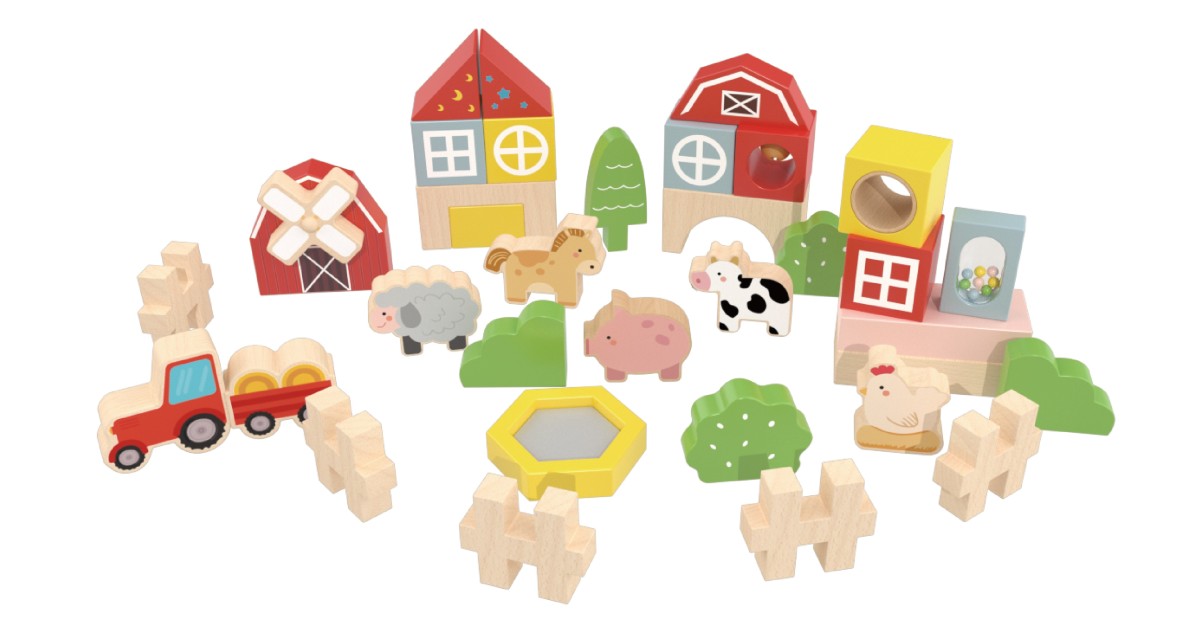
The farm set published on our own site is described as 40+ solid beech blocks covering barn, farmhouse, fence, animals and accessories, packed with a beech storage tray. Four things in that sentence are already doing work, and only one of them is the number. "40+" is a floor, not a total. The tray is in the package but is not a building block. "Blocks" is doing duty for painted figures and flat fence pieces as well as cubes. And the page does not say whether the tray sits inside the 40+ or outside it. That last point is not a criticism of the page; it is exactly the ambiguity a BOM removes, and the correct instruction to a buyer is to ask rather than assume.
The three counting conventions buyers compare
| Convention | What it counts | Where it appears | What it does not tell you |
|---|---|---|---|
| Headline count | The number a shopper or listing shows | Retail box front, product page, marketplace listing | Whether connectors, tray or printed pieces are included |
| Component list count | Every distinct BOM line and its quantity per set | Quotation, BOM, costing sheet | Which parts are packed loose versus pre-assembled |
| Packed contents count | The physical pieces a customer receives | Packing instruction, pack-out check | Whether a competitor's set is being compared on the same basis |
Swipe sideways to see the full table
Two of these numbers can both be correct and still differ by ten. A set with 42 components can ship as 44 physical pieces if two components are packed as sub-assemblies, or as 39 if three pairs are pre-assembled into units. Nobody is lying. The documents are answering different questions, and the buyer is usually holding one document while the factory is holding another.
Where an overstated count costs more than it earns
Piece count sits in the middle of four cost lines at once. It changes the material and paint quantity per set, it changes the tray and box size behind it, it changes the carton cube and therefore the freight per unit, and it changes what the customer counts at home.
An inflated count is easy to write and expensive to carry. The set weighs more than the specification implies, so the carton is bigger than the freight calculation assumed. The tray needs more wells. The packing instruction needs more lines and takes longer per set. And the count is the one claim a retail buyer can check in thirty seconds at a trade fair, in front of a competitor.
A count that is deliberately conservative — "40+" when the configuration is 42 — costs nothing and survives inspection. A count that is precise and wrong costs the relationship.
2. How to Build a Wooden Toy BOM
A bill of materials is not an engineering document that purchasing receives late. It is the unit of account. The quotation is priced per line, the purchase order commits per line, the production floor builds per line, the inspector checks per line, and the packer counts per line. If a component is not a line on the BOM, it is not managed by anyone.
That is the whole argument. Everything else in this section is about making the lines usable.
The eight fields a BOM line has to carry
| Field | Why the buyer needs it | What goes wrong without it |
|---|---|---|
| Part reference | One key that holds across drawing, PO, inspection report and packing list | The same animal is "cow", "cattle" and "animal-3" in three documents |
| Component name | A description a buyer can match to a physical part | Quotation cannot be reconciled to the sample |
| Quantity per set | Reconciles the piece count and drives material costing | Quote adds up to 58, the box says 60 |
| Material and grade | Species, panel type, thickness, hardness | Material substitution is discovered after approval |
| Finish | Coating type, coats, color reference, edge treatment | Shade drift between production runs |
| Nominal dimension and tolerance | Fit, tray cavity, carton cube | Blocks that will not interlock on arrival |
| Packing position | Where the part sits in the tray or bag | Missing pieces and transit damage both go undetected |
| Source and tooling note | Made in-house or bought in; any tooling or fixture | Lead time and MOQ surprises after the PO |
Swipe sideways to see the full table
Two of these fields carry more weight than the rest, and they are the two most often left blank.
Tolerance is a separate decision from dimension. A dimension without a tolerance is a drawing, not a specification: it tells the factory what to aim for and nothing about what is acceptable. Write the tolerance the product needs — the value at which the blocks still interlock and the tray still closes — rather than the tolerance the machine happens to hold. A machining capability figure and a product tolerance are different claims, and conflating them is how a shipment arrives "within tolerance" and still does not work.
Packing position is a quality control field. It looks like a packaging detail and is really the cheapest inspection device in the whole order. A tray with one well per component family turns completeness from a memory test into a visual one, and a BOM that names the well makes the packer's check repeatable.
The BOM a buyer receives should therefore be a table with one row per distinct component, not per component family and not per assortment group, and each row should carry the six fields above. Ask for it in that form. A supplier who returns a family list with a headline count has returned a costing summary, and the missing rows are the ones that cause the missing pieces.
What the BOM drives at each stage
| Stage | What the BOM supplies | What fails when it is incomplete |
|---|---|---|
| Quotation | Material, component count, finish steps, packaging lines | Price is a single number with no route to challenge or compare it |
| Purchasing | Timber, paint and component quantities with waste allowance | Shortages mid-run, or substitution to keep the line moving |
| Production | Assembly sequence, sub-assemblies, fixtures | Rework at the packing table, where labor is most expensive |
| Inspection | Defect definitions by component and class | Two inspectors grading the same set differently |
| Packing | Count, position, tray layout | Missing pieces found by the customer instead of the packer |
Swipe sideways to see the full table
3. How to Plan Spare Parts for Wooden Farm Block Sets
Spare parts are usually discussed at the end of a negotiation, in one sentence, by people who are tired. That is the wrong end and the wrong sentence, because the spare parts arrangement is where the retail customer's experience of a toy brand is actually decided. A missing cow in month three is not a manufacturing statistic; it is a complaint, a review, and sometimes a return that costs more than the cow.
The first thing to fix is vocabulary, because four different things get called "spare parts" in the same meeting.
Four terms that are not interchangeable
| Term | What it means | Who pays, typically |
|---|---|---|
| Spare part | An extra copy of a component supplied with the set, or with the carton, before the customer needs it | Negotiated; either absorbed in the unit price or quoted as an add-on |
| Replacement part | A part shipped after a claim, to replace a missing or broken piece | Depends on whether the cause is a factory defect, transit damage, or customer loss |
| Service part | A part held to support a product over its selling life, often for a retail or e-commerce client's after-sales process | Retailer or brand, on a stock or per-request basis |
| Set completion kit | A grouped pack of the small components most often lost, sold or supplied as one unit | Usually the brand, and usually cheaper than individual replacements |
Swipe sideways to see the full table
A supplier who quotes "spare parts included" without saying which of these four is meant has not answered the question. A buyer who accepts that answer has bought a promise with no unit of measure.
Which components deserve spare status
Spare status is a judgement about loss rate and replacement cost, not about sentimental value. Five criteria do most of the work:
- Small and detachable. If it fits in a pocket, it will leave the set.
- Repeated in play. The piece a child carries around — an animal, a driver figure, a favorite block — is lost more often than the piece that stays in the barn.
- Painted detail. A painted figure that chips is a visual failure even when it still functions.
- Friction or interference fit. Parts that are pushed together and pulled apart wear at the joint.
- Hard to substitute. A specialized connector cannot be replaced from a generic block bin, so losing it ends the set's play value.
The inverse also holds. Large building panels and the storage tray are poor spare candidates: they are rarely lost, expensive to ship, and a set missing a wall panel is a warranty claim rather than a spare parts event.
Three arrangements, and what each one commits you to
| Arrangement | How it works | What the buyer commits to | Best fit |
|---|---|---|---|
| A. In-pack spares | Extra nominated components go inside the retail unit or the master carton | A per-unit cost on every set, whether or not it is ever used | Small, cheap, high-loss components; direct-to-consumer and e-commerce channels |
| B. Held replacement stock | The factory or the brand holds a nominated stock of parts against future claims | An inventory and storage commitment, plus an agreed consumption review | Wholesale and distributor programs with predictable volumes |
| C. Replacement on request | Parts are produced or pulled after a claim | A lead time that is always longer than the customer wants, and a minimum run | Low-volume or long-life programs, where holding stock is uneconomic |
Swipe sideways to see the full table
Arrangement C is the fallback, and it is where the arguments happen. A small replacement run carries much of the setup cost of a full production run, so a request for eight animals in month nine is not a cheap transaction for anyone. Agree the minimum quantity and the lead time before you need them, not after.
What the allowance covers, and what is quoted separately
The convention for bulk orders is narrow, and it is worth stating in exactly those terms. A free allowance of roughly 1%–2% of the nominated vulnerable components — the blocks, dowels and connectors that fail or go missing at a measurable rate — is the common shape of it, calculated on that nominated list rather than on the full BOM. We quote within that band for bulk orders. The exact percentage, the nominated parts and the basis of calculation belong in the order specification, because a percentage applied to an unnamed list cannot be checked at goods-in. Anything beyond the allowance is a separate commercial line: additional spare parts, post-shipment replacement production, and stock reserved for a specific buyer are quoted per project.
Three qualifications belong with that sentence, because an allowance is only useful if its edges are visible:
- The percentage applies to nominated vulnerable parts, not to the whole set. Two percent of 40 components is not two percent of every component; it is a quantity calculated on the parts that were nominated for the purpose when the order was specified.
- The nomination is a specification decision, made before the PO. A buyer who wants a particular animal, connector or fence piece in the allowance should name it in the RFQ, not discover in month four that the allowance was spent on dowels.
- A replacement program is a recurring service, not an insurance policy. If the retail channel expects to replace parts for two years, the arrangement that supports it has to be designed and costed for two years.
Identification, consistency and the paperwork
A spare part is only useful if it matches the set it is going into. That sounds obvious and fails routinely, for three reasons: color drift between production runs, wood batch variation, and part references that change without the packing list being updated.
The controls are unglamorous. Give every spare a part reference that matches the BOM. State the color reference and the wood grade on the packing list, not only on the artwork. Keep a sealed reference sample of each spare from the approved run. And record in the order file which batch the spares came from, so that a claim in month six can be traced to a production run rather than to a general apology.
4. Retail Packaging vs Shelf-Ready Packaging vs Master Cartons
"Retail-ready packaging" is used as if it were one object. It is three, stacked, each with a different job and usually a different owner inside the buyer's organization. Confusing them is how a set arrives looking right on a shelf and wrong on a pallet.
A. Consumer unit packaging — the retail box
The retail box is the selling unit. It has to protect the product through handling, present the product or a credible image of it, carry the mandatory information for the destination market, and survive as an individual unit once the master carton is opened.
For a farm set, the box also does structural work that most packaging does not: it holds the tray, and the tray holds the count. A retail box designed without the tray in mind produces a set that looks loose on shelf and takes longer to pack.
B. Shelf-ready packaging — the case that goes to the shelf
Shelf-ready packaging (SRP) is the case that a retailer opens and places on the shelf with minimal handling, or that a store uses as a display unit. It is a retail operations decision, not a product decision, and it changes the carton: a tear line, a display front, a printed shelf edge, a case count that matches the planogram.
Two consequences follow. First, SRP usually means fewer units per case than a pure shipping carton, because the case has to be liftable and presentable. Second, SRP has to be designed against the retailer's shelf, not against the factory's pallet — which is why it comes late in the program and costs more than buyers expect.
C. Master carton and shipping configuration
The master carton is the unit of handling, storage, freight and often of ordering. For the farm set published on our site, the configuration is 1 set per retail box and 4 retail sets per master carton — a case count that makes the carton a reasonable manual lift and keeps the retail box intact as an individual unit.
That single number drives more of the commercial model than it looks. It sets how orders divide (multiples of four within a 1,000-set style minimum), how many retail units a pallet layer holds, how much handling a distributor has to do, and what a partial-carton return costs. What it does not tell you is anything about carton dimensions, gross weight, pallet pattern or container load. Those are not published for this SKU, and estimating them from a photograph would be guesswork dressed as data.
Which level carries which duty
| Level | Primary job | Information it typically has to carry | Common failure |
|---|---|---|---|
| Retail box | Sell and protect one set | Age marking, warnings, traceability details, importer details, barcode | Artwork signed off before the BOM was frozen |
| Shelf-ready case | Move stock from backroom to shelf | Case markings, barcode, case count, shelf presentation | Designed to the shelf plan, not to the retail box inside it |
| Master carton | Handle, store and ship | Shipping marks, quantity, gross weight, dimensions | Carton count changed late, tray and box no longer fit |
Swipe sideways to see the full table
Which level fits which channel
| Channel | Retail box | Shelf-ready case | Master carton priority |
|---|---|---|---|
| E-commerce, direct to consumer | Must survive parcel handling on its own | Not used | Low; parcel protection and returns matter more |
| Specialty toy retail | Presentation and shelf presence matter most | Optional | Moderate; storage space is limited |
| Mass retail and chain stores | Standardized, planogram-driven | Usually mandatory | High; case count, pallet and DC rules dominate |
| Wholesale and distribution | Often plain or branded lightly | Rarely used | High; cube and unit cost decide the sale |
Swipe sideways to see the full table
5. How Manufacturers Prevent Missing Pieces
A missing piece is the most expensive kind of defect a wooden set can produce, because it is invisible until the customer opens the box and it converts a manufacturing error into a brand complaint. It is also the one defect that sampling inspection is worst at finding, for reasons covered in the next section.
Prevention starts by accepting that there are four distinct causes, not one.
Four ways a set ships short
- Count error at packing. The packer counts from memory or from the tray, and one well is empty.
- Component shortage upstream. A bought-in part arrives short, and the run continues against the wrong quantity.
- Sub-assembly loss. Parts pre-assembled into a unit are counted as one line and one unit goes missing.
- Damage or removal after packing. A piece breaks in transit, or is removed during inspection and not replaced.
Each cause needs a different control. A packer retraining does nothing about a purchasing shortage, and a purchasing fix does nothing about a well that is hidden under the tray.
Ten controls that move the defect rate
| Control | What it prevents | Where it sits |
|---|---|---|
| Approved BOM with one line per component | Counting against the wrong list | Product development |
| Tray with a nominated well per component family | Visual misses, and damage in transit | Packaging development |
| Written packing instruction with a per-set count | Packer memory errors | Packing station |
| Sealed reference sample at the packing line | Drift after a component change | Packing station |
| Part-by-part count before the tray is closed | Count errors, missed wells | Packing station |
| Small parts in a separate bag or compartment | Loss during handling, and mixing between sets | Packing station |
| First-article pack-out check at the start of every run | Setup errors repeated across a whole lot | Run start |
| In-line verification at a stated frequency | Drift during the run | Production quality |
| Final inspection with completeness as a defined defect class | Missing pieces graded as cosmetic | Pre-shipment inspection |
| Recorded pack-out count per carton, kept with the shipping documents | Untraceable claims | Shipping |
Swipe sideways to see the full table
The last row is the one buyers underuse. A carton that records who packed it, when, and against which BOM revision turns a missing-piece claim into a traceable event with a bounded investigation. Without it, every claim is a negotiation.
Packing completeness checklist
- Approved BOM revision on the packing line, matching the revision on the purchase order
- Tray layout drawing showing a nominated position for every component family
- Written packing instruction with quantities written as digits, not words
- Sealed reference sample of the complete set at the line, from the approved run
- Small and detachable parts bagged or compartmented, not loose in the tray
- Part-by-part count completed and initialed before the tray is closed
- First-article pack-out checked and photographed at the start of each run
- In-line verification at the frequency stated in the order specification
- Completeness treated as a defined defect class, with a stated acceptance rule
- Pack-out record per carton retained with the shipment documents
6. What Buyers Should Understand About AQL and Sampling Inspection
AQL is the most quoted and least examined number in a toy purchase order. It arrives in a quotation as a badge of rigor — "AQL 0.65 / 2.5, ISO 2859-1, General Inspection Level II" — and in more quotations than not, it is a slogan attached to a plan nobody has written down. Two factories can both claim the same AQL and be operating different plans, with different sample sizes, different defect definitions and different notions of what happens when the sample fails.
The number is not the problem. The missing plan is.
AQL is a sampling parameter, not a defect allowance
Under ISO 2859-1, the acceptance quality limit is the quality level that counts as the worst tolerable process average when a continuing series of lots is submitted for acceptance sampling. It is a benchmark used to index a scheme: give the standard a lot size, an inspection level and an AQL, and it returns a sample size and an acceptance number. That is what the figure does. It does not describe a shipment.
Four misreadings account for most of the confusion in supplier conversations.
| Misreading | What the standard actually does |
|---|---|
| "AQL 2.5 means up to 2.5 percent of the shipment may be defective" | AQL indexes the sampling plan against a process average. A single lot is accepted or rejected on a sample, so a lot can pass with a defect rate above the AQL, or fail with one below it |
| "AQL 0 means the supplier guarantees zero defects" | The AQL tables begin at very small values, not at zero, and acceptance sampling cannot guarantee zero. Zero-defect requirements are handled by 100 percent inspection or by a defect class with zero acceptance, which is a different control |
| "Meeting the AQL proves the product is compliant" | AQL covers attribute conformity of the units inspected. It does not certify conformity with toy safety law, and it is not a substitute for type testing |
| "The factory sets the AQL" | The AQL and the plan are agreed between buyer and supplier, and they belong in the order specification rather than in a general brochure |
Swipe sideways to see the full table
There is a second consequence that buyers feel before they understand it. Because acceptance is decided on a sample, both parties carry risk. A good lot can be rejected and a poor lot can be accepted; the standard quantifies both risks rather than removing them. That is why the switching rules exist — tightened inspection after rejections, reduced inspection after a run of acceptances — and it is why a supplier who never moves off normal inspection is not necessarily a supplier with stable quality. It may simply be a supplier with no switching procedure.
What a complete sampling plan actually specifies
A statement like "AQL 0.65 for major defects" is one field of a ten-field document. The other nine are where inspections are won and lost.
| Element | What it fixes | Wording that survives an audit |
|---|---|---|
| Standard and edition | Which rulebook, and which version of it | "ISO 2859-1:2026" — a bare "ISO 2859-1" does not identify the edition on the report |
| Lot size | What counts as one lot | "One lot equals one purchase order line, one style, one shipment" |
| Inspection level | General I–III, or special S-1 to S-4 | "General Inspection Level II" |
| Sampling plan type | Single, double or multiple sampling | "Single sampling" |
| Sample size | How many units are drawn | "Per the tables for the declared lot size, recorded on the report" |
| Acceptance number (Ac) | Defects at which the lot is still accepted | Recorded per defect class on the report |
| Rejection number (Re) | Defects at which the lot is rejected | Recorded per defect class on the report |
| Defect classification | What counts as critical, major and minor | An annex to the order specification, with examples and photographs |
| Inspection status | Normal, tightened or reduced, and the rules for moving between them | "Normal, with switching per the standard" |
| Inspection conditions | Where, when, under what light, with which gauge, witnessed by whom | "At the factory, in-line and pre-shipment, buyer's representative may attend" |
Swipe sideways to see the full table
A plan missing any of these is an intention. The most common omission is the defect classification, and it is the one that changes outcomes most, because the acceptance number only means something once everyone agrees what is being counted.
Critical, major and minor are agreements, not universal categories
The three-class structure is standard practice across consumer goods and is often mistaken for a fixed rulebook. It is not. The classes exist so that different kinds of failure can be judged at different severity, and where the boundaries fall depends on the product, the market, the age grade and the customer's own specification.
| Class | What it covers | Examples in a wooden farm block set | How it is usually controlled |
|---|---|---|---|
| Critical | Safety or legal nonconformity | An accessible sharp edge or splinter; coating that can be peeled from a play surface; a fastener that protrudes; a missing mandatory warning | Not resolved by an acceptance number. Treated as a stop condition, with 100 percent inspection or tightened inspection |
| Major | Function, completeness or required information | A component missing against the BOM; building panels that will not fit because of a dimension error; a cracked panel; the wrong animal figure; an illegible age marking | Acceptance sampling at the agreed AQL |
| Minor | Appearance, where function is unaffected | A paint scuff on a face that is hidden when assembled; shade variation inside the approved range; a visible glue line; print misregistration on the box | Acceptance sampling at the agreed AQL |
Swipe sideways to see the full table
Two boundaries cause most disputes. The first is between major and minor on painted parts: a shade difference that is invisible on a barn wall can be the first thing a buyer notices on an animal's face, and no AQL value settles which class it belongs to. The second is between critical and major on edges and surfaces: a raised grain on a hidden internal face and a splinter on a handled edge are not the same defect, and inspectors need that written down before they start.
Which is why the classification has to be agreed in writing, with photographs, before the first inspection. Two inspectors with the same AQL and different classifications will produce two different verdicts on the same lot, and neither will be wrong.
A 100 percent completeness check is not an AQL inspection
Completeness and workmanship are checked by different instruments, and conflating them is the most consequential mistake in this area.
| Completeness check | AQL inspection | |
|---|---|---|
| Question asked | Does this set contain every component on the BOM? | Does this lot meet the agreed quality level for the classified defects? |
| Method | Every set, part by part, against the approved BOM | A sample drawn from the lot, judged against the plan |
| Resolution | One set | A defect rate across a lot |
| Record | Pack-out record per carton | Inspection report per lot, per defect class |
| Typical timing | At packing | In-line and pre-shipment |
Swipe sideways to see the full table
The reason this matters is arithmetic. Take a 5,000-set lot. At General Inspection Level II the sample size is 200 sets, and at an AQL of 0.65 for major defects the acceptance number is 3. Now consider a real failure mode — one set in a hundred ships with a missing animal. That is a 1 percent defect rate, well above the AQL, and a sample of 200 would be expected to contain two such sets: inside the acceptance number, and the lot passes.
Sampling is not built to catch a low-rate completeness failure. It is built to judge a lot's workmanship at an agreed risk. A set with 40+ components needs a per-set count, designed into the tray and written into the packing instruction, and the sampling plan then does the job it is actually good at.
Which edition of ISO 2859-1 is in the contract
This is a moving part that most order specifications have not caught up with, and it is worth ten minutes of any sourcing manager's time.
| Standard | Edition | Status | Note |
|---|---|---|---|
| ISO 2859-1:2026 | 3 | Published 22 January 2026, current | Introduces skip-lot sampling procedures and updated guidance on applying sampling strategies. Intended for use alongside ISO 2859-0 for worked examples |
| ISO 2859-1:1999 | 2 | Withdrawn | Replaced by the 2026 edition |
| ISO 2859-1:1999/Amd 1:2011 | Amendment | Withdrawn | Withdrawn with its parent edition |
| ISO 2859-1:1999/Cor 1:2001 | Corrigendum | Withdrawn | Withdrawn with its parent edition |
Swipe sideways to see the full table
The official record is on the ISO catalog page for ISO 2859-1, which lists the 2026 edition as published and the 1999 edition and its amendments as withdrawn.
Publication is not adoption, and this is the point that gets lost. Three separate questions are usually collapsed into one:
- What is published. ISO 2859-1:2026, third edition, current since January 2026.
- What the factory actually applies. A factory's inspection procedure is a controlled document with its own revision history. It does not update itself because ISO published something.
- What the contract references. The edition named in the order specification or quality agreement is the only one that governs the inspection of your order.
So a supplier statement that "inspections follow ISO 2859-1" identifies a family of standards, not a plan. The question to ask is narrower and more useful: which edition appears on the inspection report, and does it match what your own quality manual cites? If your manual references the 1999 edition, write 1999 into the order specification. If nobody has written an edition down, the first inspection of the program is the wrong time to discover that the report cannot be audited against anything.
Where the numbers come from, and where they become binding
The combination most often written into a general trade order specification is General Inspection Level II, with an AQL of 0.65 for major defects and 2.5 for minor defects. It is common because it is workable, not because a standard mandates it: ISO 2859-1 defines the tables and the switching rules, and the buyer sets the values. We quote against that basis when a specification names it, and we apply whatever basis the order names instead. Four qualifications belong with the numbers, whoever writes them down.
- They are acceptance limits for attribute sampling, not a promised defect rate. They describe how a lot is judged, not how many defective units a buyer should expect to receive.
- The sample size, acceptance number and rejection number follow from the lot size and are recorded on the inspection report for each shipment. A quotation that states an AQL without the plan it belongs to is quoting a preference.
- The classification those numbers apply to is agreed per product in the order specification, because a cosmetic variance on a painted animal is not graded the same way as a cosmetic variance on a printed carton.
- Safety-related nonconformities are not resolved by an acceptance number. They are a stop condition, handled by containment and 100 percent inspection of the affected units, whichever AQL applies to the cosmetic and functional classes.
Agreed values do not carry forward on their own. An AQL written into one order does not bind the next order, a quotation that mentions a level is an offer rather than a policy, and two shipments can legitimately run to different bases if the specifications differ. That is not a loophole; it is how sampling stays tied to the product being bought. The report itself should name the standard and the edition applied, the lot size, the sample size, the acceptance and rejection numbers per class, and the defect definitions used. An inspection report without those fields is a summary of an opinion.
7. Inside a Beech Farm Set: From the Cut Order to the Packed Carton
The published starting point is a 40+ piece solid beech set — barn, farmhouse, fence, animals and accessories, a beech storage tray, water-based paint, age 3 and up, one set per retail box, four per master carton. That is what the product page states, checked on 3 November 2026. What follows is the part a buyer usually cannot see: what the cutting stage fixes, and why changing it later costs a new program rather than a new part.
The cut fixes the fit, and the fit fixes the tray
Most of a farm set is flat or silhouette geometry — barn walls, roof panels, arched openings, fence slats, animal outlines — plus the tray that holds them. In our plant, that geometry is cut on a multi-head CNC router cell: twin spindles, automatic tool change and central dust extraction, with the outline cut, the mortise and slot work, the relief carving and the safety rounding machined in one setup rather than four. Hand-drawn concepts can be modeled into toolpaths, and DXF or STL files are accepted directly.
The figure that matters downstream is machining accuracy, which sits at ±0.1–0.2 mm. That is a capability number for the cut, not a promise about the finished product: sanding, paint film and moisture movement all move the final dimension afterwards, which is why a product tolerance and a machining tolerance are separate lines on a drawing. Its commercial value is simple. A slot and tenon that close within two tenths of a millimeter assemble without force, and a tray well cut to the same accuracy holds a block without rattle. Get the cut right and the tray works; get it wrong and the tray is where the error surfaces, at the packing table, one set at a time.
Two consequences follow, and both are specification items rather than factory matters:
- The tray is programmed from the cut parts, not from the drawing. A well cut to nominal for a part that arrives 0.3 mm over will not close, and the fix is a new tray program rather than a new block.
- A rounded edge is a cut, not a finishing step. Where safety rounding is machined in the same setup as the outline, the edge profile is repeatable; where it is sanded afterwards, it is a manual judgment per part. Ask which applies, because the answer changes how an edge defect is classified.
Materials, and the finishes that follow the cut
Solid beech is what the published set uses. The other routine species are maple, birch, basswood and pine, with plywood and MDF for panel components; FSC-certified board is a sourcing option rather than a default, and it has to be checked against the product group before any claim goes on a box. After cutting, the route runs through sanding, water-based paint, hand-painted detail on the figures, drying and assembly.
Paint is where the cut accuracy gets tested twice. A water-based film builds on the surface, so a painted part is slightly larger than the sanded part that was measured, and a paint mask on a silhouette edge is a second operation with its own alignment. A set with hand-detailed figures therefore carries a finish variation that plain blocks do not, and the approved sample is the only reference that settles it.
Sample approval on a machined set
The sample is the last cheap moment in the program: after it, a change costs tooling, artwork or a production run.
| What to check | How | What to record |
|---|---|---|
| Component consistency | Set the sample against the approved BOM, line by line | Any component in the sample but absent from the BOM, and the reverse |
| Fit at the joints | Assemble the barn and farmhouse; check slots and tenons close without force | Measured values against the tolerance on the drawing |
| Tray fit | Every component in its nominated well; the tray closes inside the box | Tray layout marked up against the BOM |
| Edge and corner profile | Compare a handled edge against the approved rounding | Photographs of a nominated set of parts, not the best-looking one |
| Finish | Species, grain, paint coverage, hand-painted detail | Photographs under consistent light, plus the color reference used |
| Packed unit | Age marking, warnings and barcode on the artwork; the box closes over the loaded tray | A photograph of the packed unit, not of the empty box |
Swipe sideways to see the full table
None of these checks is a substitute for safety testing, and a sample that passes them is not a certified product. An approved sample confirms that the factory can make what was specified; a test report confirms what the tested configuration does under a specific standard. Buyers need both, and the two answer different questions.
The records that make a packed carton auditable
Pack-out is where the set either keeps its piece count or loses it. The controls are covered in Section 5; what matters here is the record, because a record converts a claim into an investigation.
| Record field | Why it exists |
|---|---|
| BOM revision packed against | Proves which configuration was in the box |
| Carton identifier and pack date | Locates the carton in the run |
| Packer identification | Allows a targeted investigation rather than a blanket accusation |
| Count sheet, initialed | Shows that the count happened, not that it was intended |
| First-article check at run start | Catches a setup error before it repeats across the lot |
| Photographs of the packed tray | Resolves "it arrived like this" disputes |
Swipe sideways to see the full table
The case count closes the chain. One set per retail box and four per master carton means the retail box has to hold its own on the way to the shelf, and the tray has to hold the parts inside the box. Where a program later moves from four to six per carton to save freight, the retail box usually changes with it, and the tray almost always does — which is the reason the tray is the last drawing to sign off and the first to reopen.
8. What Buyers Should Confirm Before Production
Everything above becomes a purchase order at some point, and the order is only as good as what it freezes. The list below is the one we would put in front of a buyer before a first production run: not because every item is difficult, but because each one is expensive to change after tooling, artwork or a container booking exists.
The packaging specification, field by field
| Item | What to freeze | Why it is expensive to change later |
|---|---|---|
| Retail unit configuration | Sets per retail box, and whether the box is the sellable unit | Changes the tray, the box and the case count together |
| Box style and board grade | Structure, closure, board and print process | New die, new print plates, new pallet footprint |
| Internal tray or insert | Material, well layout, whether it is printed | Tooling, and every packing instruction downstream |
| Component placement | Which part sits where, including bagged small parts | Pack-out check and transit damage both move |
| Printed piece count | The reconciled number from the BOM | A claim on the box that no longer matches the contents |
| Product images and revision | Which configuration the photographs show | Reprints, and a shelf full of packs that promise the wrong set |
| Barcode and labels | Symbology, size, placement, data source | Retailer rejection at goods-in |
| Age marking and warnings | Wording, size, placement, language | Compliance exposure, and reprint of every unit |
| Traceability details | Manufacturer or importer details, batch or model reference | A box that cannot carry the information is not a finished specification |
| Destination languages | Which languages, and where each is required | Multi-market packs have to be planned, not translated afterwards |
| Master carton | Quantity per carton, markings, gross weight allowance | Pallet, freight and order multiples all shift |
| Pallet and shipping configuration | Layers, pattern, maximum stack height | Container load, and damage claims |
| Artwork approval route | Who signs, against which revision, with what record | The most common source of "we thought that was approved" |
Swipe sideways to see the full table
What a packaging development package should contain
Two lists get confused in quotation rounds: what a supplier hands over so the buyer can build packaging, and what the buyer pays extra for. Keeping them apart is the difference between a quotation that can be compared and two suppliers describing their service in adjectives.
| Deliverable | Usual commercial basis | What it is for |
|---|---|---|
| Dieline artwork file | Development input, normally part of a packaging quotation | Packaging tolerance confirmation — the line drawing the printer and box plant both work from, so a millimeter in the tray cavity does not become a lid that will not close |
| White mock-up sample | Development input, normally part of a packaging quotation | Structure and dimension verification — an unprinted box in the final board, so fit and stacking are judged without artwork hiding the problem |
| Packaging drop test | Separately quoted, usually at a third-party laboratory | Pre-checks protection against impact in handling and transit |
| Transport vibration simulation | Separately quoted, usually at a third-party laboratory | Pre-checks protection against sustained vibration over a long route |
Swipe sideways to see the full table
The word to be careful with is "included". Nothing in that table is a service level you can assume from a supplier's website: each line is either in a quotation or it is not, and the difference shows up as a line item or as an omission. Ask for the four lines explicitly, ask who commissions the laboratory tests and who receives the report, and put the answer in the order. We quote these items per project rather than as a published menu, because the scope of a packaging program varies more than a service list can express.
Both physical tests exist to catch breakage, small-part detachment and splinter exposure before a container does. Neither is a product safety test, and neither replaces type testing against a toy safety standard.
Three distinctions that get blurred in supplier conversations
Recommendation versus requirement. A window that shows the product, a hang tab, a matte finish, a printed insert: commercial and aesthetic choices. The age marking, the applicable warnings, the traceability information and the language: not choices. The European Commission's toy safety pages are the reference point for the current EU framework, including how it changes — Regulation (EU) 2025/2509 was adopted on 26 November 2025, entered into force on 1 January 2026, and applies from 1 August 2030 after a transition period, introducing a digital product passport alongside the existing labeling duties.
On traceability, Directive 2009/48/EC requires the manufacturer's name and a single contact address, plus a type, batch, serial or model number or another identifying element, on the toy or — where size or nature prevents it — on the packaging or an accompanying document (Article 4(5) and 4(6)). Warnings must be visible before purchase, which includes distance selling (Article 11(2)): a warning that only appears once the parcel is open has not met the obligation. In the United States, children's products must carry distinguishing marks permanently affixed to the product and, to the extent practicable, to its packaging, showing the manufacturer, importer or private labeler, the location and date of production, and batch or run information — the requirement behind what the trade calls a tracking label.
Product requirements versus packaging requirements. Toy safety rules govern the product and the information that must accompany it. Packaging placed on the EU market is regulated separately — the Packaging and Packaging Waste Regulation entered into force on 11 February 2025 and applies generally from 12 August 2026, and it addresses composition, recyclability and minimization rather than toy safety. A board or coating chosen for print quality may need a different assessment from one chosen for recyclability, and the two conversations belong to different people in the same company.
Packaging change versus product change. Not every packaging change requires the toy to be retested, and not every packaging change is exempt. The governing question is whether the change touches the product, its accessible parts, or the information the safety file relies on. A new printing process on the same board is a different question from a new coating on a component a child puts in their mouth. Treat it as a question for whoever owns the technical file, not as a rule of thumb.
What test documentation and certificates actually show
This is the area where supplier marketing and buyer expectation drift furthest apart, because four different documents get described with the same word: "certified."
| Document | What it establishes | What it does not establish |
|---|---|---|
| Product test report to EN 71-3 | Migration of certain elements from the tested materials, in the tested configuration | Mechanical and physical properties (EN 71-1), flammability (EN 71-2), or any other part of the EN 71 series. A report to Part 3 is not "EN 71 compliant" |
| Product test report to ASTM F963 | The requirements of the cited edition, for the sample tested | US market obligations that sit outside the standard: third-party testing by a CPSC-accepted laboratory, a Children's Product Certificate, and the tracking label |
| The edition cited on either report | Which version of the standard was applied | That a later edition has been tested, or that an earlier one is still current |
| FSC chain of custody certificate | The certified organization's chain of custody, within a defined scope of sites and product groups | That every product that organization makes may carry an FSC claim |
| FSC sales or delivery document | The FSC claim and certificate code for a specific transaction | That the material in your carton matches, unless product group and quantities are checked too |
| Batch or production record | Traceability of a run | Conformity with any standard |
Swipe sideways to see the full table
Editions move, and reports have dates. EN 71-3 is the clearest current example. The harmonized reference moved to EN 71-3:2019+A2:2024 with effect from 16 December 2025, through Commission Implementing Decision (EU) 2025/2519; the previous reference, EN 71-3:2019+A1:2021, is withdrawn from 16 June 2027 after a transition period. A report citing +A1:2021 is not fraudulent today, but it carries an expiry date, and a buyer who does not ask which edition is in the file will find out at the wrong moment. ASTM F963 moved the same way: F963-23 was incorporated into 16 CFR 1250 by direct final rule (89 FR 3344), effective 20 April 2024, so a report to F963-17 is answering a question that is no longer the current one.
FSC has four separate concepts, and supplier copy usually merges them. They are worth keeping apart because each one is verified by a different document:
| Term | What it is | What it is not |
|---|---|---|
| FSC chain of custody certification | Certification of an organization's chain of custody, with a defined scope of sites and product groups | A certificate issued per production batch |
| FSC-certified material | Material that is eligible as an input under the applicable standard and control system | A statement that the finished product may carry a claim |
| FSC product claim | The claim on the output — FSC 100%, FSC Mix, FSC Recycled, or FSC Controlled Wood — determined by the eligible inputs and the control system used | A label that can be applied because the factory holds a certificate |
| Transaction documentation | A sales or delivery document recording the claim and the supplier's FSC code | Something a certificate PDF can substitute for |
Swipe sideways to see the full table
The most common error in supplier copy is the leap from a factory-wide certificate to a product-level claim. A chain of custody certificate covers the product groups listed in its scope, at the sites listed in its scope; it does not convert every item the factory makes into an FSC product, and it does not make all incoming timber FSC-certified. The defensible wording is narrower: FSC-certified material is available on request, within a scope that has to be checked against the SKU. The FSC chain of custody pages set out the standard requirements, and any certificate can be checked against the public FSC certificate database before a claim goes on a box.
Where our own statement sits: our farm set product page lists EN 71-3, ASTM F963, and FSC chain of custody on request (scope-limited), with FSC-certified material shown as available on request rather than as a default. Beyond that, two properties of these documents hold whoever issues them. A test report describes the configuration and the sample that were tested, so it cannot be transferred to a configuration that has not been tested; an FSC certificate covers the sites and the product groups in its scope, so it cannot be extended to a pack whose material and product group have not been checked. Neither property is a policy question, which is why the useful next step is procedural rather than promotional: name the document you need, for which SKU, and at which point in the order you expect to see it. A buyer who needs a specific claim on a specific pack should raise it in the RFQ, where it can be answered with a document rather than an adjective.
Spare parts and service terms to settle before the PO
Four terms decide whether a spare parts arrangement works in practice, and none of them is the percentage.
- Which components are nominated. Name them, by part reference, at the point of specification.
- The quantity basis. State whether the allowance is calculated on nominated components, on the set, or on the carton.
- The cost boundary. Anything beyond the standard allowance is quoted separately; get that in writing before the first claim rather than after it.
- The replacement route and lead time. Who receives the claim, who decides whether it is a factory fault, and how long a replacement run takes.
9. The Farm Block Set RFQ Checklist
Most first-round quotations are not comparable because the RFQ did not ask comparable questions. The six groups below are the ones that change the price. Copy them into a spreadsheet, fill what you know, and mark what you do not — a supplier can quote around an open field, but not around a missing one.
A. Product configuration
| Item | What to state |
|---|---|
| Concept or reference images | Photographs, sketches or a competitor reference, with a note on what you want to keep and what to change |
| Target piece count | A number or a band, and whether it includes the tray and printed pieces |
| Component families | Buildings, blocks, figures, vehicles, tray, packaging — and which are out of scope |
| Target age group | The age grade you intend to declare, not the age of the children you imagine |
| Intended play pattern | Free building, guided build, role play — it changes part sizing and detail |
| Preferred wood species | Beech, pine, birch, plywood, MDF, or open to recommendation |
| Dimensions and tolerances | Any overall size constraint, and the tolerance the product needs |
Swipe sideways to see the full table
B. Material and finish
| Item | What to state |
|---|---|
| Solid wood or panel | Species and grade, or the performance you need and let the factory propose |
| Paint and coating | Water-based or solvent-based, and any restriction your market imposes |
| Color references | Pantone, RAL, a physical standard, or "match the approved sample" |
| Surface finish | Sanded, oiled, natural, painted, printed, edge treatment |
| FSC requirement | Whether FSC-certified material is required, preferred, or not required — and for which components |
| Substitution rules | What the factory may substitute, and what requires your written approval |
Swipe sideways to see the full table
C. Quality and compliance
| Item | What to state |
|---|---|
| Destination market | Country, and the sales channel if it carries its own requirements |
| Applicable toy safety requirements | The directives, regulations and standards you are designing to |
| Required test reports | Which reports you need to see, and for which configuration |
| Required standard editions | The edition you expect to see on the report, if your quality manual names one |
| Inspection requirements | Whether you inspect, whether a third party does, and at which stages |
| Defect classification | Your definitions of critical, major and minor, or a request that the supplier proposes them for agreement |
| Traceability requirements | What has to be marked on the product, the retail box and the carton |
Swipe sideways to see the full table
D. Spare parts
| Item | What to state |
|---|---|
| Spares required | Yes or no, and for which channels |
| Nominated components | Part references or component names you want covered |
| Quantity basis | Percentage of nominated components, fixed quantity per carton, or per 1,000 sets |
| In-pack or bulk | Whether spares travel inside the retail unit, in the carton, or separately |
| Replacement stock | Whether you need the factory to hold stock, and for how long |
| Replacement lead time | The maximum acceptable time from claim to delivery |
| Cost responsibility | Who pays, under which circumstances, and up to what point |
Swipe sideways to see the full table
E. Packaging
| Item | What to state |
|---|---|
| Retail box style | Box type, board expectation, print process, finish |
| Internal tray or insert | Required, preferred, or open to proposal |
| Shelf-ready requirements | Whether the case must be shelf-ready, and the retailer's specification if so |
| E-commerce requirements | Parcel-ready, frustration-free, or standard retail box |
| Master carton quantity | Units per carton, and any maximum carton weight |
| Barcode and labeling | Symbology, data source, placement, and who supplies the artwork |
| Packaging artwork | Who designs, who approves, and how many revision rounds are included |
| Destination languages | Required languages and where each must appear |
Swipe sideways to see the full table
F. Commercial information
| Item | What to state |
|---|---|
| Initial order quantity | First order, by style and by carton multiple |
| Annual forecast | A range is more useful than a single number, if it is honest |
| MOQ per style | What you understand the minimum to be, so a mismatch surfaces in round one |
| Target FOB price | A target, with the basis stated, or a request for a cost breakdown |
| Destination port | Port, and Incoterms if not FOB |
| Target shipment date | Ready date, not arrival date, and the season it has to hit |
| Sampling requirements | Pre-production sample, production sample, or both, and who approves |
| OEM, ODM or private label | Which model applies, and who owns the tooling and artwork |
Swipe sideways to see the full table
A copyable RFQ template
The template below is deliberately short. It is not a substitute for the checklist above; it is the message that gets a supplier to a number in one round instead of four.
RFQ — wooden farm block set
Product concept — reference images attached; what to keep, what to change
Target piece count — and whether the tray and printed pieces sit inside that number
Target age grade and destination market — the grade you intend to declare
Wood species and grade — or the performance you need, and let us propose
Paint and finish — water-based or solvent-based; color reference
FSC requirement — not required / preferred / required, and for which components
Test reports required — and the standard edition you expect to see on them
Inspection basis — inspection level, AQL per defect class, who inspects and at which stage
Defect classification — your definitions, or ask for a proposal with examples
Spare parts — nominated parts, quantity basis, in-pack or bulk, cost boundary
Retail packaging — box style, board, tray, and who owns the artwork
Packaging development — dieline, white mock-up, drop test, vibration; who commissions the test
Master carton — units per carton and any maximum carton weight
Initial order quantity and annual forecast — a range is more useful than one number
Target price basis — FOB target with the basis stated, or a cost breakdown requested
Target ready date — and the season the shipment has to hit
Why the template shortens the quotation cycle
Every blank line in that template is a question the supplier would otherwise have to ask, and every question costs a day.
| What is missing | What the supplier has to do | What it costs the buyer |
|---|---|---|
| Target piece count | Quote a range, or quote one configuration and caveat it | A price that cannot be compared with the next quotation |
| FSC requirement | Assume standard material, or quote both and let the buyer sort it out | A second round on the largest single cost variable |
| Destination market | Quote to a generic standard, or ask | Compliance scope uncertainty, resolved late |
| Retail packaging level | Price the simplest box | A packaging re-quote after the channel is confirmed |
| Annual forecast | Price at the minimum | Volume breaks discovered after the price is anchored |
| Spare parts arrangement | Ignore it, or bury a guess in the unit price | A cost nobody can find and nobody can challenge |
Swipe sideways to see the full table
The last row is the one that hurts most, because an unstated spare parts arrangement does not disappear. It becomes an allowance inside the unit price, and the buyer pays for it on every set whether or not a spare is ever used.
10. Frequently Asked Questions
What should a wooden farm block set BOM include?
One line per distinct component, carrying a part reference, component name, quantity per set, material and grade, finish, nominal dimension with tolerance, and packing position. The BOM should also record which revision was approved and which configuration it describes, because the artwork, the packing instruction and the inspection report all have to reference the same revision. A BOM that lists only quantities is a costing sheet; the fields that make it a manufacturing document are tolerance and packing position.
How do manufacturers calculate the piece count of a wooden toy set?
By summing the quantity column of the component list, then reconciling that total against three other numbers: the headline count used in marketing, the printed count on the retail box, and the physical count a packer makes from the tray. Where they differ, the difference is usually a tray, a printed piece, or two components pre-assembled into one unit. The count should be calculated from the list, not written first and matched afterwards, because every downstream document inherits whichever number was written first.
Should spare parts be included in wooden toy packaging?
Not by default, and not for every component. Spares make commercial sense for small, detachable, frequently lost or painted parts — animals, figures, connectors — and poor sense for large panels and the tray. The arrangement is a commercial decision with three common shapes: in-pack spares, held replacement stock, or replacement on request. What matters is that the choice is explicit, with the parts named, the quantity basis stated, the cost responsibility agreed and the replacement lead time written down.
How can importers prevent missing pieces in wooden toy sets?
By controlling completeness separately from workmanship. Four controls do most of the work: a tray with a nominated well per component family, a written packing instruction with quantities in digits, a part-by-part count initialed before the tray is closed, and a recorded pack-out count per carton. Sampling inspection cannot substitute for this, because a missing-piece rate of one set in a hundred sits well inside the acceptance number of a normal sampling plan.
What should buyers check in a wooden toy manufacturer's AQL inspection plan?
Check that it is a plan, not a slogan. It should name the standard and its edition, the lot size definition, the inspection level, the sampling plan type, the sample size, the acceptance and rejection numbers per defect class, the defect classification with examples, the inspection status and switching rules, and the inspection conditions. Most quotations supply only the AQL values. The values are one field of ten, and the other nine decide what the inspection actually does.
What is the difference between FSC CoC certification and FSC-certified products?
Chain of custody certification applies to an organization, within a defined scope of sites and product groups. An FSC-certified product is one that may carry a claim — FSC 100%, FSC Mix, FSC Recycled or FSC Controlled Wood — because its inputs were eligible and the applicable control system allowed that output claim. A certificate does not automatically convert every product a factory makes into an FSC product, and the evidence for a specific shipment is the sales or delivery document recording the claim and the supplier's FSC code.
What should be included in a wooden toy RFQ?
Six groups: product configuration, material and finish, quality and compliance, spare parts, packaging, and commercial information. The fields that most often go missing are the target piece count basis, whether FSC material is required or preferred, the retail packaging level, the spare parts arrangement, and the annual forecast. Each of those changes the price materially, and each one that is omitted produces a quotation that cannot be compared with the next.
What is the difference between retail packaging and master carton packaging?
The retail box is the selling unit: it presents the product, carries the mandatory information, and has to survive as an individual unit once the carton is opened. The master carton is the handling unit: it carries shipping marks, quantity and weight, and it sets how orders divide, how a pallet is built and how much handling a distributor faces. Shelf-ready packaging sits between them, and is a retail operations decision rather than a product decision.
11. Final Thoughts and OEM/ODM Inquiry
A farm block set is a simple product with a complicated commercial life. The piece count is a claim, the BOM is an argument about cost, the spare parts arrangement is a decision about the customer's second year of ownership, and the packaging is where all of it either survives or does not. None of that is visible in a photograph of the set, which is why two quotations for the same looking product can differ by a fifth and both be honest.
The practical conclusion is unglamorous. Fix the component list before the price. Fix the spares before the first claim. Fix the packaging before the artwork. Fix the sampling plan before the first inspection, and write down which edition it is written to. Four documents, one production run, and the arguments that would otherwise happen at the packing table happen in week one instead.
If you are specifying a farm set now, the useful next step is not a request for a price. It is a request for a conversation about configuration:
- Share your reference images or concept, and say which parts of it are fixed.
- Confirm your target piece count and what it includes.
- Discuss material and finish requirements, including any FSC requirement and its scope.
- Review the spare parts arrangement, with the components you want nominated.
- Develop the retail packaging specification against the channel you are actually selling into.
- Request an OEM/ODM quotation against that specification, with the inspection plan attached.
Our farm building block playset is a published starting point for the configuration questions above, our OEM/ODM service page covers how a project moves from concept to production, and our private label customization page sets out what changes when the pack carries your brand rather than ours. Our inspection approach describes how we handle piece-level checks, and the Expert Insights section carries the rest of our procurement guides.
If you would rather start with the document than the conversation, send the RFQ template above with whatever you already know. A half-completed template is more useful than a perfect brief that arrives after the quotation round has closed.
Specifying a wooden farm block set?
Send your reference images, target piece count and packaging requirements. We will come back with a configuration route, a component-level quotation and the inspection plan that goes with it — and we will tell you which fields we still need before we can quote.